Search This Blog

Monday, May 31, 2021

The Boy Who Stepped Through Time by Anna Ciddor. Melbourne, Allen and Unwin, 2021


The title of this novel is very suitable. The hero, Perry, literally goes for a walk and ends up in fourth century Roman Gaul. There is a bit more to it than that, but it’s a pretty good description.


Twelve year old Australian boy Perry, in the south of France with his family, is attending a Roman festival in Aix, for which his enthusiastic mother has made costumes. While there, he checks out a display which includes a Roman child’s coffin from the fourth century. Roman children’s coffins included the exact age they were when they died. 


Perry goes for a walk, picks up a Roman stylus and writes on the ground with it and...voila! Back in Roman times, at a villa which was only a ruin last time he looked at it. The master is just returning from the north after a long trip and somehow Perry(Peregrinus in Latin) is mixed up with the new slaves who have returned with the travel party. Not only that, but he can speak and understand Latin. 


Fortunately, the family for whom he is working is quite nice, and he soon makes two friends, Carotus, a fellow slave, and Valentia, the master’s daughter. 


Naturally he spends a lot of the novel trying to work out how he got there and how to get back to his family, but he soon discovers to his horror that the Roman child who died in Aix is someone he knows and cares about. Can he change history before he goes home? 


In the course of the story we are taken through some of the Roman agricultural year and festivals. (Perry agrees the Saturnalia is more fun than Christmas) And there is none of this “don’t step on a butterfly” business. It’s not history when you meet and like the people way back when. Perry works hard to find his way home, but also to save the person who is otherwise doomed to die, by finding out how and where it will happen; thanks to the coffin inscription he already knows when. 


It’s a sweet story, and charming. It’s not an exciting adventure, but not meant to be. There is no villain, which makes that easier.


It rather reminds me of her other two most recent novels, in which not a lot happens, but we learn a bit of history and culture, very  entertainingly. Somehow it works.


And once again, Anna Ciddor shows her artist skills with the internal illustrations.


The author has done her research, but doesn’t shove it in your face. In fact, her sister, a historian who knows a lot about the era, helped with the research, as did another sister and a nephew. Oh, my goodness, how much work those researchers did! 


Well worth a read, for children from about 9-13.


Check out this link from the author’s web site to see what children think of it so far. Hopefully it should be available soon outside Australia.


https://annaciddor.com/books-by-anna-ciddor/the-boy-who-stepped-through-time/

Balticon #55 - A Virtual And Free Science Fiction Convention


Over the last year, one silver lining to the lockdowns has been the ability to attend science fiction conventions on-line via Zoom or YouTube. I know, the social aspect has been cut back to chatting on line, and the joy of meeting new people and having room parties is not there. But if you want to learn new stuff and hear favourite writers and artists you can still do that, and I have to say I have learned a lot from experts in various subjects. Plus I can leave if the panel isn’t what I had in mind, without offending anyone.


I’ve attended, on line, Worldcon, World Fantasy Con, NASFIC, and others. I couldn’t have done that face to face, due to family commitments. And some were free. Those that weren’t gave attendees lots of books to enjoy and vote on. I’ve joined this year’s Worldcon, even though I can’t go and it’s face to face, because the Hugo Award packet alone is worth the price of membership and I can vote. 


This weekend I have been attending yet another virtual con, Balticon, which is free. 


I have only seen a couple of panels so far, but nearly everything is being recorded and put up on YouTube, so not hard to catch up. Just type “Balticon” into YouTube to find it, and as a bonus you will find panels from other years, which is nice, because the recorded panels of most of the virtual cons we have been enjoying over the last year have been up for about a month on average. This year’s Balticon is #55. You don’t have to join, just wander over to the website to see what is on, or go straight to YouTube, probably best as the con will be over now. The Guest of Honour is Seanan McGuire, author of the October Daye urban fantasy series and many others. Seanan was here in Melbourne for a convention a few years ago. She has cats, which get mentioned on her Twitter account. 


The panel on which I saw her over the weekend, was about bad movie adaptations. It was interesting to hear what the panellists thought were bad(nobody mentioned The Dark Is Rising, a British classic which was completely ruined by being Americanised). But one question which stuck in my mind was “Would you agree to having your books turned into films?” All of the panellists said hell, yeah! Seanan argued that even a film that gets a lot of bad reviews and drops out of sight can make the author of the original book much more money than normal income. I do remember her, at the Melbourne event, saying that even as a full time writer she was not well off and couldn’t afford to pay health insurance, something necessary in the US, where there is no universal health cover. 


I’m off to watch some more panels. See you on YouTube! 

Tuesday, May 18, 2021

Reasonable Doubt by Dr Xanthe Mallett. Sydney: Pan Macmillan, 2020


 We all put our faith in the criminal justice system. We trust the professionals: the police, the lawyers, the judges, the expert witnesses. But what happens when the process lets us down and the wrong person ends up in jail?


Henry Keogh spent almost twenty years locked away for a murder that never even happened. Khalid Baker was imprisoned for the death of a man his best friend has openly admitted to causing. And the exposure of 'Lawyer X' Nicola Gobbo's double-dealing could lead to some of Australia's most notorious convictions being overturned.


Dr Xanthe Mallett is a forensic anthropologist who has written a number of books on the subject of crime.


This time, the theme is what happens when forensic scientists and other experts get it wrong, so that innocent people are convicted, often spending years in prison before being freed when the error is picked up - if it ever is. 


If you are Australian, you will certainly have heard of one case not  covered in this book, but which is a good example: Lindy Chamberlain. She was the woman whose baby was carried off by a dingo while the family was camping. The forensics team found her guilty of killing her own child in the car. That area of forensics was not very good at the time and they came to the wrong conclusion. It was several years before the baby’s matinee jacket was found and she was exonerated. 


The cases covered in this book make me wonder if we can rely on those who are supposed to work out what happened using science. I have, in fact, recently read an article that says there is now an argument going on among forensic specialists about whether “shaken baby syndrome” is a thing. Forensics will hopefully improve, but the cases in this book were mishandled because the experts stuffed up. If you are a jury member and an expert witness gets up to explain why the defendant is guilty, you think, well, he knows what he is talking about...


The final chapter of the book deals not with a victim of miscarriage of justice but with someone who has been responsible for many herself.


For many years Nicola Gobbo, known as Lawyer X, was both representing some of the most notorious members of Melbourne’s crime community, during the gangland wars, and using what she had learned to inform against them. Not only that but she also used information from the police taskforce to help her clients. 


  “Conflict of interest” is a major understatement!


   As a result of all this coming to light, hundreds of convicted people will have the opportunity to claim miscarriage of justice and some will be released. 


What a mess! 


Dr Mallett concludes that on the whole the system works, despite all the cases covered in the book, but urges any readers who might find themselves on a jury not to be blinded by science or powerful expert testimony, which can, after all, go horribly wrong, and has. 


Each chapter has a useful section in which an expert in that area explains how it works. 


A fascinating true crime book that shows the other side of crime - when convictions go wrong. Highly recommended.


You can buy this book on all the usual websites, including Amazon, Booktopia and Book Depository. It’s available both in print and ebook, both Kindle and ePub.


Cuckoo’s Flight by Wendy Orr. Melbourne: Allen And Unwin, 2021


 If she had stayed to load the kiln as she should have, she’d never have seen the ship. Mama said the ship still would have been there, so everything had to happen the way it did. But that’s not true. Clio saw it, and the world changed.


When a raiders’ ship appears off the coast, the goddess demands an unthinkable price to save the town – and Clio’s grandmother creates a sacred statue to save Clio’s life.But Clio is torn between the demands of guarding the statue and caring for her beloved horses. Disabled in an accident, she must try to put aside her own grief at no longer being able to ride – and in the process, save a friend’s life and stop a war.


Here is the third of Wendy Orr’s ancient Crete novels. The first, Dragonfly Song,  was about Aissa, a girl who travels to Crete to become a bull dancer. The heroine of the second was Leira, a girl who fled her island, Thera, to escape a volcanic eruption that was bigger than Krakatoa’s. 


In this third volume, the heroine is Leira’s granddaughter, the daughter of a potter and her Trojan husband. Clio has an injury that makes it no longer possible for her to ride her beloved horse Grey Girl, but her father is building her a chariot. 


Clio sees raiders in the bay. There is time for the townsfolk to prepare to defend themselves, unlike in Dragonfly Song, but the Lady(priestess of the mother goddess) of the town, announces that they may have to choose a girl for sacrifice, so grandmother Leira prepares a perfect priestess figurine as an alternative, one which must be preserved until the final decision is made. She dies, but in the course of the novel we learn about all the good things she has done over the years, since we last met her as a girl in Swallow’s Dance. 


Clio is a worthy granddaughter to Leira. Despite all her problems, she is willing to help a refugee girl who is being badly treated by her brother - who also has reasons for being the way he is. 


Each of the books in this series has just a touch of fantasy, and it’s nice to see a throwaway mention of Troy, presumably the Trojan War. Clio’s father Hector is definitely one of Homer’s “horse taming Trojans.” It doesn’t matter, because the book is aimed at children, who have probably never heard of Homer, but some will look it up, others will simply find out about it later.  


There are no kings or princesses in this book, just a peaceful small town daily life with ordinary people who suddenly have to prepare for war. 


It’s also the most personal of the trilogy, as the author, too, has had an injury preventing her from riding. 


A nice ending to the series! 


I’m not sure when it will be available outside Australia, but it’s worth checking the usual sites to pre order. 


Although each novel stands alone, it’s also worth reading the first two. Why not do that if you have to wait for the new one?


Recommended, especially for children from about 9 to 12.


Friday, April 30, 2021

A To Z Challenge 2021 - Reflections


Public Domain

So, yet another month of A to Z has passed! As usual, I chose a topic of which I knew something already, and it worked, I think. This is a subject that fascinated me when I first discovered it as a child in primary school.


Oddly, the first one I can remember is the story of Achilles being dipped in the river and his mother missing the heel. But I did read the whole Robert Graves book from cover to cover.


Again, I have only visited the sites of people who visited me. I would have liked to discover some more and will try next year, but I have made some new friends here, whom I am now following, and had visits from old ones, which is nice. 


It’s a fun activity and makes me write something every day, even if it’s not something I can sell.


I do try to choose a topic each year that connects in some way with my book blog. I think Greek myths worked in that respect. 


No idea, yet, what next year’s theme will be, but that will continue. 


Thank you to everyone who visited and commented! You were much appreciated. For those who are now following, I will see you soon, as I have a few reviews to do. 


Fair Use


Just one sad thing to share. A lady called Valerie Parv has passed away. I only met her once or twice, but we did correspond for a while. She was Australia’s best known romance writer, and someone pointed out on social media that she had sold literally millions of books (in fact, 34,000,000), which would put her on a bestseller list if it was anything but romance fiction. She did receive an Order of Australia. Personally, I don’t read romance except for books of other genres with romance in them,  but I admire anyone who can do it. It’s not a skill I possess, alas! I had a pen pal who wrote for Mills And Boon, who told me that any new book would stay  on bookshop shelves for a month and no more. You have just that much time to woo new readers.


I knew Valerie before she became a big name, back when she was a Star Trek fan writer. Who knew then that she would do so well? 


Vale, Valerie! 

Thursday, April 29, 2021

A To Z Blogging Challenge - Z Is For Zeus

Zeus. Public Domain


 What we know most about Zeus is all those women he seduced or raped. It’s hard to see how he found time to run the universe in between all those amorous adventures(not all of them even in human shape), but he did. 


In the opening episode of the TV series Hercules: The Legendary Journeys, he appears, holding his newborn son and, smiling, assuring him that one day he will learn the pleasures of women and have a great time. That role was played by Anthony Quinn, not the majestic Zeus we usually imagine, but certainly getting across Zeus the womaniser.


A number of other actors have played the role in films, of course. Liam Neeson played the role in the 2010 Clash Of The Titans, with Laurence Olivier in the Ray Harryhausen film. Sean Bean played the role in Percy Jackson And The Lightning Thief. Even Rip Torn got to play Zeus, in the animated Hercules film.


Usually he is presented as a dignified figure, with a long white beard and long hair - think Laurence Olivier. I believe that the later images of Jesus are based on the image of Zeus; the Byzantine Jesus is very different. 


To be honest, though, I don’t see him as remotely dignified. He is always at it, with chasing women, and having to make sure nobody can overthrow him, for which I don’t blame him, as he overthrew his own father, Cronos, who had done nasty things to Uranus, his father.


In Offenbach’s Orpheus In The Underworld, the gods of Olympus laugh at Jupiter(Zeus) for all his affairs, after he has taken Pluton(Hades) to task for his.


After escaping being swallowed by Cronos and being nursed and cared for by some nymphs(one of them a goat, whose horn became the Horn of Plenty), Zeus grows up on Mount Ida, among the shepherds. Armed by his mother, Rhea, with the appropriate emetic, he makes Cronos vomit up his siblings and leads them in revolt, before taking up his position as king of the gods on Olympus. 


Zeus in his chariot. Public Domain


After that, it’s one woman after another, with Hera pursuing her rivals to make their lives miserable. Pretty much every myth I can think of about him, after that rebellion, involves a woman(or, in some cases, a boy). A randy god indeed! Thinking about it, it’s surprising the world isn’t filled with demigods! 


Someone said that a lot of us are related to Genghis Khan; if the Greek myths are true, we can probably add Zeus as a relative.


What do you think? Would you like to be a Zeus descendant? 


And here we will end, except tomorrow’s summary of this year’s A to Z. I hope you have enjoyed reading this as much as I have enjoyed writing it.


Wednesday, April 28, 2021

A To Z Blogging Challenge 2021 - Y Is For Youth

 Today’s brief post will be about the youth of some characters in Greek mythology. We read so much about their adventures as adults, but not much about their childhood, a shame, because there are some interesting childhoods there.


Hera was the enemy of Heracles from his birth onwards, but was tricked into suckling the baby once. Heracles was such a big strong boy that he sucked rather too greedily and Hera, in pain, she pulled her breast out of his mouth. The milk splattered over the sky and became the Milky Way. That’s one of the imaginative ways that Greek myths explain the universe.


Baby Heracles strangles a snake. Public Domain


A few months later, Hera sent a couple of snakes to kill him. As they slithered into his crib, his mortal twin Iphicles screamed in terror, but when Amphitryon, the father of Iphicles, rushed in, armed with the sword he had grabbed up to defend the children, he found little Heracles,  Zeus’s boy, chuckling and waving the strangled snakes. Take that, Hera! 


Hermes has one of the more entertaining childhood stories. He is born in a cave to a nymph called Maia. She wraps him in swaddling clothes and lays him down to sleep. 


Little Hermes gets bored very quickly and grows into a little boy, so he can go out and have adventures. Outside he wanders off and steals the cattle of Apollo. Taking them away, he confuses any pursuit by wrapping their hooves in bark.


Apollo is indeed confused, but eventually tracks down the thief, who, however, is back in his swaddling clothes, looking innocent and pretending to be asleep. 


However, Apollo wakes Maia, who has been lulled to sleep by her son’s new invention, the lyre, and demands she do something about her naughty son. She can’t believe it, so Apollo takes him to Olympus and complains. 


Hermes admits the theft, but says he only slaughtered two of the cattle and sacrificed them to all the gods. He used the guts to make the lyre. He agrees to take Apollo to where the cows are hidden, inventing shepherds’ pipes on the way. Delighted with both instruments, Apollo offers to swap the cattle for the lyre and his golden staff for the pipes. That’s why you see Apollo as the god of music and Hermes as the patron of heralds. But the instruments were invented by a cheeky little boy.


Apollo and Artemis were born to the goddess Leto, on a floating island, as Hera had made it impossible for her to give birth on land or in water. As soon as she was born, Artemis was helping her mother to give birth to Apollo. The children defended their mother from the giant snake threatening her. 


As a three year old, she asked Zeus, her father, for a long list of gifts, mainly involving hunting gear and attendants to look after her hounds and goods. The attendants were to be nymphs of her own age. When he had agreed, she went away to organise it. 


Because of her help with her mother’s childbirth, she knew already that she would be the patroness of childbirth, despite the fact that she had no intention of ever having her own children.


Other gods, of course, were grown-up from the start. Athene sprang fully-armed from Zeus’s head. Like Artemis, she was a girl who knew exactly what she wanted! 


See you tomorrow, when Z is for Zeus! 


Tuesday, April 27, 2021

A to Z Blogging Challenge 2021 - X Is For Xanthus


Xanthus and Balius. Public Domain


Today’s mythological characters aren’t human or even human-shaped. They are Xanthus and Balius, a couple of horses, immortal ones. In Greek myth, it doesn’t seem to take a horse shaped being to make a horse shaped child. In this case, the mother was the harpy Podarge; harpies tend to be bird-women. The father was Zephyrus, the West Wind. Winds were sometimes depicted as winged men, sometimes as horses, which may explain the horse children. Anyway, I can definitely see the appeal of a horse that is literally a son of the wind! 


But Xanthus and Balius were, in the end, horses, even if they were immortal. They didn’t even talk, except Xanthus, on one very special occasion. 


Poseidon, who had a connection with horses, as the god of horses, trained these two and gave them to Peleus as a wedding gift at that fateful wedding when Eris, goddess of strife, started the Trojan War at second hand. 


Later, Peleus gave these two beautiful animals to his son Achilles, who took them to the war with him, to pull his chariot. They would have been kept idle for a while when Achilles went on strike. 


However, when Achilles’ lover and best friend, Patroclus, decided to fight in his place, they were hitched up and driven into battle again, till Patroclus got himself killed. 


After this, Achilles hitches them up, but tells off his horses for having let Patroclus down. This is when Hera gives Xanthus a voice, even temporarily, and the horse says it wasn’t their fault, that it was a god who killed Patroclus and by the way, Achilles hasn’t much longer to live. Then an Erinye shuts Xanthus up.


It would have been Xanthus and Balius pulling the chariot when Achilles tied the body of Hector to the tail of his chariot. 


Achilles didn’t live much longer, as predicted, and the horses mourned him till his son, Neoptolemus, arrived to drive them. 


I’m uncertain what happened to them next. If they were indeed immortal, perhaps they are still around somewhere, thinking how different the world is now. 


Tomorrow I’ll muse a little about the youth of some of the characters we have met. See you then! 

Monday, April 26, 2021

A To Z Blogging Challenge 2021 - Whom The Gods Would Destroy by Richard Powell


 There is a saying: “Those whom the gods would destroy, they first make mad.” We aren’t sure where it comes from originally; for a long time it was attributed to playwright Sophocles, but that, apparently, isn’t true. It does go back a long way.


The title works for this book, anyway. It’s a Trojan War novel, my favourite of all those I have read. The characters from the Iliad are certainly crazy in one way or another. If you are expecting noble kings and heroes, you are out of luck. There is a lot of humour among the drama, and much of it is in the descriptions of the Greek heroes. The only one not sent up is Odysseus, who is clearly the only sane one of the lot, and intelligent.


The story is seen from the viewpoint of Helios, a Trojan boy captured on the first day of the war and growing up with Neoptolemus, son of Achilles. Helios is the son of a Rhodian slave girl in Priam’s palace, and claims Priam as his father. His mother died at his birth and he has been brought up by the horse master and his wife, a baker.


In Troy, he is friends with Princess Cassandra, with whom he learns to read and write, in Linear B.


In the Greek camp, he is befriended by Odysseus, whom he comes to regard as a father figure, but spends much of the war on Skyros with Neoptolemus and a girl called Deira, a granddaughter of Theseus. 


At one point, Helios and Neoptolemus find Helen outside the city, bathing, and get the bright idea of taking her to the Greek camp so they can end the war. Helen is amused. The Greek leaders are not happy; the last thing they want is to take her and scuttle off home. She knows that very well.


I remember when I was studying first year ancient history at university there was a theory presented to us that any Trojan War would have been about economics, not Helen. I can see that. Troy would have been in a very good position to issue tolls to passing trade ships.


There is almost no magic in this book, no gods or goddesses participating. The war is really not about Helen at all; she is just an excuse. There is a bit of prophecy. Cassandra gets it right, and Helios, when he has been with her, sees the future himself, including Rome, where the Trojan survivors went under the leadership of Aeneas - in this novel shown as a decent and likeable character.  


The style is chatty and very readable, but the author has done his research. Linear B was a real writing form. There is a reference to the Dorians, later to invade the Mycenaean world, and their iron swords; Helios and Neoptolemus manage to steal one each when on a journey with Odysseus. There are references to the Goddess. 


I’ve read other books set in the Trojan War, such as Marion Zimmer Bradley’s The Firebrand(seen from the viewpoint of Cassandra, still in print) and Kerry Greenwood’s novels Cassandra and Electra, both in print from Clan Destine Press, but they are so very serious! 


Whom The Gods Would Destroy is out of print physically, but still available on Kindle. You can get a Kindle app for iPad. It’s well worth downloading the app for this book. 


Tomorrow I will be writing a short post about Xanthus and Balius, Achilles’ immortal horses. I told you I wouldn’t have to cheat on X this year! 

Sunday, April 25, 2021

A To Z Blogging Challenge - V Is For Victory, Goddess of...


Nike. Fair use.


Okay, so I have had to cheat a bit on this one. The goddess’s name is Nike, but she is the goddess of Victory and, now I think of it, her Roman name is Victoria, so it works after all. 


Although she was strictly a virgin like Athene(with whom she hangs out in sculpture) and Artemis, Nike was a very popular goddess, one you would really want on your side. Think about it.


She had wings, and was the daughter of Pallas and the nymph Styx. Pallas was a Titan, father of Nike and three strong boys, Zelus, Kratos and Bia. Styx was the goddess of the river of the Underworld. Oh, and these two had one more daughter, Scylla - yes, that Scylla, who ended up as a scary monster. So Nike was her sister, much more successful than poor Scylla. 


When Zeus was getting ready to take on the Titans ruling the world, Styx brought along Nike and her three boys, to offer him as helpers. 


Nike’s wings came in handy for fluttering around the battlefield handing out laurel wreaths, but she also drove Zeus’s chariot. Nice to see a woman doing the driving.


The image of her has been a big thing over the centuries. The Winged Victory of Samothrace, which was sculpted in about the third century BCE and is now in the Louvre, was probably created to celebrate a naval victory. A pity the head and one arm are missing because it’s a stunning work, of a young woman flying joyously upwards. 


Winged Victory. Fair Use


I’m quite sure it’s not for nothing that there is a brand of running shoes named for her, implying “If you want to win that race, wear these!” Nike was an amazing runner.


In fact, she was a general symbol of victory, including in athletics, often shown holding a palm leaf over winners.


There is a statue of Athene holding a small winged Nike, and a temple of Athene Nike on the Acropolis in Athens, with a wall that had a frieze of winged Nike images. 


As Victoria, in Rome, she was much bigger than in Greece, with temples and a statue of her that was removed by the Emperor in late fourth century Rome, infuriating her worshippers, including, no doubt, the generals who sacrificed to her when returning from a successful war.


A pity that her name now is associated with a brand of shoe; anyone who hasn’t heard the myth will likely think of that first. 


Tomorrow I will be telling you about my favourite Trojan War novel, Whom The Gods Would Destroy by Richard Powell.


Friday, April 23, 2021

A To Z Blogging Challenge 2021 - U Is For Underworld!


Persephone being abducted.public domain


Have you ever heard the expression “Hot as Hades”? Felt as if you are pushing  a rock uphill only to have to do it again and again? What about getting that close to your goal only to have it snatched away? 


Apart from the heat, you are probably thinking of the stories of the Greek Underworld. That was not especially hot unless heat was involved in your punishment, such as Ixion on the wheel of fire,


Hades was the god of the Underworld, a brother of Zeus, but he could just as easily have been King of the gods or god of the sea instead of Poseidon. When the three brothers were splitting up the world among them, they shook lots in Hades’ helmet. Hades got the world below. 


To reach the Underworld you crossed the River Styx, in a ferry boat rowed by the ferryman Charon, so you were farewelled with a coin under your tongue to pay the fare. This is why Psyche, sent to the Underworld by her dreadful mother in law, Venus, to fetch some of Persephone’s perfume, held two coins in her mouth, so she could return. 


There was a guardian to the Underworld, the three-headed dog Cerberus. Psyche carried a distraction, some food, while Orpheus carried his lyre. 


The three judges of the dead, Minos, Rhadamanthys and Aeacus, decided where to send you. Mostly it was a boring place called the Asphodel Fields, with Elysium and the Isles of the Blessed as rewards, although the impression I get from my reading is that you mostly had to be related to the gods to get into those places. Mind you, most of the characters in Greek mythology seem to be related to the gods in one way or another.


In the Odyssey, Odysseus visited the Underworld to get some information from the seer Tiresias and, while he was there, spoke to other shades. They needed to drink blood from his sacrificial animals to be able to speak and remember who they were, presumably because the shades had to drink from the stream of Lethe, which made them forget. That was no doubt a mercy! But when Odysseus speaks with his old comrades from Troy, Achilles says that he would rather be the slave of some poor farmer on Earth than ruler of this whole realm. 


It’s interesting to note that, actually, the rulers of Hades’ realm lived comfortably enough, with a palace and gardens from which Persephone, Hades’ Queen, ate those fateful pomegranate seeds that doomed her to spend half the year there before returning to her mother, Demeter.


Far below Hades was Tartarus, which started off as a prison for Zeus’s enemies, but became a place of punishment for people who had done things even the horrible gods couldn’t stomach. 


There was Ixion, who had betrayed the concept of how to treat your guests or hosts, murdering his father in law when the old man was his guest  and betraying his own duties as a guest on Olympus. Never mind the details, he ended up strapped to a wheel of fire.


Tantalus stood in a lovely, clear pool beneath fruit trees which were always just out of reach, unable to drink from the pool, however thirsty he was, for cutting up his son Pelops and serving him up to the gods. Silly man for thinking he could get away with it! This, of course, is where we get the word “tantalise”.


Sisyphus was doomed eternally to roll a stone up a hill, only to watch it roll back down again. He had killed guests and relatives at his home, plus a lot of other things I’ll let you look up. 


There were these fifty women, the Danaids, who had all killed their husbands on their wedding night, who had to draw water forever, in leaky jars.


That was Tartarus for you!  


It seems to have been possible to enter the Underworld from Earth, judging by the number of live people in the myths who do manage to get there - and back. There was even a spot in Sicily where traditionally Kore, Demeter’s daughter, a goddess of spring, was kidnapped by her uncle Hades and became Persephone.


Personally, that is one quest I’ll skip, thank you!


Do join me again on Monday, when the theme is V for Victory, Goddess of...


Thursday, April 22, 2021

A to Z Challenge 2021 - T Is For Theseus And Thetis


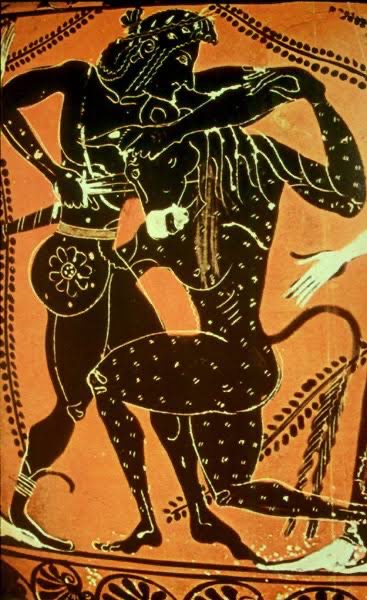
Theseus and the Minotaur Wikipedia Commons


Theseus is a demigod who has two fathers, King Aegeus of Athens and Poseidon the sea god. (Robert Graves thinks the character might originally have had a mortal twin, like Heracles). 


Here is how it happened. It starts with King Aegeus going to the Delphic oracle to find out how he could have a child, as neither of his late wives had had any children. The oracle tells him only that he must not open his bulging wineskin till he gets home, or he will one day die of grief. Oracles were like that, never giving you a straight answer. And in Greek myth, people quite often don’t interpret them as they should. Aegeus doesn’t figure out what “wineskin” means. 


On the way home he stops by the seaside city of Troezen, to visit his old friend King Pittheus. Pittheus had a daughter, Aithra, who had been engaged to Bellerophon(remember him?) before he got into trouble and set off on his adventures. In those days, virginity was not a thing, unless you were following Artemis, of course. In some places, girls were required to lose their virginity before marriage, dedicating it to a goddess. So Pittheus gets Aegeus drunk and sends him to bed with his daughter. Later that night, Aithra has a Dream and heads off to a nearby island, where she encounters the sea god. So Theseus can take his pick of fathers.


Aegeus leaves his sword and sandals under a rock and tells Aithra that if any son she might have is able to lift the rock and collect the tokens, she is to send him to Athens. 


Young Theseus, now sixteen, does lift the rock and collect the goodies. In The King Must Die, in which Theseus isn’t a giant bulging with muscles, he uses his brains to work out how to lift that rock. 


Setting off on his travels, he goes via the Isthmus of Corinth instead of the safer sea route, wanting to clear the area of bandits, which he does, fighting villains such as Cercyon(with scientific wrestling), Sinis(by giving him a taste of his own medicine, tying him to two trees and letting go) and Procrustes, the guy with the “Procrustean bed” and the charming habit of stretching or cutting off his guests’ legs.


Reaching Athens, he is nearly poisoned by Medea, who is his father’s lover and wants her own son as heir to the throne, but survives it when his father recognises his tokens. She flees...again. This time she takes her child with her.


Everyone rejoices in the arrival of Aegeus’s son. 


Soon after, the Cretans turn up to collect their tributes, seven boys and seven girls to be fed to the Minotaur at the centre of the Labyrinth. Theseus volunteers, like Katniss in The Hunger Games, which was inspired by this story. Aegeus is devastated, but makes his son promise to paint his sail white if he comes back safely. 


In Crete, Theseus catches the eye of the king’s daughter, Ariadne, who helps him to kill the monstrous Minotaur(her brother, by the way), giving him a ball of thread(which must have been very long) so he can find his way back. 


A lot of killing follows and the Athenians return, led by Theseus...who forgets to change the colour of his sail. Hence, the oracle is fulfilled and Aegeus dies of grief, thinking he is dead, and falls off the cliff. 


Ariadne, who has joined the returnees, is left on the island of Naxos. She is no Medea, poor girl. But the god Dionysus arrives and takes her away to live happily ever after, which is more than can be said for Theseus. 


Theseus has many more adventures, some with his BFF, Peirothous. Among other things, he captures and marries the Amazon Hippolyta, who bears him a son, Hippolytus, and dies in battle. He marries Ariadne’s sister, Phaedra, who eventually does a Potiphar’s wife on his son. Cursed, the boy is wiped out by the sea while driving his chariot along the beach. 


He loses his friend Peirothous while the two of them are raiding the Underworld and, in the end, is pushed off a cliff on Skyros by its king, Lycomedes. 


You really should read The King Must Die to see how Mary Renault interprets all the events in his story; she makes them believable, with no need for magic or real gods.


Thetis by Rubens. Public Domain


Finally in this post, I’ll tell you about Thetis. Thetis is the mother of Achilles, Greek hero of the Trojan War. And “mother” is pretty much what she is, once her son is born. 


Thetis is a sea goddess, one of the Nereids, daughters of Nereus. She can shape change like her father, an Old Man of the Sea, and her suitor, Peleus, has to deal with that.


Zeus wanted her as one of his many conquests, but found out that any son she bore would be greater than his father. To make sure she isn’t going to affect his rule, he finds her a nice mortal, Peleus, to marry, but Peleus has to grab her and hold her through her shape changes, a bit like Janet and Tam Lin(though it was the other way around in that story, with Janet holding Tam Lin). Anyway, Thetis gives in and marries him, with all the gods invited to the party, except Eris, goddess of strife, sister of the war god Ares, who gets her revenge by throwing that golden apple among three goddesses, leading to the Trojan War, in which Thetis’s son will shine. 


When Achilles is born, Thetis makes an effort to make him invulnerable, either by dipping him into the Styx, river of the Underworld, or burning him in the fire and rubbing in ambrosia. In both cases, she doesn’t protect his heel, making him not quite invulnerable and giving us a body part called the Achilles’ tendon. 


Personally, if I had only one vulnerable spot, that’s the bit I’d protect, but Thetis gets him a set of armour made by Hephaestus, the smith god. As I said...a mother, first and foremost, not running around having lots of affairs like the other gods. 


When the Trojan War is about to happen, she sends him to Skyros, to the court of her friend Lykomedes(yes, the one who shoved Theseus off that cliff), disguised as a girl. But Odysseus, who got pushed into the war himself, tricks him into revealing himself by setting off an invasion alarm.


When Achilles’ lover Patroclus is killed wearing his armour, Thetis has another set made(it’s in the Iliad). 


Thetis shows up a lot in the Iliad, and she appeared as a character in Clash Of The Titans, played by Maggie Smith, much younger than as Professor McGonagall and Julie Christie(Madame Rosmerta in Harry Potter) in Troy, where she appeared in a scene in which she was telling her son his two choices while splashing around in the water. 


Achilles was offered the choice of a short life with glory or a long dull life. He chose the short one, but we can guess which Thetis, that very loving mother, would have preferred.


Tomorrow we are off to the Underworld!