Search This Blog

Tuesday, April 27, 2021

A to Z Blogging Challenge 2021 - X Is For Xanthus


Xanthus and Balius. Public Domain


Today’s mythological characters aren’t human or even human-shaped. They are Xanthus and Balius, a couple of horses, immortal ones. In Greek myth, it doesn’t seem to take a horse shaped being to make a horse shaped child. In this case, the mother was the harpy Podarge; harpies tend to be bird-women. The father was Zephyrus, the West Wind. Winds were sometimes depicted as winged men, sometimes as horses, which may explain the horse children. Anyway, I can definitely see the appeal of a horse that is literally a son of the wind! 


But Xanthus and Balius were, in the end, horses, even if they were immortal. They didn’t even talk, except Xanthus, on one very special occasion. 


Poseidon, who had a connection with horses, as the god of horses, trained these two and gave them to Peleus as a wedding gift at that fateful wedding when Eris, goddess of strife, started the Trojan War at second hand. 


Later, Peleus gave these two beautiful animals to his son Achilles, who took them to the war with him, to pull his chariot. They would have been kept idle for a while when Achilles went on strike. 


However, when Achilles’ lover and best friend, Patroclus, decided to fight in his place, they were hitched up and driven into battle again, till Patroclus got himself killed. 


After this, Achilles hitches them up, but tells off his horses for having let Patroclus down. This is when Hera gives Xanthus a voice, even temporarily, and the horse says it wasn’t their fault, that it was a god who killed Patroclus and by the way, Achilles hasn’t much longer to live. Then an Erinye shuts Xanthus up.


It would have been Xanthus and Balius pulling the chariot when Achilles tied the body of Hector to the tail of his chariot. 


Achilles didn’t live much longer, as predicted, and the horses mourned him till his son, Neoptolemus, arrived to drive them. 


I’m uncertain what happened to them next. If they were indeed immortal, perhaps they are still around somewhere, thinking how different the world is now. 


Tomorrow I’ll muse a little about the youth of some of the characters we have met. See you then! 

Monday, April 26, 2021

A To Z Blogging Challenge 2021 - Whom The Gods Would Destroy by Richard Powell


 There is a saying: “Those whom the gods would destroy, they first make mad.” We aren’t sure where it comes from originally; for a long time it was attributed to playwright Sophocles, but that, apparently, isn’t true. It does go back a long way.


The title works for this book, anyway. It’s a Trojan War novel, my favourite of all those I have read. The characters from the Iliad are certainly crazy in one way or another. If you are expecting noble kings and heroes, you are out of luck. There is a lot of humour among the drama, and much of it is in the descriptions of the Greek heroes. The only one not sent up is Odysseus, who is clearly the only sane one of the lot, and intelligent.


The story is seen from the viewpoint of Helios, a Trojan boy captured on the first day of the war and growing up with Neoptolemus, son of Achilles. Helios is the son of a Rhodian slave girl in Priam’s palace, and claims Priam as his father. His mother died at his birth and he has been brought up by the horse master and his wife, a baker.


In Troy, he is friends with Princess Cassandra, with whom he learns to read and write, in Linear B.


In the Greek camp, he is befriended by Odysseus, whom he comes to regard as a father figure, but spends much of the war on Skyros with Neoptolemus and a girl called Deira, a granddaughter of Theseus. 


At one point, Helios and Neoptolemus find Helen outside the city, bathing, and get the bright idea of taking her to the Greek camp so they can end the war. Helen is amused. The Greek leaders are not happy; the last thing they want is to take her and scuttle off home. She knows that very well.


I remember when I was studying first year ancient history at university there was a theory presented to us that any Trojan War would have been about economics, not Helen. I can see that. Troy would have been in a very good position to issue tolls to passing trade ships.


There is almost no magic in this book, no gods or goddesses participating. The war is really not about Helen at all; she is just an excuse. There is a bit of prophecy. Cassandra gets it right, and Helios, when he has been with her, sees the future himself, including Rome, where the Trojan survivors went under the leadership of Aeneas - in this novel shown as a decent and likeable character.  


The style is chatty and very readable, but the author has done his research. Linear B was a real writing form. There is a reference to the Dorians, later to invade the Mycenaean world, and their iron swords; Helios and Neoptolemus manage to steal one each when on a journey with Odysseus. There are references to the Goddess. 


I’ve read other books set in the Trojan War, such as Marion Zimmer Bradley’s The Firebrand(seen from the viewpoint of Cassandra, still in print) and Kerry Greenwood’s novels Cassandra and Electra, both in print from Clan Destine Press, but they are so very serious! 


Whom The Gods Would Destroy is out of print physically, but still available on Kindle. You can get a Kindle app for iPad. It’s well worth downloading the app for this book. 


Tomorrow I will be writing a short post about Xanthus and Balius, Achilles’ immortal horses. I told you I wouldn’t have to cheat on X this year! 

Sunday, April 25, 2021

A To Z Blogging Challenge - V Is For Victory, Goddess of...


Nike. Fair use.


Okay, so I have had to cheat a bit on this one. The goddess’s name is Nike, but she is the goddess of Victory and, now I think of it, her Roman name is Victoria, so it works after all. 


Although she was strictly a virgin like Athene(with whom she hangs out in sculpture) and Artemis, Nike was a very popular goddess, one you would really want on your side. Think about it.


She had wings, and was the daughter of Pallas and the nymph Styx. Pallas was a Titan, father of Nike and three strong boys, Zelus, Kratos and Bia. Styx was the goddess of the river of the Underworld. Oh, and these two had one more daughter, Scylla - yes, that Scylla, who ended up as a scary monster. So Nike was her sister, much more successful than poor Scylla. 


When Zeus was getting ready to take on the Titans ruling the world, Styx brought along Nike and her three boys, to offer him as helpers. 


Nike’s wings came in handy for fluttering around the battlefield handing out laurel wreaths, but she also drove Zeus’s chariot. Nice to see a woman doing the driving.


The image of her has been a big thing over the centuries. The Winged Victory of Samothrace, which was sculpted in about the third century BCE and is now in the Louvre, was probably created to celebrate a naval victory. A pity the head and one arm are missing because it’s a stunning work, of a young woman flying joyously upwards. 


Winged Victory. Fair Use


I’m quite sure it’s not for nothing that there is a brand of running shoes named for her, implying “If you want to win that race, wear these!” Nike was an amazing runner.


In fact, she was a general symbol of victory, including in athletics, often shown holding a palm leaf over winners.


There is a statue of Athene holding a small winged Nike, and a temple of Athene Nike on the Acropolis in Athens, with a wall that had a frieze of winged Nike images. 


As Victoria, in Rome, she was much bigger than in Greece, with temples and a statue of her that was removed by the Emperor in late fourth century Rome, infuriating her worshippers, including, no doubt, the generals who sacrificed to her when returning from a successful war.


A pity that her name now is associated with a brand of shoe; anyone who hasn’t heard the myth will likely think of that first. 


Tomorrow I will be telling you about my favourite Trojan War novel, Whom The Gods Would Destroy by Richard Powell.


Friday, April 23, 2021

A To Z Blogging Challenge 2021 - U Is For Underworld!


Persephone being abducted.public domain


Have you ever heard the expression “Hot as Hades”? Felt as if you are pushing  a rock uphill only to have to do it again and again? What about getting that close to your goal only to have it snatched away? 


Apart from the heat, you are probably thinking of the stories of the Greek Underworld. That was not especially hot unless heat was involved in your punishment, such as Ixion on the wheel of fire,


Hades was the god of the Underworld, a brother of Zeus, but he could just as easily have been King of the gods or god of the sea instead of Poseidon. When the three brothers were splitting up the world among them, they shook lots in Hades’ helmet. Hades got the world below. 


To reach the Underworld you crossed the River Styx, in a ferry boat rowed by the ferryman Charon, so you were farewelled with a coin under your tongue to pay the fare. This is why Psyche, sent to the Underworld by her dreadful mother in law, Venus, to fetch some of Persephone’s perfume, held two coins in her mouth, so she could return. 


There was a guardian to the Underworld, the three-headed dog Cerberus. Psyche carried a distraction, some food, while Orpheus carried his lyre. 


The three judges of the dead, Minos, Rhadamanthys and Aeacus, decided where to send you. Mostly it was a boring place called the Asphodel Fields, with Elysium and the Isles of the Blessed as rewards, although the impression I get from my reading is that you mostly had to be related to the gods to get into those places. Mind you, most of the characters in Greek mythology seem to be related to the gods in one way or another.


In the Odyssey, Odysseus visited the Underworld to get some information from the seer Tiresias and, while he was there, spoke to other shades. They needed to drink blood from his sacrificial animals to be able to speak and remember who they were, presumably because the shades had to drink from the stream of Lethe, which made them forget. That was no doubt a mercy! But when Odysseus speaks with his old comrades from Troy, Achilles says that he would rather be the slave of some poor farmer on Earth than ruler of this whole realm. 


It’s interesting to note that, actually, the rulers of Hades’ realm lived comfortably enough, with a palace and gardens from which Persephone, Hades’ Queen, ate those fateful pomegranate seeds that doomed her to spend half the year there before returning to her mother, Demeter.


Far below Hades was Tartarus, which started off as a prison for Zeus’s enemies, but became a place of punishment for people who had done things even the horrible gods couldn’t stomach. 


There was Ixion, who had betrayed the concept of how to treat your guests or hosts, murdering his father in law when the old man was his guest  and betraying his own duties as a guest on Olympus. Never mind the details, he ended up strapped to a wheel of fire.


Tantalus stood in a lovely, clear pool beneath fruit trees which were always just out of reach, unable to drink from the pool, however thirsty he was, for cutting up his son Pelops and serving him up to the gods. Silly man for thinking he could get away with it! This, of course, is where we get the word “tantalise”.


Sisyphus was doomed eternally to roll a stone up a hill, only to watch it roll back down again. He had killed guests and relatives at his home, plus a lot of other things I’ll let you look up. 


There were these fifty women, the Danaids, who had all killed their husbands on their wedding night, who had to draw water forever, in leaky jars.


That was Tartarus for you!  


It seems to have been possible to enter the Underworld from Earth, judging by the number of live people in the myths who do manage to get there - and back. There was even a spot in Sicily where traditionally Kore, Demeter’s daughter, a goddess of spring, was kidnapped by her uncle Hades and became Persephone.


Personally, that is one quest I’ll skip, thank you!


Do join me again on Monday, when the theme is V for Victory, Goddess of...


Thursday, April 22, 2021

A to Z Challenge 2021 - T Is For Theseus And Thetis


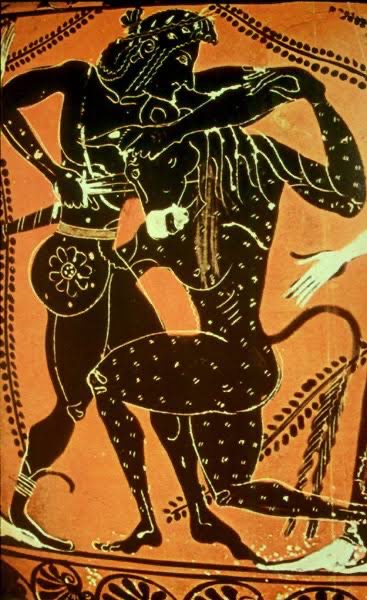
Theseus and the Minotaur Wikipedia Commons


Theseus is a demigod who has two fathers, King Aegeus of Athens and Poseidon the sea god. (Robert Graves thinks the character might originally have had a mortal twin, like Heracles). 


Here is how it happened. It starts with King Aegeus going to the Delphic oracle to find out how he could have a child, as neither of his late wives had had any children. The oracle tells him only that he must not open his bulging wineskin till he gets home, or he will one day die of grief. Oracles were like that, never giving you a straight answer. And in Greek myth, people quite often don’t interpret them as they should. Aegeus doesn’t figure out what “wineskin” means. 


On the way home he stops by the seaside city of Troezen, to visit his old friend King Pittheus. Pittheus had a daughter, Aithra, who had been engaged to Bellerophon(remember him?) before he got into trouble and set off on his adventures. In those days, virginity was not a thing, unless you were following Artemis, of course. In some places, girls were required to lose their virginity before marriage, dedicating it to a goddess. So Pittheus gets Aegeus drunk and sends him to bed with his daughter. Later that night, Aithra has a Dream and heads off to a nearby island, where she encounters the sea god. So Theseus can take his pick of fathers.


Aegeus leaves his sword and sandals under a rock and tells Aithra that if any son she might have is able to lift the rock and collect the tokens, she is to send him to Athens. 


Young Theseus, now sixteen, does lift the rock and collect the goodies. In The King Must Die, in which Theseus isn’t a giant bulging with muscles, he uses his brains to work out how to lift that rock. 


Setting off on his travels, he goes via the Isthmus of Corinth instead of the safer sea route, wanting to clear the area of bandits, which he does, fighting villains such as Cercyon(with scientific wrestling), Sinis(by giving him a taste of his own medicine, tying him to two trees and letting go) and Procrustes, the guy with the “Procrustean bed” and the charming habit of stretching or cutting off his guests’ legs.


Reaching Athens, he is nearly poisoned by Medea, who is his father’s lover and wants her own son as heir to the throne, but survives it when his father recognises his tokens. She flees...again. This time she takes her child with her.


Everyone rejoices in the arrival of Aegeus’s son. 


Soon after, the Cretans turn up to collect their tributes, seven boys and seven girls to be fed to the Minotaur at the centre of the Labyrinth. Theseus volunteers, like Katniss in The Hunger Games, which was inspired by this story. Aegeus is devastated, but makes his son promise to paint his sail white if he comes back safely. 


In Crete, Theseus catches the eye of the king’s daughter, Ariadne, who helps him to kill the monstrous Minotaur(her brother, by the way), giving him a ball of thread(which must have been very long) so he can find his way back. 


A lot of killing follows and the Athenians return, led by Theseus...who forgets to change the colour of his sail. Hence, the oracle is fulfilled and Aegeus dies of grief, thinking he is dead, and falls off the cliff. 


Ariadne, who has joined the returnees, is left on the island of Naxos. She is no Medea, poor girl. But the god Dionysus arrives and takes her away to live happily ever after, which is more than can be said for Theseus. 


Theseus has many more adventures, some with his BFF, Peirothous. Among other things, he captures and marries the Amazon Hippolyta, who bears him a son, Hippolytus, and dies in battle. He marries Ariadne’s sister, Phaedra, who eventually does a Potiphar’s wife on his son. Cursed, the boy is wiped out by the sea while driving his chariot along the beach. 


He loses his friend Peirothous while the two of them are raiding the Underworld and, in the end, is pushed off a cliff on Skyros by its king, Lycomedes. 


You really should read The King Must Die to see how Mary Renault interprets all the events in his story; she makes them believable, with no need for magic or real gods.


Thetis by Rubens. Public Domain


Finally in this post, I’ll tell you about Thetis. Thetis is the mother of Achilles, Greek hero of the Trojan War. And “mother” is pretty much what she is, once her son is born. 


Thetis is a sea goddess, one of the Nereids, daughters of Nereus. She can shape change like her father, an Old Man of the Sea, and her suitor, Peleus, has to deal with that.


Zeus wanted her as one of his many conquests, but found out that any son she bore would be greater than his father. To make sure she isn’t going to affect his rule, he finds her a nice mortal, Peleus, to marry, but Peleus has to grab her and hold her through her shape changes, a bit like Janet and Tam Lin(though it was the other way around in that story, with Janet holding Tam Lin). Anyway, Thetis gives in and marries him, with all the gods invited to the party, except Eris, goddess of strife, sister of the war god Ares, who gets her revenge by throwing that golden apple among three goddesses, leading to the Trojan War, in which Thetis’s son will shine. 


When Achilles is born, Thetis makes an effort to make him invulnerable, either by dipping him into the Styx, river of the Underworld, or burning him in the fire and rubbing in ambrosia. In both cases, she doesn’t protect his heel, making him not quite invulnerable and giving us a body part called the Achilles’ tendon. 


Personally, if I had only one vulnerable spot, that’s the bit I’d protect, but Thetis gets him a set of armour made by Hephaestus, the smith god. As I said...a mother, first and foremost, not running around having lots of affairs like the other gods. 


When the Trojan War is about to happen, she sends him to Skyros, to the court of her friend Lykomedes(yes, the one who shoved Theseus off that cliff), disguised as a girl. But Odysseus, who got pushed into the war himself, tricks him into revealing himself by setting off an invasion alarm.


When Achilles’ lover Patroclus is killed wearing his armour, Thetis has another set made(it’s in the Iliad). 


Thetis shows up a lot in the Iliad, and she appeared as a character in Clash Of The Titans, played by Maggie Smith, much younger than as Professor McGonagall and Julie Christie(Madame Rosmerta in Harry Potter) in Troy, where she appeared in a scene in which she was telling her son his two choices while splashing around in the water. 


Achilles was offered the choice of a short life with glory or a long dull life. He chose the short one, but we can guess which Thetis, that very loving mother, would have preferred.


Tomorrow we are off to the Underworld! 


Wednesday, April 21, 2021

A To Z Blogging Challenge 2021 - S Is For Semele And Selene

 Today’s letter is S. 


The story of Semele has yet another example of Zeus cheating on Hera, and Hera getting her revenge. 

Death Of Semele. Rubens. Public Domain


Semele, the pretty daughter of Theban rulers Cadmus and Harmonia, who have their own story, has been having an affair with Zeus. Unlike many others, he didn’t need to rape her, and she knew who he was. No doubt she was flattered at the identity of her lover. 


So, all has been going nicely. Semele is six months pregnant. And then Hera finds out. Really, that goddess must spend most of her time chasing up the “other women”, there are so many of them. But unlike some other occasions, she doesn’t just turn the other woman into a tree or whatever. She makes sure that the two lovers do her revenge for her.


Disguised as an elderly neighbour, she visits her latest rival and settles down for a nice chat. Maybe she comments on the swelling belly.


“So, who is the father?” she asks.


“Well, actually...” Semele leans over and whispers, “I’ve been sleeping with Zeus himself!”


Holding back her fury, Hera says,”Go on, dearie, pull the other one! Is that what the boy told you? You girls nowadays are so silly!” She cackles. 


“But - but - he is!”


“Make him prove it, then. I bet he doesn’t shimmer and shine, and he walks in the door like everyone else. If it were me, I’d make him show himself as a god, in all his glory. But you know better, no doubt.” 


She is right in one respect: Semele is silly. She can’t leave well enough alone, though if she had ignored Hera’s advice, Hera would probably have found another way. 


So, when Zeus turns up next time, she demands to see him in all his glory. Shocked, he tells her it’s not a good idea, but not why - that it will kill her. She gives him an ultimatum: no glory, no sex. 


Possibly muttering that if he does what she wants he isn’t going to get any nookie anyway, he slips off his mortal shell and turns into his dazzling self. Semele is destroyed, but he manages to grab the baby before he can be killed and sews the foetus into his thigh, a bit like when he swallowed his first wife, Metis, and gave birth to Athene through his head.


The child is Dionysus, god of wine, who travels around with a bunch of crazy women, the Maenads, who run all over the mountains in a frenzy and tear people like Orpheus into shreds. Interestingly, C.S Lewis manages to make him, as Bacchus, into a jolly, liberating character in his children’s books.


As an adult, Dionysus goes into the Underworld and retrieves his mother, whom he takes home to Olympus, as a goddess, so that was all right, but not a fun way to die. 


Selene with her crescent crown. Public domain.


Selene is the moon goddess, in fact an anthropomorphic version of the moon itself, known to the Romans - and us - as Luna. She is the daughter of the Titans Hyperion and Theia, the sister of sun god Helios and Eos, goddess of the Dawn. She rides a chariot during the night, just as Helios drives his during the day. She is shown with crescent moons in her hair, which sometimes look like horns.


Selene and Endymion. Public domain


She has had a number of lovers, including Pan and Zeus(she must have got away with that, but then, she is a goddess), but the one for whom she is best known is Endymion, a beautiful young man who fell asleep in a cave and slept eternally, young and beautiful. According to various versions of the story, she may have put him to sleep, just so she could look at him as she passed in the night, or he asked to be put to sleep for his own reasons. One way or another, though, there he was, and she peeked in at him or kissed him in his sleep, which sounds a very pretty way to describe the moon seen through your window, except that there is also a version of the myth that says she managed to have fifty children with him. 


The mind boggles.


Still, she did better than her sister, Eos, who fell in love with a mortal, Tithonus, for whom she asked and got immortality, forgetting to ask for eternal youth. Poor Tithonus just got older and older, shrivelled up and finally turned into a cicada.


See you tomorrow for the stories of Theseus and Thetis! 


A To Z Blogging Challenge 2021 - R Is For Rhea And Renault

 Today, two people starting with R!


Rhea handing over a wrapped stone. Public Domain


The first is the Titan goddess Rhea. Rhea was the wife of Cronos, an early king of the gods, and the mother of several Olympian gods. There had been one of those prophecies that Cronos would be killed by one of his sons. He decided to swallow the children Rhea had borne him, including, for some reason, the daughters, Hestia, Hera and Demeter. After he had swallowed Hades and Poseidon, Rhea decided she had had enough and smuggled her third son, Zeus, away to be raised by some nymphs and gave her husband a stone wrapped in swaddling clothes. To make sure his crying wasn’t heard, she arranged to have the noisy warriors, the  Curetes, dance around clashing their shields. 


When Zeus was grown up, she helped him give his Dad an emetic in his drink, so that he would vomit up the earlier children, as presumably gods can do this without digesting anything or harming the people inside.


Later on, Rhea persuaded Demeter to come off strike after her daughter Persephone was kidnapped by Hades, and come to a compromise. 


The lesson we learn in both cases is, never come between a mother and her children.


Mary Renault. Fair use.


And now, we come to Mary Renault, author of several books set in Ancient Greece,  two of them based  on the Greek myths. I discovered The King Must Die, the story of Theseus,  when I was in primary school. My copy over the years has become so worn with reading and rereading that I ended up buying the ebook.


Mary Renault was born in Essex in 1905. She became a nurse during World War II and met her partner Julie Mullard, a fellow nurse. Winning a large award gave the couple the chance to move to South Africa, where being gay wasn’t going to cause them the headaches it did in England. Before you say, “But apartheid!” she was very much against that and joined the Black Sash, a women’s group working against apartheid. 


Oddly, though, she was not keen on the gay rights movement. 


She died in 1983, of lung cancer.


Her Ancient Greece novels included a trilogy about Alexander the Great, starting with Fire From Heaven(I found a proof copy of that at a school fete). I also have a copy of her novel The Mask Of Apollo, about an actor in Athens at the time of Plato. That one made me feel as if I was there. 


However, the real power is in her two Theseus novels, The King Must Die and The Bull From The Sea. Mary Renault’s Theseus is not tall, despite what the Greeks believed. The reason she suggests  is that if he had been tall he wouldn’t have been much use as a bull leaper. He is a king who believes fervently in his job, but a king of a patriarchal society; he certainly does overthrow a matriarchy on his way to Athens early in the first book. The title is based on the killing of the sacred king; he wrestles and kills one on his journey, takes his place and manages to avoid being killed himself at the end of his own year. 


The Bull From The Sea was the second part of Theseus’ life, going up to his death on Skyros, where, like his father Aegeus, he jumps off a cliff. He has had a stroke and doesn’t want to disappoint young Achilles, to whom he is a hero. 


I do like the way she works out how it might actually have happened, adapting the myth to a possible real-world setting. The only fantasy element in these books is Theseus’s ability to know when an earthquake is coming, a family ability. 


Both novels were adapted for radio, as an 11 part series, in 1883, by Michael Bakewell, who went on to adapt Lord Of The Rings. If you can get hold of either radio play, I do recommend them. If you just want the audiobook, the abridged version is narrated by the wonderful Michael York.


Theseus does appear in a number of other books, including one, The Sword Is Forged, by Evangeline Walton, best known for her four novels inspired by The Mabinogion. She wrote it about the same time as The King Must Die, but couldn’t sell it for some time because Mary Renault got in first. To be honest, I think her Celtic myth novels were her masterpiece, while I’m very glad Mary Renault did beat her into print with Theseus. The Walton book just wasn’t as good. 


Mary Renault wrote the classic based on this particular myth! 


Tomorrow, we will discuss the story of a young woman who just couldn’t leave well enough alone, Semele. 


Monday, April 19, 2021

A To Z Blogging Challenge 2021 - Q Is For Quests

 Today we will talk about a few quests in Greek mythology. I have already mentioned some - Heracles’ Labours, Orestes’ quest for the image of Artemis that would enable him finally to escape the Erinyes, Jason’s quest for the Golden Fleece, Perseus’s quest for Medusa’s head(although that was from the viewpoint of Medusa), Bellerophon and his quest to slay the Chimaera.


A number of these quests are arranged by someone who doesn’t wish the hero well. 


Heracles is doing the Labours because he was driven mad and killed his family, but Eurystheus just wants him out of the way and gives him a series of quests that would be impossible to anyone else, to keep him busy. He does end up with a useful lion skin, I guess. But on the whole, he didn’t gain much by them.


Jason is sent on his quest for the Fleece by a king who has heard a prophecy involving himself and wants Jason out of his way and dead if possible. 


Still, he has an interesting time along the way. One adventure involved the women of Lemnos, who had killed off their men for sleeping with captive women. When the Argonauts arrived, the women realised that there was not going to be another generation on their island - whoops! - and asked Jason and his men to impregnate them; they were only too happy to oblige...


Phineus and the winged brothers. Public Domain


My favourite of their adventures on the way was the story of the blind king Phineus and the Harpies who were plaguing him, ruining every meal. Harpies are smelly women with bird bodies and wings (There is a short story by Aussie author Helen Sargeant in which the Harpies are in fact sea gulls). Jason had hoped to get some advice to help with his journey, but the two Harpies had to be dealt with first. Fortunately two of the Argonauts were Calais and Zetes, sons of the North Wind and Phineus’s brothers-in-law. They had wings, so were able to chase the Harpies away. Phineus’ advice for navigating the Bosphorus ends with telling them that once in Colchis Jason should rely on Aphrodite. Well...yes. Medea falls in love with him.


Public Domain


Perseus is after Medusa’s head for an unselfish reason: to help his mother out, though that’s not much comfort  to poor Medusa. His mother, Danae, had been thrown into a chest with Perseus, her baby by Zeus, and washed up in Seriphos,  the kingdom of Polydectes, who fancied her and tried to marry her by force. Perseus, now a grown young man, defends her. 


Polydectes says he is now going to marry another woman and asks his nobles for a horse each to present, except Perseus, who says he has nothing, but will get him anything he likes, even Medusa’s head. Oh, dear...


“Yes, please, that sounds great!” says Polydectes, happy to get rid of the boy. The quest begins with various gods helping out. It ends with Polydectes and his nobles being turned to stone. A dramatic end to that quest! 


Odysseus, of course, has a quest to get home, which sees him arrive after twenty years, alone, after storms and monsters, being a goddess’s toy boy, visiting the Underworld and even after reaching home having to clear out his wife’s suitors. 


The Roman tale of Cupid and Psyche has Psyche’s quest to get back her husband by obeying the orders of her mother-in-law, Venus, who makes her do some virtually impossible things, including  going to the Underworld. That story has a lot of elements later found in folk tales, including animal helpers and earning back her husband after making a big mistake.


There is Orpheus’s quest to the Underworld to bring back his wife, spoiled by an understandable error. I think I prefer the ending to the mediaeval version.


Quests in modern fiction do tend to end well for the heroes, more or less. They usually involve a group of heroes who travel together  to bring back the stolen gem or defeat the villain or whatever. Many of the ancient quests are individuals. Orestes has Pylades to go with him and, of course, there is the Argo quest, which is more like the ones we’re familiar with.


Quests in the Greek myths don’t always end well. Look at Jason and Bellerophon. 


Tomorrow I’ll be talking about Mary Renault, who wrote the definitive stories of Theseus.


Sunday, April 18, 2021

A To Z Blogging Challenge 2021 - P Is For Prometheus


Public Domain


Today’s character from Greek mythology is Prometheus. Among all those nasty gods, here is one who got into trouble for sticking up for humans. He was a trickster figure we can like, and he is used as an icon for the arts and misunderstood artists. 


Prometheus was one of the Titans, a bunch of gods who were related to, and ruled the planet before, the Olympian gods. His father was the Titan Iapetus, his mother an Oceanid called Clymene. He had three brothers, Atlas(yes, that Atlas of the Eleventh Labour), Menoetius and Epimetheus. 


Menoetius was killed during a rebellion of the Titans against Cronos, who ruled before Zeus. Atlas, who looked after the Garden of the Hesperides and ruled Atlantis, escaped the flooded island and joined Cronos. Afterwards, he was condemned to hold up the heavens, which he did except briefly when Heracles took over, to give Atlas the chance to collect the Golden Apples for him. 


But Prometheus decided it was smarter to fight on Zeus’s side and talked Epimetheus into doing the same, so they looked set to prosper under the new regime.


No such luck. Prometheus created humans and cared about their welfare. He taught them all the arts of civilisation, which he apparently got from Athene, whom he birthed from Zeus’s head. So, he had done Zeus two favours, right? He had fought on his side and cured him of a dreadful headache.


But this wasn’t considered quite good enough. And Zeus was annoyed at how well these beings were doing and considering wiping them out. Prometheus talked him out of it, but when the time came to decide what was the human share of sacrifices and what was the gods’ share, Prometheus got sneaky.


He sewed up two bags of the animal’s hide and put in one bag all the good stuff, covered by the yucky-looking stomach. In the other bag, he put bones wrapped in very tempting-looking fat. Then he invited Zeus to choose. Of course, he picked the yummy-looking share, which turned out to be nothing but bones. So humans sacrificing to the gods got to eat the meat while the gods were stuck with the useless bits of the animal.


As you can guess, Zeus was not impressed. 


“Fine,” he said, “they can eat their meat raw.” 


He withdrew fire. Rather than see his beloved humans freeze and eat food raw, Prometheus sneaked onto Olympus through the back door, with Athene’s help, and picked up a coal from the chariot of the Sun, which he hid in a giant fennel stalk, and hurried back to Earth with it.


Zeus was furious, but he had one more thing to try. He got the craftsman god, Hephaestus, to make a stunningly beautiful woman, had the Winds breathe life into her and the goddesses dress her. She was sent to Earth and offered to Epimethius as his wife.


Prometheus was understandably suspicious and told Epimetheus  to beware of any gift from Zeus. The lady’s name, Pandora, by the way, means “all gifts” and she seemed to be bringing yet another gift, a jar or box with something in it. She didn’t know what that was. 


This warning was the last straw as far as Zeus was concerned. He had Prometheus carried off to the Caucasus Mountains, chained down and tortured by having an eagle eat his liver every day. As he was immortal, of course, it grew back overnight, to be eaten again. There is a scene in Miller’s novel Circe in which the heroine meets Prometheus as he is being taken off to his torture. 


He was eventually rescued by Heracles(that event, by the way,is in an episode of the TV show Hercules: The Legendary Journeys).


But Epimetheus panicked and agreed to marry Pandora, who, as we know, opened that jar out of curiosity and let out all the world’s troubles, except Hope, which was locked in just in time.


It seems the Bible isn’t the only source that blames all our woes on a woman!


Tomorrow Q is for Quests!