Search This Blog

Tuesday, April 21, 2020

A To Z Blogging Challenge 2020: S Is For Sagramore, Safir and Segwarides

I think I first encountered Sir Sagramore Le Desirous in Mark Twain’s Connecticut Yankee In King Arthur’s Court, which I read  when I was in primary school. In that novel, the Yankee, Hank Morgan, offends him unintentionally during a tournament. Hank has just had to listen to Sir Dinadan’s dreadful jokes; when the Humorist has left, he says something rude about him aloud, which Sagramore assumes is about him, and challenges him to a duel to the death. This keeps getting put off until, finally, Hank shoots him dead with a gun, a la Indiana Jones. The bullet hole is still in the armour centuries later, when it’s on display in a museum, and the assumption is that the bullet was fired by one of Cromwell’s soldiers. 

The Sagramore of mediaeval romance was definitely not shot by a time travelling American. 

In Malory and other mediaeval tales, he is a good knight, though the Malory version of him is mainly there to be knocked off his horse by other knights. He is bad tempered. 

In Tennyson’s  Idylls Of The King, he wanders into the wrong bedroom in the dark, when exhausted, lies down in the wrong bed and wakes up next to a girl he doesn’t know and has to marry her, this being Victorian literature. Apparently, they have a happy marriage anyway. 

There are different versions of his background. In one version, he is Hungarian! He comes to Britain in his teens, to join Arthur’s court. In another, he is a foster brother of Mordred, when his family rescues the child, who has been put aboard a ship along with a lot of other children born on Mayday(one of Arthur’s less heroic deeds), when the ship founders. 

In the musical Camelot, Sagramore is one of three knights Guinevere sets on Lancelot at the tournament, while singing about it (“Then You May Take Me To The Fair”). Here is Julie Andrews singing it on Broadway, along with Sir Lionel, Sir Dinadan and, of course, Sir Sagramore...

Let’s move on to Sir Safire/Safir/Safere and Sir Segwarides. These two are of interest as the brothers of Sir Palomides. Both of them become Christians before he does. They all end up on Lancelot’s side when he has been caught with the Queen, and go with him to France, where he makes them Dukes. 

In Malory, Safir is one of those knights of the Round Table who ride around the countryside challenging each other. His first appearance in Malory is when Palomides has just been swapping sad stories with a wounded knight called Sir Epinogris. Palomides tells Epinogris that he has lost the friendship of Tristram and will never see Iseult again! Epinogris says, firstly, that Palomides was never going to get Iseult, because everybody knows she is with Tristram! (Does everyone know about that but Mark?) Then he tells Palomides  he has lost his lady to another knight, in a fight, hence his wound.

 “I’ll get her back for you!” cries Palomides and, after  helping the man to a nearby hermitage, goes charging off to find the lady. He finds her being led on a palfrey by Helior, the knight who took her, and another knight fights him for her. (I wonder if this post should have included S is for Sex Object?) Palomides tries to sneak her away to her lover, but finds himself challenged by the winning knight, whom he fights until...they discover they are brothers! This happens a lot in Malory.  Characters meet, fight, nearly kill each other, then discover they are brothers. It must be those 15th century helmets hiding their faces. In fact, once they have identified themselves, they take off their helmets and hug each other, and the sex object - er, lady - is handed back to the man she loves...who, incidentally, has killed her father and one of his knights to get her. Sigh!

The two brothers ride off on some further adventures together. 

Tristram and Segwarides. Public Domain 


Segwarides is involved quite a lot in the Tristram story, as the husband of a woman with whom Tristram has been having an affair. In fact, Tristram and his uncle Mark have been quarrelling over her! Naturally, Segwarides is not happy, and he and Tristram nearly kill each other. 

This goes on for some time. However, eventually, after a lot of fighting over the wife, they meet again and Segwarides says he forgives Tristram, because what the hell, he is a noble knight and she is just a slut(“light lady”), not worth fighting over.  

Oh, dear. The Round Table really is a boys’ club, isn’t it? 

Tomorrow, we will hear more about Tristram. See you then! 


Monday, April 20, 2020

A To Z Blogging Challenge 2020: R Is For... Dame Ragnell!

R is for Dame Ragnell, the wife of Sir Gawain and the only woman he ever loved. Their story is told in a couple of poems, The Marriage Of Sir Gawain and The Wedding of  Gawain and Ragnell. There is at least one Arthurian telemovie that features the story, Merlin And The Sword. 

Gawain and the Loathly Lady. Public Domain


The Loathly Lady - which Ragnell is - is a motif in Stith Thompson’s motif index. She turns up in one of the Child ballads, King Henry, sung here beautifully by Steeleye Span.

Basically, she is a terribly ugly woman under a spell until a man marries her despite her ugliness - a bit like a reverse Beauty And The Beast. She turns up in a lot of different folklores, including Irish and Norse. I have a soft spot for King Henry, by the way, because this particular Loathly Lady turns up in a story by the wonderful Lois McMaster Bujold, Labyrinth. In the ballad, young King Henry is hunting and stops for the night at a “haunted hall” where a ferocious female monster demands of him food(his horse, hounds and hawks) drink and finally himself as a husband. In the morning, the spell is broken and she is a beautiful girl. 

In the Bujold story, her hero Miles Vorkosigan finds himself locked up with a young woman who is a genetically engineered super soldier, from an experiment that failed. She is very tall and has fangs. She demands of him food, drink and himself (to prove he considers her human). He gives her a ration bar in his pocket, all he has, finds water for her from a pipe above their prison, and makes love to her, with sympathy and kindness, not because he has no choice. They escape together and he recruits her for his mercenary fleet. She never turns magically into a regular looking human, but cleans up well in her own way. See? If this wasn’t based on King Henry, it should be! 

So, Ragnell. She is a woman under a spell. King Arthur is hunting,  when he meets a terrible knight who demands, in exchange for his life, that he answers the question, “What do women really want most?”  His nephew helps him do the research and finally, they find an ugly, ugly hag who says she can answer the question - in exchange for Gawain as a husband. Gawain agrees. The answer turns out to be that what women want most is sovereignty, to have their own way. Nobody can argue with that. Why shouldn’t you? 

So, he marries her. They are in the bedroom. She offers him the choice - beautiful by day, ugly by night, or the other way around? And Gawain gives her the choice; after all, she is the one who will suffer if he makes the wrong choice. Boom! The spell is broken. A beautiful girl is before him and she announces that she will be beautiful by day and night. 

If you’ve read Chaucer, you might find this story familiar. That’s because it’s in the Wife Of Bath’s Tale in The Canterbury Tales, except it’s not Gawain, it’s an unnamed knight who is in trouble for rape. Fortunately for him, he is the pet of the ladies of Camelot, so he gets time to find out the answer. On the wedding night, he cringes at his wife, who offers him the choice between ugly and faithful or beautiful and adulterous. Meekly, he lets her choose and once it’s clear who gets to make the decisions in that family, she says she  will be beautiful and faithful. 

This was written before the story of Gawain and Ragnell and there is a theory that the Gawain story might have been inspired by it and been tongue in cheek. The later tale might even have been written by Malory! 

Personally, I think the Gawain version shows us a Gawain like the decent young man of Gawain And The Green Knight, but if it was written by Malory, you can completely understand that the man who wrote such enthusiastic sports stories about Lancelot, Tristram and the others might well have thought a story about love was hilarious. (Maybe a mediaeval rom com?)

The story shown in Merlin And The Sword is rather sweet. Gawain has met the cursed young woman before, and had help from her in a quest. Really, she just has a pig’s snout, nothing else, not a hag. But he approaches the King and Queen to announce he wants to marry Ragnell. They are shocked, ask him if he needs help, is there a reason he has to marry her.  No, he says, he just loves her. He wants to marry her. And they go down the aisle and when he kisses her, the curse is broken. She is beautiful! Even if she wasn’t, they would still have been happy, because, like Beauty in Beauty And The Beast, he loves her for who she is, not her looks. Mind you, I do wonder what would have happened if she had been a hag. 

Not a very good film, though it had a fine cast(Malcolm McDowell as Arthur, Rupert Everett as Lancelot, Edward Woodward as Merlin), but I liked that it included this story. 

Ragnell does  appear in modern fiction, but I can’t remember where I have read about her outside of mediaeval literature. I just have. 

She appears in my as-yet-unpublished novella A Matter Of Honour, some years after the Green Knight adventure. If you want to find out more, I’m still offering a free copy of the story in ebook till I find a market for it. Email me. Contact details are on this site. 

Tomorrow, Sagramore, Safir and Segwarides. The last two are the brothers of Palomides. 


See you then! 

Sunday, April 19, 2020

A To Z Blogging Challenge 2020: Q Is For ... Questing Beast!

Q is for Questing Beast... 

Arthur Rackham. Public Domain.

And I have a confession to make. I first encountered this creature in an episode of Lost In Space. Nothing wrong with that, as I know as an adult. When I was a child, I discovered that the story of Cinderella’s slipper started in ancient Egypt, not in a book or an educational magazine but in a Superboy comic(another comic told me Nero’s full name). When  my Grade 4 teacher, Mr Savage, started to tell us the story, I said, “Oh, yes, I know that!” and finished it. “Why, yes!” said Mr Savage. “How did you know that?” I suddenly found something on the floor to look at... Now? Whatever the source of information is, the information is still the same.

So, the Questing Beast and Lost In Space. An elderly knight in armour, accompanied by his small, gentle dog, arrives on the Space Family Robinson’s planet, searching for the Questing Beast, something he has been doing for a very long time. Then he discovers that the Beast is a female and decides sadly that he really can’t hunt a girl. The Beast, who speaks, realises this hunting makes him happy, so says, “You can’t catch me!” and allows him to happily chase her. 

I rather think this version must have been inspired by The Once And Future King. The first time we meet King Pellinore in that novel, he is fumbling and dropping things in the forest, while his brachet(a type of dog) is tied to a tree because its leash has gotten all tangled up. He tells the Wart(young Arthur) that hunting the Beast is the Burden of the Pellinores. (And yes, she is female.)

This may be so, but it is also Palomides who must hunt it. In Malory, it’s after Pellinore’s death. In White’s novel, it’s when Pellinore gets married. 

So, what is the Beast? It’s a creature with the head of a serpent, body of a leopard, feet of a hart and haunches of a lion. It sounds very much like a heraldic animal to me, but there you are. Interestingly, at least part of it - the spotty bit? - is based on the giraffe, which was known in the Middle Ages as a cameleopard. But I can’t imagine someone chasing a giraffe through the forest! 

The Beast makes a sound like “thirty couple of hounds questing” , which gives it the alternative name of “Beast Glatisant” (Barking Beast). 

Oddly, the first time we hear of it in Malory is not in connection to Pellinore, but when Arthur sees it in the forest while hunting. (Hunting, usually of a white hart - does seem to be the way that he - or one of his best knights - gets to encounter a strange beast) It gallops past, stops for a drink and continues on. Pellinore arrives on foot, having killed his horse chasing old Glatisant, and grabs Arthur’s horse to continue the chase, while Arthur protests that he wants the quest. Pellinore says only he or a close relative can catch it and charges off on Arthur’s horse. 
Arthur and the Beast. Public Domain.


Arthur has recently slept, unwittingly, with his half sister Morgause, begetting Mordred, and I wondered, reading it, whether there was a connection. 

It is good, though, to see one of the few quirky creatures in Arthurian romance because, despite all those visions we get of Arthurian knights slaying dragons and such, there really aren’t too many of them around, and where they do appear, it’s often in visions and dreams, as symbols. Usually, a knight encounters a lion or a serpent, mysterious but actual animals. 

I will be talking about the various creatures which do appear, whether in dreams or as part of the quest, in my Z post, under “Zoology.”  


So, if you had a quest, what critter would you like to pursue? 

Saturday, April 18, 2020

Vale Merv Binns!

A sad post today, alas! Tomorrow back to the A to Z and the Questing Beast. 

A part of my youth is gone now. I have only just learned that Merv Binns, a major member of Australian science fiction fandom, passed away several days ago. In fact, he died on the same date as my friend Helene Shaw, April 7. If there is an afterlife, I hope the two of them are having a cup of tea together and catching up on the gossip.

Merv was the owner of Space Age Bookshop in Melbourne, till he finally sold it in 1985. For a while afterwards, there was still a science fiction bookshop at the same premises, Slow Glass, which eventually went on line, as did Merv’s business. 

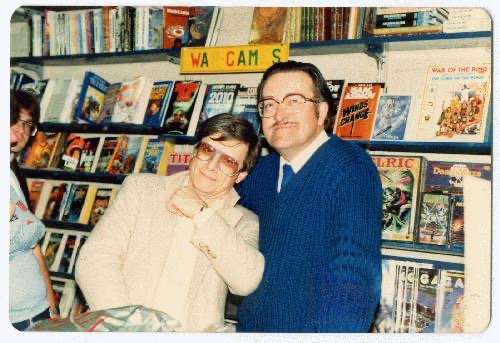
Merv, second from left. Photo by Helena Binns. Fair use.

Space Age was the first bookshop in Australia that specialised in science fiction. I remember going there on Fridays, after work, to browse and buy. It was also the site of special events, such as visiting authors who had come to Australia for a convention and were invited to Space Age afterwards for a book signing. So those of us who really couldn’t go interstate for a con were at least able to meet the guest of honour. I met Frank Herbert, the author of Dune, there and found out he was very much a plotter, not a pantser. Merv also organised a mini convention there, with Harry Harrison(author of The Stainless Steel Rat and many others) as guest of honour. 

Thanks to him, I also had the chance to meet many other authors and attend conventions he had organised.

But for me, the real joy was those Friday afternoons in his shop, the exciting book discoveries I made there, the people I met and befriended. He even stocked  fanzines on behalf of clubs; it was there I found my first issue of the local Star Trek club fanzine, SPOCK, and got contact information. I joined. The guy who started the club and edited that fanzine is still a good friend.

Merv with Harlan Ellison. Photo by Helena Binns. Fair use,
Merv was one of a group of young fans who hung out together in the 1950s. They founded a science fiction club which is still around, as the Melbourne Science Fiction Club. 

One of the others in that group of fans, Race Matthews, went into politics, and became a Minister in a Victorian Labor government. I remember when I was at the banquet at Aussiecon 2, the toastmaster, author Bob Shaw, remarked that this was the only place he had been where a government Minister had a fanzine...

Merv was given a number of awards to recognise his contributions to fandom. I’ll give you a link here to the Fancyclopedia, where you can read what they were.

In later years, he and his wife Helena couldn’t travel, but came to conventions in Melbourne when they could. It was always comforting to see them at the cons. The last time I saw them was at Continuum last year. Helena is an artist and a passionate photographer who loves to take photos at fannish events, so there are plenty to see. I’m using two of her photos with this post; I don’t think she will mind. 

Vale Merv! You are much missed.


Friday, April 17, 2020

A To Z Blogging Challenge 2020: P Is For... Palomides!

P is for Sir Palomides...or Palamedes... or Palamede... Like other characters in Arthurian literature he has a number of name spellings. It doesn’t matter. He is the same character. I’ll call him Palomides.

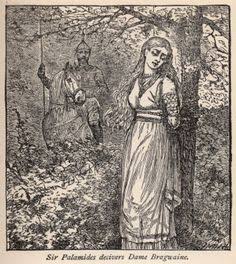
Palomides saves Iseult’s lady. Public Domain.
Palomides is a knight of the Round Table, and proof that Arthur is okay with diversity in his hiring policy, since Palomides is a Saracen, presumably a Muslim(though everyone kind of hopes he will convert to Christianity). He has a couple of brothers who are also Arthur’s knights, Sir Safir and Sir Segwarides, so he isn’t the only Muslim in the village - er, in Camelot.They are sons of the King of Babylon. 

He even has his own mediaeval romance, though I haven’t read it yet.

He appears in modern fiction, most notably in The Once And Future King - of which more later - but also in Persia Woolley’s  Child Of The Northern Spring, a Guinevere novel, in which he introduces stirrups to Britain, giving Arthur’s cavalry a big boost. 

Mostly, Palomides appears in the story of Tristram and Iseult. In Malory, he gets a brief mention as the new pursuer of the Questing Beast after the death of Pellinore(more of this tomorrow, in the Questing Beast post), but he appears properly as one of the many knights competing for Iseult’s hand in marriage at the tournament in Ireland. This is important, because it leads into the rivalry of himself and Tristram, one which lasts a very long time. 

At that first tournament Palomides defeats ten of Arthur’s top knights - presumably not Lancelot, who later becomes his friend and who automatically wins every tournament he enters. Iseult panics and insists the still-recuperating Tristram go and fight in the tournament or she will end up with Palomides. So, because the likes of Tristram and Lancelot have to win, Tristram wins, ordering Palomides to stay out of armour for a year and stay away from Iseult. I don’t know about the armour, but he certainly doesn’t follow orders about staying away from Iseult. Given that, after all this, Tristram goes away without marrying her and then returns to win her for his uncle, I can’t say I blame Palomides, except that Iseult doesn’t want him and he can’t seem to get that into his head. 

Several times in the course of the Morte, he and Tristram end up fighting over the woman they both love. Somehow they never do end up fighting to the death. They keep being interrupted. And Palomides befriends Lancelot, so that’s okay. Whatever I think of Lancelot, he at least isn’t a racist.

Palomides does eventually convert to Christianity, in time for the Quest of the Holy Grail. That was an important issue when the story was written. Whatever she thinks of him, Iseult does at one stage stop Tristram from killing her other suitor, because she doesn’t want him to die unbaptised. 

In the Malory-inspired Once And Future King, Palomides is a humorous character. He is described as a black man, a “learned paynim”. He speaks like an Indian, though, using words like “maharajah sahib”. 

The reason he inherits the Questing Beast is because King Pellinore is missing her after she disappears. He and a knight called Sir Grummore decide to dress up as the Beast to cheer him up... then the real Beast comes along and falls in love with what she thinks is a male Beast. They have to hole up in Queen  Morgause’s castle, which the lovesick Beast besieges.

Merlin, passing through the area with Nimue, suggests the two of them psycho-analyse her. 

“Well, you see,” Sir Grummore was shouting, “when a hen lays an egg...”

Late in the novel, Lancelot tells the Queen that Tristram was a lout, who was foul to his wife and having a go at poor Palomides for being black. (He uses the n word). 

Anyway, Palomides follows the Questing Beast. More of her tomorrow. 

I just find it interesting that way back in the 15th century, European Christian authors were capable of doing a bit of the diversity thing and creating a diverse character who was not a villain, even if he does keep pestering a woman who doesn’t want him. Merlin does that too, to the point of sexual harassment, and he is considered wonderful. 

What do you think? 


Thursday, April 16, 2020

A To Z Blogging Challenge 2020: O Is For ... Olwen!

O is for Olwen. The name means “white tracks” because wherever she goes, white trefoils  spring up behind her. 

White clover. Creative Commons.


Olwen is the amazingly beautiful daughter of an amazingly ugly giant, Yspaddaden. She appears in Culhwch And Olwen, which I have mentioned in my C post, as the love interest for the young prince Culhwch, whose stepmother has put a curse on him, that he will never have a wife unless it is Olwen. Upon hearing this curse, the boy immediately falls in love with a girl he has never met, a bit like  Tamino and Pamina in The Magic Flute...

The lady must have decided on this girl because she knows how unlikely Culhwch is to win her. Her father has set about thirty-nine impossible tasks to win her hand in marriage, for the very good reason that he knows that when she marries he will die. For some reason, unlike in the fairy tales, he hasn’t locked her in a tower, so when Culhwch and his companions arrive near his castle she is able to come out and meet them. 

Olwen and Culhwch. Public Domain.


She turns out to have been worth the wait. There is a detailed description of Olwen on her approach, from her red-gold clothes to her skin, white as snow, soft as - well, you get the point. Personally, I’d be thinking anyone that white would be leprous, but when the story was written, in Europe, White was Wonderful.

Olwen is not dumb, either. Despite not being locked up in a tower and needing rescue, she doesn’t simply run off with Culhwch. She tells him that if he wants her, he has to speak to her father. Which, of course, means doing all the tasks he will be set. 

Maybe this is why she hasn’t been locked away. She must be pretty fed up with the whole situation, but she is prepared to follow the rules. 

The story of a maiden who has to be won via apparently impossible tasks, or  seemingly impossible tasks given to a girl who wants to get back her lost husband, such as Cupid And Psyche or East Of The Sun, West Of The Moon,  is not unusual. There is even one mentioned in Culhwch And Olwen, the story of Creiddylad and her two suitors, who have to fight for her every first day of May till the end of the world. The winner then gets the girl. Now, she must be really annoyed! 

It does sound downright mythological, doesn’t it? And it has been suggested that Olwen might also have started as a solar goddess. 

It’s entirely possible. She turns up in another story, as an otherworldly being who becomes the mother of the bard Taliesin. Taliesin has his own lot of wonder stories. 

While Olwen isn’t in much modern fiction, Terry Pratchett’s heroine Tiffany Aching finds flowers sprouting wherever she walks, when she unintentionally takes the place of the Summer Lady in the novel Wintersmith. Terry Pratchett knew his folklore and made good use of it in his Discworld novels. Wintersmith especially uses quite a lot of folklore and myth, including going to the Underworld to bring back the real Summer Lady. 

Is Olwen a Summer Lady? Whatever she is, Olwen is, I believe, more than just another princess needing to be won by the hero. Who, incidentally, doesn’t do many of those bride-winning tasks in this story, but leaves it to his Arthurian superhero companions! 


What do you think? 

Wednesday, April 15, 2020

A To Z Blogging Challenge 2020: N Is For... Nimue!

N is for Nimue... Nyneve...Niniane... Viviane - no, not for Viviane, but those who think of the Lady of the Lake often think all these are the same character. Given that there are so many poems and romances featuring a Lady of the Lake, I can’t see why they all have to be the same person, and given that she would have to be doing everything from raising Lancelot to handing Arthur his sword to locking up Merlin and then becoming court wizard. I suppose if she was an immortal fairy, she might be able to do that, but sometimes she is presented as human. 

Malory presents her as “one of the damsels of the Lake”, so, in his work, definitely one of a group of women who hold this title. Interestingly, Merlin is travelling with her when they arrive in Benwick, where Lancelot is still with his parents, and Merlin promises them that within twenty years he will be doing amazing things. (Maybe Malory read one of Lancelot’s propaganda sheets...)

In the Morte, it says that Merlin keeps pestering Nimue and won’t leave her alone. Today, it would be considered sexual harassment, but this was written in the 15th century, so instead of reporting him to the king, who would probably not go against his mentor anyway, she decides she might as well get something out of it - training in his craft - and makes him swear not to use magic on her if she does what he wants. She says nothing about using magic on him!  

Nimue enchanting Merlin. Public Domain.


Merlin goes away with her despite knowing what’s going to happen. Arthur argues that since he knows, he should use that knowledge to prevent it from happening, but Merlin say no, he just has to get on with it. 


As I recall, somewhere in T.H White’s novel, Merlin tells him the story of the “Appointment in Samarra”, to explain it. (That’s the one in which a merchant encounters Death in the marketplace in Baghdad. Death looks surprised. The man is terrified and gallops off to Samarra overnight. There, he meets Death again, and this time Death tells him it’s his time, explaining that he had been surprised to see the man in Baghdad because he knew he was due to meet him that day in Samarra). So, explains Merlin, he can’t avoid what will happen. When you think about it, this is how it works in a Greek tragedy. A man is told he will kill his father and marry his mother and tries to avoid it(no one has told him he is adopted). Then he kills an old man he meets on the road and marries his widow, who is old enough to be his mother...

In Malory’s version - and White’s, which is based on Malory - he is locked in the cave, having told Arthur almost everything he needs to know, except who his mother was...

The thing is, after this happens, Nimue turns up again as the new court wizard - and does a very good job, saving lives, including Arthur’s, and issuing warnings when needed. She is probably better at the job than Merlin, in my opinion. One does have to wonder what she told Arthur about what she did with his former wizard.

Nimue saving Mad Lancelot. Public Domain


She marries Sir Pelleas, one of Arthur’s knights, and presumably lives happily ever after, at least till Camelot is wiped out, and maybe after. 

Nimue gets a lot of written works, though usually as a secondary character. She appears in the Warlord Chronicles(Cornwell) as a major character, one of Merlin’s wards and his lover, somewhat crazy, but so is Merlin. 

She is there in Tennyson’s Idylls Of The King. I think this version may be what inspired some Pre-Raphaelite art. 

She is a positive character in Mary Stewart’s Merlin trilogy - see my post M Is For Merlin for details. 

In Bradley’s The Mists Of Avalon, she is the daughter of Lancelot and his wife Elaine. One of their children is, of course, Galahad, that most Christian knight, but their daughter goes off to Avalon to study to be a pagan priestess. From there, she is sent to be one of the Queen’s ladies in waiting and meets Kevin, the Merlin - a title, rather than a name - who has been travelling around, so has never met her and doesn’t know she is a trained priestess. She is under orders from Avalon to seduce him and take away his powers. If you want to know why, you’ll have to read the book for details. 

It ends in tragedy for both of them. 

I confess, I have used Nimue in my own fiction, including two published stories, “The Sword From The Lake”(Andromeda Spaceways 5) and “Decisions”(Andromeda Spaceways 12) and she plays a large role in my Green Knight novella, “A Matter Of Honour”, for which I am still looking for a market, but will send you in ebook on request, for free. Email me. 


In the first mentioned short story, she is a teenager studying with the Ladies of the Lake. When the Faerie who have been guarding Excalibur won’t give it up for Arthur, she steals it and swims away from their island, with Morgana chasing her, and hastily shoves it out of the water for Merlin to take. (Yes, she is the owner of the hand in white samite!)

In the second story, originally written to submit to an anthology about the death of Camelot, she is older, now married to Pelleas and trying to prevent Camelot from falling. Nothing works; each attempt ends up in a world which is even worse than the one she is in. Oh, and she didn’t lock up Merlin, he merely retired. 


The story of the Green Knight is seen largely from Nimue’s viewpoint in “A Matter Of Honour”.

I like this character! In my opinion, if she did lock up Merlin, he had it coming. 

What do you think? 


A To Z Blogging Challenge 2020: M Is For ... Merlin!

Today, we will be checking out Merlin - Merlin the Magician, Merlin the Enchanter, Merlin the Wizard, even Merlin the phony... 

Merlin more or less first appears as a character in Geoffrey of Monmouth’s History Of the Kings Of Britain (late12th century). He is not the old man with the long beard later imagined, but a boy. 

His Welsh name was Myrddin, but Geoffrey Latinised it to “Merlinus”. There is a suggestion that he chose Merlinus rather than Merdinus because that name sounds too much like the French word merde, as in shit! 

Traditionally, he is supposed to have been the son of a mortal woman and the Devil. This is important for his portrayal in Geoffrey of Monmouth’s book, because there is a story in which King Vortigern is trying to build a tower, which keeps falling down. He is told that it will only stand if he sacrifices a boy who never had a father. The boy is Merlin, but Merlin is quick witted. He says that the real problem is under the tower. 

The problem is soon revealed. It’s two dragons fighting, a red one and a white. The red dragon is a symbol of Britain, the white of the Saxons. The white dragon wins.

The young Merlin was also believed to have built Stonehenge, bringing the stones from Ireland. In Mary Stewart’s Merlin novel,The Crystal Cave, it is, in fact just one stone brought from Ireland, and it’s a feat of engineering bringing it to Britain and setting it up, not a feat of magic. 

The boy Merlin building Stonehenge. Public Domain 


Malory’s Merlin is probably the old white-haired one. He looks after Arthur from the very beginning. When Uther Pendragon lusts after the Duchess of Cornwall,  it’s Merlin who arranges what he wants, provided that the child conceived that night is put into his care, and takes him to Sir Ector, father of Kay.

Later, he arranges the whole sword in the stone thing - and goes to the Lady of the Lake with Arthur when the silly young man goes adventuring, nearly gets killed and breaks the sword from the stone. The new sword - Excalibur - comes with a scabbard, and Merlin warns Arthur not to lose that, because it will stop him from bleeding to death.


That Merlin ends up locked in a cave, or a tree in the Forest of Broceliande. He is put there by his apprentice Nimue(more of her tomorrow), after he annoys her by being a dirty old man chasing after a young woman.


This has been dealt with in different books and films. Mary Stewart’s Merlin has been a virgin, because it was a choice between having love or having power. When he is ageing, he is losing the power anyway, and decides on love. In fact, she doesn’t lock him up at all. He simply gets a stroke that makes him seem dead. He is laid to rest in his “Crystal Cave”, which fortunately has air and food supplies he put there before, and dripping water. When he recovers he manages to cope until a passing knight hears him and lets him out. His beloved pupil has married by this time, and he wishes her well. 

 Edward Burne-Jones. Public Domain


T.H White’s Merlin does know he is going to be locked up, because he is living backwards, so he remembers things that haven’t yet happened. 

There seems to be an assumption in much fiction that this is traditional - it’s not. But because of it, Peter David’s Merlin(Knight Life) manages to escape from his cave as an eight year old boy(only physically, he still thinks like an adult).


In Dan Simmons’ science fiction novel, Hyperion, there is a dreadful condition called Merlin’s Syndrome, in which a young woman doing an archaeological dig on a far planet starts to live backwards, becoming ever younger until her desperate father takes his baby daughter back to the planet in hopes of finding a solution. 

Bernard Cornwell’s Merlin is portrayed as a crazy old Druid. 

Mark Twain’s Merlin is the fake. He was big at Camelot before the Connecticut Yankee, Hank Morgan, came along, so becomes Hank’s enemy. He does get in one bit of magic - he puts Hank to sleep for twelve hundred years, so he wakes up back in his own time. In fact, it’s he, not Merlin, who sleeps in that cave! 

In recent years, the Merlin portrayed in films and on TV has no longer been the old man with the starry robes. (In The Hollow Hills, by Mary Stewart, the newly crowned Arthur offers Merlin a robe with stars on it, asking if he would wear it for him. “Not even for you, Arthur!” he says). The TV series featuring Colin Morgan shows a young man who is about the same age as Arthur, who is the Crown Prince with a living father, not Sir Ector’s ward. 

There is another TV series about Merlin, in which the role is played by Sam Neill, an actor I think would have made a very good Mary Stewart Merlin, if they had ever gone past The Crystal Cave, which was turned into a children’s mini series starring young actor George Winter. It went as far as burying Merlin’s father, the warrior Ambrosius, at Stonehenge. (In that story, he is Arthur’s cousin; his mother made up the story about the demon lover in order to protect him from Vortigern, but it backfires, because it suggests the “boy without a father” thing is correct.) 

The Sam Neill version included the Vortigern story(Rutger Hauer was Vortigern), but Merlin is a grown man. He and Nimue are the same age. The cave is where she is living. As an old man, he returns and uses his last bit of magic to restore their youth. 

Mary Stewart’s Merlin is my favourite. What about you?