Search This Blog

Saturday, April 23, 2022

A to Z Challenge 2022: Shakespeare - T Is For The Tempest

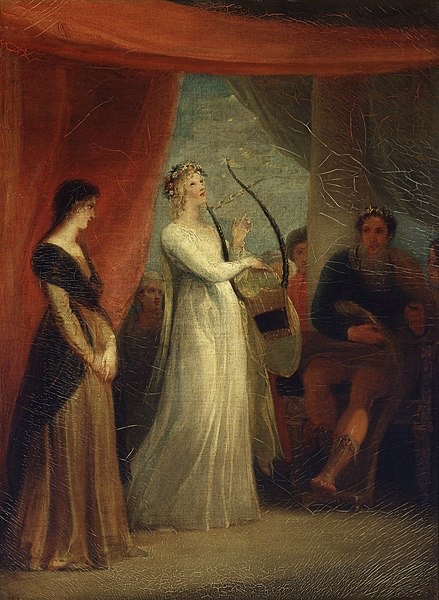
Prospero and Miranda. Public Domain


 The Tempest is probably Shakespeare’s last play. At the very end, the magician Prospero speaks of retirement, throwing his book into the deep and getting rid of his staff, suggesting Shakespeare’s own retirement. 


Anyway, it’s a nice one to end on, if so. And as you’ll know, it has been used for other shows, from Forbidden Planet to a musical called Return To The Forbidden Planet which uses 1950s songs.


It begins with a storm(the tempest of the title). The ship has a number of people important to the protagonist, Prospero. It’s a magical storm which he caused, so everyone thinks they are shipwrecked but in fact, the ship is fine. Nobody has drowned.


Prospero lives on an island with his young daughter Miranda, and a couple of magical servants, Ariel an “airy spirit” and a rather less airy creature called Caliban, whose mother was a witch, Sycorax, who had died. Prospero brought Caliban up and was okay to him till he tried to rape Miranda. 


Father and daughter are there because while he was Duke of Milan  he spent so much time with his books that it was easy for his brother, Antonio, to send him off to sea in a rotten boat with his toddler daughter, Miranda, and usurp the Dukedom. A kindly, loyal courtier sneaked them enough supplies to get to an island and be able to set up there. 


Now Antonio has come to the island with a bunch of others, including another Duke, whose son Ferdinand is about to fall in love with Miranda, of course. 


Prospero has become a very powerful magician during his years on the island, so he is able to confuse everyone, with the help of Ariel, and make their lives miserable for a while. Caliban is hanging out with a couple of coarse crewmen, Stephano and Trinculo, who introduce him to alcohol, which he enjoys for a while, till he realises that they are not good for him.


Prospero makes Ferdinand work, pretending to disapprove of his relationship with Miranda, who has, after all, never seen a man before except her father, unless you count Caliban, who is not really human. Of course she is going to be attracted to the first pretty young man she meets. 


Anyway, all eventually turns out well. There is a wedding with a masque played by spirits of the island. Prospero frees Ariel and embraces Caliban as his other half, a bit like Captain Kirk in “The Enemy Within” embracing his “evil” half, without whom he really can’t function. He undoes all the nasty stuff he has done during the play and forgives, after Ariel says he/she feels sorry for them, and makes his speech about retiring from magic. 


I’ve seen many productions of it on stage, including one where the island is Australia and Ariel and Caliban are both Indigenous Australians; when Ariel is freed, she throws off her western clothing and joins a group of other indigenous women. Caliban was presented as an Indigenous man in chains, inspired by a historical photo of a group of chained men. He is not interested in hugging Prospero and regards him with contempt as he throws off his chains.


To be honest, I’m not fond of Prospero, who neglected his job as Duke for his studies and had his throne stolen as a result. But it’s interesting to see the character develop, to the point where he accepts his dark side and overcomes his resentment to show mercy. 


There have been quite a few impressive actors doing The Tempest over the years - so many that I’ll give you a Wikipedia link. 

https://en.wikipedia.org/wiki/ProsperoA


There was a film in 2010, which cast Helen Mirren in the lead as Prospera. I see that one of the smaller roles was played by Alfred Molina, whom you may have seen at the beginning of Raiders Of The Lost Ark, as Indiana Jones’ assistant, who got killed by one of the many traps in the cave, and has since played a Spiderman villain.


The BBC version I saw many years ago had a terrific cast - comedian Michael Hordern as Prospero, David Dixon as Ariel(you may have seen him in Hitchhiker’s Guide To The Galaxy as Ford Prefect), Nigel Hawthorne(Yes, Minister) as Stephano, Andrew Sachs as Trinculo(the waiter from Barcelona, Manuel, in Fawlty Towers). 


I played Ariel the airy spirit once, at university. It was great fun to do. 


Have you seen a performance of this? If you are in the mood, there are a number of productions on YouTube. 


See you on Monday for U!

Friday, April 22, 2022

A To Z Challenge 2022: Shakespeare- S Is For Sebastian And Shepherd


Olivia and Sebastian. Public Domain


Today’s letter is S. We will take a brief look at two S characters. 


S is for Sebastian, who is the twin brother of Viola, the heroine of Twelfth Night. He and his sister are parted during a storm off the coast of Illyria. The two of them think the other is dead, but both have survived the shipwreck. We see a lot of Viola, who appears in the very first scene and decides to disguise herself as a boy in order to get a job with the Duke, but Sebastian doesn’t arrive on the scene till later in the play, when he arrives with a sea captain called Antonio, who rescued him, but really is not happy to be in Illyria, where he is not welcome and likely to be arrested. Antonio lends him some money and they split up, agreeing to meet later. 


There is a lot of confusion as people mix him up with his sister, who is working for Duke Orsino under the name of Cesario. Antonio meets “Cesario” and is arrested as he had feared, asking for his money back, not realising he is speaking to the wrong twin.


Sebastian meets Olivia, whom Duke Orsino had wanted to marry, and marries her himself about five minutes later, angering Orsino, who thinks his trusted page Cesario has betrayed him. 


What a mess! 


Another S character is the old Shepherd in The Winter’s Tale, who finds a baby girl on the shores of Bohemia and raises her as his own. The child is a Princess, Perdita, daughter of Hermione and Leontes. More of this in the W post. His son, the young Shepherd, saw the death of Antigonus, courtier of Leontes, who had brought the baby to be abandoned, describing Antigonus’s mauling by a bear. 


“Thou met’st with things dying, I with things newborn,” his father tells him, showing him the baby. These two characters are funny and loveable and lighten up the tone of a play that has been grim till then.

More of these characters in W for The Winter’s Tale!

Thursday, April 21, 2022

A To Z Challenge 2022: Shakespeare - R Is For Richard III


David Garrick as Richard III. Public Domain.


We all know about the real Richard III, the one who was found  under a car park in Leicester a few years ago and buried respectfully in an oak coffin built by a Canadian descendant of one of his sisters. At the funeral one of the guests, who read a poem, was also descended from one of Richard’s relatives. I mention him because that family member was Benedict Cumberbatch, who played one of the nastiest versions of Richard III I have ever seen, in The Hollow Crown series.  

You may know him better as Marvel’s Dr Strange. 


Today we will check out Shakespeare’s version of Richard III, that complete and total villain. Mind you, villain or not, he often can’t believe how easy those victims of his are to con. Benedict Cumberbatch does it best, his face expressing sheer amazement as the woman whose husband he killed is persuaded by him right over her father in law’s coffin. Later in the play he talks to his sister in law, Edward’s Queen, who knows all the dreadful things he has done and still tells him to write to her about marrying her daughter, his niece. Again, Richard shows utter amazement at her willingness to make deals with the man who killed off her family, and doesn’t Benedict Cumberbatch perform this beautifully!


I studied this play in Year 11. We had a very good English teacher that year, who happily discussed all the details with us, as well as telling us about Josephine Tey’s novel, Daughter Of Time, which cleverly had her character Inspector Grant handle a cold case from his hospital bed and work out the story of the real Richard III. I read it and ended up joining the Richard III Society. 


But, evil or not, Shakespeare’s Richard is a fascinating character. He starts the play with that famous speech beginning:


Now is the winter of our discontent

Made glorious summer by this sun of York,

And all the clouds that lour’d upon our house

In the deep bosom of the ocean buried. 


The speech is all about how things are going so well for his family, but peace is boring! He isn’t suited for it because with his hunch back no woman wants him anyway. 


About five minutes later, mind you, he woos the Lady Anne and talks her into marrying him! 


There is a Dave Allen skit of this scene. Richard offers her his dagger to kill him, knowing she won’t, but in the skit she stabs him. He sinks to the floor groaning,  “You weren’t…supposed…to do that…”


The play is absolutely full of dead bodies with Richard gleefully standing over them - and with his speeches he sucks the audience into laughing with him.


Shakespeare got his information from a variety of sources, including Holinshed’s Chronicles. It’s inaccurate, of course, but Shakespeare was, after all, writing in the age of Elizabeth I, granddaughter of Henry VII, who killed Richard and took the throne. It’s one of his earlier plays, but certainly powerful. The fact that there have been so many productions of it certainly suggests that. 


Laurence Olivier’s film is the one we saw when I was in high school. Olivier’s Richard was utterly charming…until he wasn’t. The scene where little Richard of York, the younger prince, makes a joke about his hump is the one where the child suddenly realises his nice uncle isn’t so nice, when Richard turns and glares at him. The boy is terrified.

There is a version I can’t get hold of, with Ian McKellen in the lead, performed in 1930s costumes. The film opens with a party at the palace celebrating the family’s victories, with a dance band and a glamorous female singer singing a song with lyrics by Marlowe. The Queen’s brother is shown as an American, who would be considered an outsider in those days. The battle scene near the end involves tanks. If I can ever get a copy I will re-view it with great pleasure. 


Looking For Richard is an American film with Al Pacino, in which the play is discussed in great detail and scenes from it performed by Pacino and others. It’s definitely worth a watch, though you might prefer a straight performance of the play.


References are made to the play in many films and TV shows. My favourite is the first episode of Blackadder with Roman Atkinson. The premise is that Richard’s defeat at the battle of Bosworth was all a lie made up by Henry VII for propaganda purposes. In the opening scene, Richard, played by Peter Cook, is playing with his nephews, one of whom, Richard of York, grows up into Brian Blessed. He wins Bosworth for his uncle, but Richard III is killed by Edmund Blackadder(Atkinson) in mistake for a horse thief(“A horse, a horse, my kingdom for a horse! Ah, horsie…”). Edmund’s father, Richard of York, becomes Richard IV. 


There are, of course, many Richard III novels, including my favourite, We Speak No Treason by Rosemary Hawley Jarman, which uses a line from the Shakespeare play for a title, but is about the real, decent Richard. 


See you tomorrow for the letter S! 


Wednesday, April 20, 2022

A To Z Challenge 2022: Shakespeare- Q Is For Mistress Quickly And Queen


Mistress Quickly And Falstaff. Public Domain.


Mistress Quickly is the proprietor of the Boar’s Head Tavern in Eastcheap, where Prince Hal and his friends, including Falstaff, hang out in Henry IV Part 1. This is, I think, her first appearance, but she is in a number of other plays, including Henry IV Part 2, Henry V and The Merry Wives Of Windsor.


She is a comical character, who utters a lot of malapropisms and is annoyed at Falstaff for calling her a woman. The first time you see her she is telling him off for owing her a lot of money. However, the speech she makes in Henry V, describing Falstaff’s death, is quite poignant.


She is married in the first play, but presumably is widowed by Henry V, because she has married Pistol, one of the Boar’s Head gang. 


The role has been played by some well known actresses such as Julie Walters in The Hollow Crown and Judi Dench in the Kenneth Branagh Henry V. It is a plum role for a middle-aged actress.


There are a lot of Queens in Shakespeare’s plays, so I will stick to one, Gertrude from Hamlet.


Gertrude is, of course, Hamlet’s mother. She loves him, really she does, but she has, in his opinion, committed a crime in marrying his uncle, Claudius, so soon after his father’s death, and that’s before he finds out his father was murdered. He isn’t crazy about Claudius in the first place and doesn’t understand why she would marry the inferior brother after having his father. There is, though, no real indication that she knew about the murder. 


In the Franco Zeffirelli production, starring Mel Gibson, the role was played by a relatively young Glenn Close, due to the theory that Gertrude would probably have been married young, as women were in those days. While it’s possible, we know that Hamlet is thirty because the Gravedigger reminisces about a battle Hamlet’s father won on the day he was born, thirty years ago. So Gertrude would be, at best, in her mid forties.  


Julie Christie played the role in the Kenneth Branagh version. She was in her fifties at the time. 


Wayne and Schuster did a Hamlet skit, “All In The Royal Family”, in which Gertrude talks like the character from All In The Family, telling us that “my son Hamlet is coming home from college!” It was a very funny skit, but the only one I could find on YouTube was dubbed into Spanish! 


As per usual for a Shakespeare tragedy, the stage in covered in bodies in the last scene, including that of Gertrude, who has drunk poisoned wine her husband has put out for Hamlet. 


Let’s stop here and see what tomorrow brings! 


Tuesday, April 19, 2022

A To Z Challenge 2022: Shakespeare - P Is For Pericles, Prince Of Tyre


Marina sings for Pericles. Thomas Stothard. Creative Commons


Pericles, Prince Of Tyre is one of Shakespeare’s lesser known plays, first produced in 1607-8. I’m fond of it. I have seen it at least twice on stage and it has been made into a telemovie, way back in 1984, as part of the BBC Shakespeare series.


It is one of a group of unusual plays known as  romances, because it’s neither a tragedy or a comedy, but has a happy ending. There are arguments as to whether Shakespeare wrote the whole play or collaborated with a playwright called George Wilkins. Anyway, it’s enjoyable, so who cares?


 It’s based on a story by the poet Gower, who turns up in the play as a narrator.


 Pericles, a young prince, is a suitor for the unnamed daughter of King Antiochus. Antiochus has offered his daughter’s hand in marriage for anyone who can answer a riddle but death if they don’t. Unfortunately it’s death either way, as the answer to the riddle is that the king and his daughter are committing incest. You do have to wonder why they bother, since Antiochus has no intention of handing over his daughter, but there you are.


Pericles is not stupid; when he figures out the riddle, he escapes and goes home, followed by an assassin. He leaves again and is shipwrecked, after helping out the rulers of Tarsus from famine. Luckily he is stranded in the kingdom of King Simonides, who has a pretty daughter, Thaisa, whom he adores but isn’t doing anything inappropriate with. Some fisherman find Pericles a rusty suit of armour which he uses to win a tournament and Thaisa’s hand.


Thaisa goes into labour at sea and apparently dies. Pericles sends her overboard in a sealed chest and continues on with his baby daughter, Marina, whom he leaves with the ruler of Tarsus and his wife, who bring her up with their own daughter, but plot to kill her out of jealousy because she is prettier than their own girl.


She survives but only because pirates capture her and take her to Mytilene where she is sold into a brothel. Being a Shakespearean heroine, she manages to keep her virginity - in fact, some of her would-be clients decide to reform! She persuades the brothel owners to let her teach sewing and such instead of working for them and is soon known for her virtues and skills. 


Meanwhile, Pericles travels around, thoroughly depressed. He has been told by that nasty Tarsus couple that his daughter is dead. 


When he reaches Mytilene someone gets the idea of having their national treasure help him. Father and daughter are reunited. Better still, it turns out that Thaisa is alive and well, in the Temple of Diana at Ephesus. And all the baddies are dead, though offstage. 


Happily ever after! 


If you have seen Geraldine McEwan as Miss Marple, you might be interested to know she played the role of Marina, as a much younger woman, in 1958! There have been a fair few productions since then.


If you are interested, there are a couple of productions of the play on YouTube. One is the Southwest Shakespeare Company, the other is done by international drama students in England. Just type in the name of the play. 


Tomorrow we will talk about Mistress Quickly and a Queen or two. See you then! 

Monday, April 18, 2022

A To Z Challenge 2022: Shakespeare - O Is For Oberon And Olivia

By Joseph Noel Paton. Public Domain


 A Midsummer Night’s Dream is one of my favourite Shakespeare comedies, along with Much Ado About Nothing and A Comedy Of Errors. It’s hilarious! Trying to explain the storyline is pretty hard, though. There are three stories, four if you count the royal wedding - and, in fact, quite often Theseus and Hippolyta also play Oberon and Titania. 


Anyway, O is for Oberon. Oberon is the king of the fairies. His wife is Titania. When the two of them have a real fight, the weather can go crazy, as mentioned in the play. 


In this story, though, the fight is over a changeling boy. You know what changelings are, right? Usually they are human children stolen away by the fairies and swapped for fairies, including elderly fairies who want a holiday. 


In this case, though, the boy is an orphan. Titania wants to hang on to him, because his mother was a dear friend, a priestess of her order in India. So, basically she and Oberon are minor gods. 


Oberon wants the kid to be a part of his retinue, hunting with him and such. When Titania refuses to hand him over, Oberon decides to have a bit of fun and hopefully get the child anyway. He sends his sidekick Puck to pick up a certain flower with interesting properties - not quite an aphrodisiac, but it does make you fall passionately in love with the next living thing you see. The idea is that Titania will make a fool of herself over someone totally ugly. Which she does, going crazy over a lower class mortal, Bottom, who is innocently rehearsing with his friends in the forest for a play they hope to perform for the royal wedding. To make absolutely certain, Puck gives him a donkey head. (Just as well, since in the most recent film version of Dream, the role of Bottom was played by the dashing Kevin Kline). 


While all this is going on, Oberon shows he is really quite kind, ordering Puck to use some of that juice to make young lover Demetrius fall back in love with Helena, his former girlfriend who has followed him into the forest. Puck gets the wrong couple, making Lysander, the other young man, fall in love with Helena and dump his own girlfriend, Hermia. In one scene BOTH boys are in love with Helena, who thinks they are sending her up. Oberon has to get it sorted out, but by morning the two couples are back to normal and ready to get married.


You realise just how powerful Oberon is when you see the National Theatre production, in which the lines are swapped and Titania does all this, while Oberon falls in love with Bottom. It does make a huge difference.


I confess I nearly wrote this couple into my novel Wolfborn, just for fun, but my editor told me firmly that they belong in Shakespeare and my story was set a few centuries earlier, so I replaced them with a couple of Gaulish gods who suited the story.


King Of Shadows, by the wonderful Susan Cooper, author of The Dark Is Rising series, is about Nat Field, an American boy actor in England to play Puck, who gets very sick one night and wakes to find himself in Shakespeare’s England. He is supposed to be playing Puck in a revival production, and the boy he has replaced has the same name as he has and has been brought in after the regular boy has gone on the road with comedian Will Kemp. The role of Oberon is being played by Shakespeare himself and they form a father/son relationship. The “King of shadows” is Oberon. I won’t tell you more, due to spoilers, but read it if you can, or there is a radio play.


O is for Olivia, from Twelfth Night. 

Olivia is a rich young woman who has vowed to stay away from men for a certain time, in mourning for her brother. Despite this, the Duke, Orsino, is wooing her and being sent away. Finally he sends his new servant, Cesario, who is really Viola, a shipwrecked girl, to woo Olivia for him. Apart from the fact that Viola is a girl, she is also in love with Orsino. She does her best anyway.


The real problem is when Olivia falls in love with “Cesario”, completely forgetting her vow, and makes her interest clear. Poor Viola has Olivia pursuing her on the one side and Orsino threatening her on the other, when he thinks she is his rival.


Fortunately for everyone, Viola’s twin brother, Sebastian, turns up and Olivia, thinking it’s Cesario, grabs him and promptly marries him. He has no idea what’s going on, but when a beautiful, rich girl wants you, why argue? 


This role can be very funny if played right, as I discovered when I saw a production done by the Melbourne Theatre Company. The actress playing Olivia was, in my opinion, the funniest cast member in the show. 


When I did a French language conversation class at university, our tutor was a professional French actor, who had played Orsino. He made the point that when Orsino accepts Viola at the end, as far as he is concerned she is Cesario. She doesn’t even change her clothes. It is an interesting point, which applies also to Olivia, though she does accept Sebastian. She fell in love with Cesario, not Viola. In a YA novel I read, she is still in love with Viola many years after they both marry. 


Just a thought! 


Tomorrow we will talk about Pericles, Prince of Tyre! 


Friday, April 15, 2022

A To Z Challenge 2022: Shakespeare - N Is For Nerissa and Nurse


Juliet And Her Nurse: Henry Perronet  Briggs. Public Domain


Today’s characters have names starting with N. They aren’t the lead characters in their plays, but are interesting anyway!


N is for Nerissa. Nerissa is the gentlewoman who serves Portia, the young woman who marries Bassanio in The Merchant Of Venice and rescues Antonio, who was in danger of having a pound of flesh taken from him. Nerissa isn’t just a standard nameless servant. Like Charmian and Iras(Antony and Cleopatra), Maria(Twelfth Night) and Margaret and Ursula(Much Ado About Nothing), she has more of a role to play. Nerissa supports her mistress and joins her in disguising as a man to go to court, with Portia as a lawyer and Nerissa as a law clerk. She has agreed to marry Gratiano, one of Antonio’s friends. She hears the idiot swear he would rather have her dead than Antonio lose his case, and squeezes out of him the ring she gave him as herself. In the last scene she yells at him, but we know he is going to pay for it for the rest of their lives...


The Nurse from Romeo And Juliet is a character whose actual name we never learn, though we do know she had a daughter called Susan, now dead. Nurse starts the play with some crude comments, remembering when her husband made a joke about little Juliet falling on her face, but she would fall on her back when she was older and smarter, ha ha.


There is no question that the Nurse loves Juliet dearly, and gives her support in marrying Romeo. However, I can’t help thinking she likes the romance of her little girl falling in love and getting married. She doesn’t really care who it is. 


The day after the Capulet party where the young lovers meet, the Nurse goes out to find Romeo to make arrangements for the wedding. Having successfully done that, she returns to the Capulet house, teasing Juliet before telling her the good news. 


But here is the thing, and the reason why I think the Nurse doesn’t really care who Juliet marries. When Romeo has killed Tybalt and the lovers have had their wedding night, Lord Capulet has decided it might cheer up his daughter if she marries Paris, a young man who wanted to marry her early in the play. Juliet gets upset instead, not only because she loves Romeo, but because they are married, dammit, and he has gone into exile and she can’t get in touch with him. 


And what does the Nurse say, knowing Juliet is Mrs Montague? That she, the Nurse, even organised it? She urges Juliet to marry that “lovely gentleman” Paris. After all, when is she ever going to see Romeo again? 


So, at the very time when Juliet needs support, her nurse abandons her. No doubt she thinks it’s for the best, but still, she has abandoned her girl. I do wonder what she feels after the play is over and Juliet's dead?


In the Baz Luhrmann modern dress film, with Leonardo Di Caprio and Claire Danes, the Nurse was played as a Latina by British actress Miriam Margolyes. 


In West Side Story, the musical inspired by Romeo And Juliet, the Nurse character is Maria’s(Juliet’s) brother’s fiancée, Anita, who leads a group of Puerto Rican girls in the lively song and dance America.


A very different interpretation! 


See you Monday for O Is For Oberon and Olivia! 


A to Z Challenge 2022: Shakespeare - M Is For Much Ado About Nothing


Claudio acts like an idiot. Hero faints. Public Domain. 


Just so you know, the word “nothing” in the title of this play is pronounced “noting” and has a meaning it doesn’t have today. It’s a pun and a slang word meaning - well, look it up. I remember showing a video to my Year 8 class, about various words from Shakespeare’s plays and what they meant. When they got to “nothing”, every student’s back straightened and jaws dropped. I bet most of them will remember it. 


Shakespeare loved doing cheeky puns. They even come into Romeo And Juliet, where Romeo is among those making jokes using them.


Just thought I would mention it here before talking about the story. 


If you have been following this series of posts, you will remember the one about Don John, the villain of this play, who nearly succeeds in destroying the happiness of a young couple. 


Let’s talk about the rest. 


The city of Messina is in party mood, with the return of the soldiers led by Don Pedro of Aragon, after a successful campaign. Among the soldiers are Claudio, a young man who fell in love with a girl called Hero before their departure, and his friend Benedick, who is a local and, as we learn, was once dating Hero’s cousin, Beatrice. We never find out why they broke up, but ever since, they have been slanging each other off. To Benedick’s irritation, Beatrice usually wins. 


It’s fairly clear, early on, that they are still in love. Certainly Benedick shows this when Claudio asks his opinion of Hero. He says she is okay, but nothing special compared to Beatrice, who would be far better than Hero if it wasn’t for her tongue. 


Hero’s father Leonato, the city governor, invites the officers to stay with him, and throws a masked ball, during which Don Pedro woos Hero on Claudio’s behalf and Beatrice upsets Benedick badly while they are both masked. Does she know who he is? No idea! 


Don Pedro chats with Beatrice and impulsively proposes to her. She says no, but he then has a word with Claudio, Hero and Leonato, suggesting they get Beatrice and Benedick together.


It’s all too easy. They are in love, after all - only thry don’t know it. The men let Benedick overhear them saying that Beatrice is crazy for him, and Hero and her friends talk in front of Beatrice, saying the same thing about Benedick. Each of them is thrilled. 


They don’t discuss it immediately; the wedding is being planned and there is a lot to do.


Unfortunately, this is when Don John and his friend Borachio plot to ruin it.They set it up so that the night before the wedding Claudio and Don Pedro will see Hero apparently being unfaithful. It isn’t her, of course, but her waiting woman Margaret, who is dating Borachio, who calls her Hero while they are together. 


After his success, Borachio is bragging about it to another man, Conrade. They are overheard by members of the city watch, led by an over-the-top policeman called Dogberry, and dragged off to the station. 


The worst thing is that the whole thing could have ended here, but when Dogberry arrives at the governor’s home to say he has a couple of rogues who need to be examined, Leonato is too busy preparing for the wedding and tells Dogberry to just do it himself.


At the wedding, Claudio abuses Hero in front of everyone. (What is it with these egotistical males in Shakespeare’s plays?)She faints and he and Don Pedro leave. When only the priest, her immediate family and Benedick are left, it’s decided that for now, she hides and it will be announced that she is dead.


Left alone together, Benedick comforts the furious Beatrice. Suddenly, he bursts out that he loves her more than anything in the world. What can he do to help?


Her reply? “Kill Claudio.” Then, in tears, “Oh, that I were a man!”


He is shocked at first, but understands. He agrees to go and challenge that idiot Claudio to a duel. 


Even after being told that Hero is dead, Claudio and Don Pedro want to have a chuckle with good ol’ Benedick, that funny mate of theirs. 


Coldly, he says, “You have killed a sweet lady,” and gives his challenge. He knows she is alive, but that’s not Claudio’s fault, is it? 


However, soon the truth about that night comes out. Claudio is devastated. Leonato says he can make up for it by marrying a niece who looks like Hero. Claudio agrees and turns up.


And of course, it’s Hero. Forgiveness ensues. The now happy couple hand Benedick and Beatrice notes from each other proving they love each other. Benedick kisses Beatrice to shut up her denial. A message comes in that Don John, who had escaped, has now been arrested. Benedick advises his friend to leave it for tomorrow and just have fun tonight.

I love this play! It has to be my favourite of the lot. And I have seen it many times. 


The first time I saw it, I was at university, and the costumes were Regency style. It made me wonder if Jane Austen got some of her ideas from this play. 


Later I saw Hugo Weaving(yes, that Hugo Weaving, aka Elrond and Agent Smith) and Pamela Rabe, who also played Petruchio and Kate, as a wonderful Benedick and Beatrice in 1950s costume. Beatrice is caught in a sun lounge she is trying to open when she overhears.


Most recently on stage, I saw the Bell Shakespeare Company do it. The scene where Claudio and Hero are reunited was just as I wanted it: she does forgive him, but first, she takes a deep breath and slaps his face - as he deserves, and he knows that.


I confess I never saw the Joss Whedon film, but the Branagh/Thompson one was wonderful. It was done in 19th century costume. I saw it soon after I moved into my flat. 


Yesterday I re-watched the Tennant/Tate version, to which I have left a link on the Don John post. Those two have such chemistry it’s utterly breathtaking. When Benedick says he loves her, you believe it, and want them to be happy. Even if you know how it ends, you hold out till it does. 


David Tennant uses his own Scottish accent, which is lovely. 


Watching the titles, I suddenly realised that the director was Josie Rourke, who also directed Coriolanus with Tom Hiddleston. The actor who played Don John, Elliot Levey, was also in that play.  


He is introduced in this production’s opening scene offering a cigarette to a small boy, who looks thoughtfully at it and accepts! You know immediately this guy is no good.


An interesting thing about this play is that Benedick and Beatrice’s romance isn’t supposed to be the main one. Beatrice is an orphan, living with her cousin’s family. She doesn’t get a conventional romance. Hero is the daughter of a governor. You are supposed to be following her love story; Beatrice is just the romcom heroine’s kooky best friend, who eventually gets her own guy - maybe. 


Yeah, sure, Will! If you think we believe that, London Bridge is up for sale… 


Wednesday, April 13, 2022

A To Z Challenge 2022 : Shakespeare - L Is For Leontes

Public Domain


There seems to be something about jealous husbands in Shakespeare, not sure why, but this one ends more happily than Othello, even if it takes years. The difference is that Othello was talked into thinking his wife was unfaithful; Leontes just decides on the basis of no evidence but something going on in his crazy mind.


Leontes is the king of Sicily in Shakespeare’s The Winter’s Tale. He has a wife, Hermione, and a son, Mamilius. He also has a best friend, Polixenes, the King of Bohemia, who is visiting. 


For no real reason, Leontes, within the first few minutes of the play, goes crazy with jealousy. He asks Polixenes to extend his stay, but when he only agrees to stay on Hermione’s request, Leontes starts to get suspicious - hey, she talked Polixenes into it when Leontes couldn’t! There must be an affair happening. In fact. Hermione is heavily pregnant at the time, so whose kid is it?


Polixenes is warned and leaves in a hurry. Hermione has no chance to do the same, so goes on trial. 


Leontes just can’t see he is wrong. Well, not yet. He calls on the oracle of Delphi and gets a reply via messengers that he really wasn’t expecting.


Suddenly, he has lost his wife and son and his baby daughter, Perdita(meaning “Lost”). 


The newborn baby girl is taken to Bohemia and left on the seashore. This is the play from which we get the famous line “Exit pursued by a bear.” It also has landlocked Bohemia with a seashore. 


More of this in my W post. 


But just so you know, he does feel remorse and become a better person, and meanwhile he is punished by some of the people in his life. Hermione isn’t dead, but hides away with the help of her lady in waiting, Paulina, until Leontes is ready to be forgiven. And serve him right!


There have been some very well known actors in the role, including John Gielgud, Patrick Stewart, Jeremy Irons and Antony Sher. Laurence Harvey played the role in a 1967 film of the play, which I saw on late night TV back in the days when you had to stay up to watch a film on TV or miss out…


Tomorrow’s post will go into more detail about Much Ado About Nothing. See you then! 

A To Z Challenge 2022: Shakespeare - K Is For Katherina


Lilli Palmer and Maurice Evans. Public Domain


Today, K is for Katherina, the heroine of The Taming Of The Shrew. There has been so much argument over what he had in mind with this play, I’m going to give you a link to the Wikipedia entry and let you make up your own mind. Here it is. But read this post first, as it’s rather long and waffly. https://en.wikipedia.org/wiki/The_Taming_of_the_Shrew


One thing you may not know about this play is that it is a play within a play. It begins with a nobleman having fun with pretending to a tramp, Christopher Sly, that he is a nobleman. The story of Katherina and Petruchio is done as a performance for the tramp  by a bunch of wandering players. The Wikipedia entry has a lot of arguments about how misogynistic the play is or isn’t  using the “induction”, but the fact is, I have only seen this done once, on a TV production. It was done in 19th century costume and set in Australia. It was fun, but really not necessary. 


I’ve seen it on stage with Pamela Rabe(a Canadian actress who lives in Australia )and Hugo Weaving(Elrond and Agent Smith), who also played Benedick and Beatrice in Much Ado About Nothing. It was done in 1950s costume, which worked well.


Katherina is a young woman whose father won’t let his younger daughter Bianca get married till Katherina is married. Bianca, who is considered a perfect woman, has several suitors, but nobody wants to marry Katherina, because she is considered rather too strong for the average young man.


Bianca’s suitors decide to find Katherina a husband so that they can get on with wooing the girl they want. One of them has a chat with Petruchio, who has just arrived in Padua, the setting of the play. Petruchio agrees and next thing you know he has married her and set out to “tame” her, by contradicting everything she says, throwing away food he says isn’t good enough, refusing her clothes she likes… When they are heading back to Padua for her sister’s wedding, he makes it quite clear that if she doesn’t agree with what he says, however stupid, she doesn’t get to go to the wedding. And there is probably more where that comes from.


In the end, she makes a long speech about why women should obey their husbands. 


However misogynistic this all is, he never actually commits any violence against her. He uses words, and not even abusive ones. 


Not my favourite play, but there is plenty to play around with. The stage version I saw ended with the two of them laughing and chasing each other around the house, clearly in love, in comparison with her sister, who isn’t quite as obedient as she pretends to be. 


Over the years, there have been many versions, but also many adaptations. The first film I saw of the original play was the Franco Zeffirelli version with Richard Burton and Elizabeth Taylor, made in 1967. It was very, very funny.


There are so many adaptations inspired by the play, though. There is an episode of Moonlighting, a TV detective series with Bruce Willis and Cybill Shepherd, in which a teenager who has to study the play falls asleep while watching Moonlighting, and the characters play out the Shakespeare play. It was called “Atomic Shakespeare” in case you want to look it up, but means more if you are familiar with Moonlighting. Poor Bruce Willis has recently had to retire from acting due to a serious illness.


Musical Kiss Me Kate is not a direct adaptation of Shrew, but a play within a play. Fred and Lilli are actors who have been hired to do a show based on Shrew. They are divorced, and Lily is about to marry someone else. Fred, still in love with her, is hoping she will change her mind. In the meantime there are a lot of funny things happening and they do a lot of singing and dancing as part of the musical within the musical. The film version has Kathryn Grayson and Howard Keel, with the wonderful singer/dancer Ann Miller in the “Bianca” role. The film is easy enough to rent or buy online. It contains some wonderful songs by Cole Porter and is cheekily inspired by the fighting between the Lunts, a show biz couple, while they were performing the Shakespeare play.


There is 10 Things I Hate About You, which sets it in a high school, starring Heath Ledger and Julia Stiles. This is another one you can rent or buy online. 


Here is a list of other versions on Wikipedia.


https://en.wikipedia.org/wiki/The_Taming_of_the_Shrew_on_screen#Television

Monday, April 11, 2022

A To Z Challenge 2022: Shakespeare - J Is For Don John


This is what Don John causes. Public Domain.


Today’s Shakespeare character is Don John, the main villain from Much Ado About Nothing. 


He is not a deep or subtle character like Iago. Although, now I think of it, you do have to wonder about the subtlety of someone who ruins lives and destroys a marriage over a job! Still. 


Much Ado About Nothing is one of my favourite Shakespeare plays. It’s a screwball comedy about Benedick and Beatrice, two wonderful, smart people who are constantly slanging each other off but are crazy about each other. More of that later, in M Is For Much Ado About Nothing.


But there is a part of the story about the other couple, Hero and Claudio, and how their lives are nearly ruined. 


Don John is the illegitimate brother of Don Pedro, a prince who is leading an army. The soldiers turn up in Messina, where the play is set, and proceed to party and be celebrated for their victory.


Everyone seems to be having fun except Don John. He hates everyone enjoying themselves and when Claudio, a young soldier and friend of Benedick, gets engaged to Beatrice’s cousin Hero, a sweet young thing, he decides he is going to ruin it for them. The thing is, there is no obvious reason  why he’d do that, other than jealousy of his brother and resentment of being illegitimate. What this has to do with Hero and Claudio is hard to see. But because this is a comedy and has to end happily ever after, there is no pile of bodies on the stage at the end.


His friend Borachio helps out by appearing in a window with his lover Margaret, one of Hero’s two women, who looks a bit like her, so that her fiancé thinks she is unfaithful and humiliates her at the altar.


Claudio gets his comeuppance for doubting his girl and humiliating her - more of that in my M post. 


So does Borachio, who makes the mistake of bragging about it in the presence of the klutzy policeman Dogberry, who arrests him. Don John doesn’t get away with it either.


The role has been played by the likes of Derek Jacobi, in a production with a much younger Maggie Smith and Robert Stephens. I have that on a vinyl boxed set from the old days before CDs and streaming services. 


Keanu Reeves played the role in the film with Emma Thompson and Kenneth Branagh. Who would have thought? 


A later version, directed by Joss Whedon, featured Sean Maher in the role(Serenity).


Elliot Levey played the role in the version with David Tennant and Catherine Tate. He seems to be best known for some stage productions with the National Theatre, including Coriolanus, in which he played Brutus, a tribune of the People. So I have seen him before, and also in the David Tennant production.


Which is available online. Here is a link.


https://archive.org/details/muchadoaboutnothing_202001


This, and the Branagh/Thompson version are the two best I have ever seen!