Search This Blog

Saturday, April 09, 2022

An Interview With Sarah Tolmie by Bryn Hammond


 Today I present for you an interview of author Sarah Tolmie, whose new book All The Horses Of Iceland has just been published by Tor. The actual interview was done by author Bryn Hammond, who kindly agreed to post it here. It looks amazing! I may have to get my own copy.


Take it away, Bryn! 


Author Sarah Tolmie


All the Horses of Iceland 

Sarah Tolmie 


A hypnotic historical fantasy with gorgeous and unusual literary prose, from the captivating author of The Fourth Island.

Everyone knows of the horses of Iceland, wild, and small, and free, but few have heard their story. Sarah Tolmie’s All the Horses of Iceland weaves their mystical origin into a saga for the modern age. Filled with the magic and darkened whispers of a people on the cusp of major cultural change, All the Horses of Iceland tells the tale of a Norse trader, his travels through Central Asia, and the ghostly magic that followed him home to the land of fire, stone, and ice. His search for riches will take him from Helmgard, through Khazaria, to the steppes of Mongolia, where he will barter for horses and return with much, much more.

All the Horses of Iceland is a delve into the secret, imagined history of Iceland's unusual horses, brought to life by an expert storyteller.


Bryn. I thought your style owed somewhat to the sagas, which can be terse, rather phlegmatic on emotions, with a liking for simplicity in telling. Did you set out to write in saga-style? Did the sagas guide you in how to write your story?


Sarah.

Yes, the book is explicitly in saga style. This means some telescoping of action, not the kind of detailed description of travel you get in travelogues or in today’s historical fiction. Travel in itself is not of interest in sagas: it’s a means to an end, and that end is making money. So it’s trade protocols, laws, ceremonies, personalities, all those things that facilitate strangers getting to know one another and working out their relations that they tend to concentrate on (those sagas about “wide-travellers” like Eyvind at least).


Bryn. You also drew upon the Secret History of the Mongols. Most obviously, you transpose names from the Secret History into your ninth-century story, while your note cautions us that these have no relation to the people of the same name from the life of Chinggis Khan. How else did the Secret History feed into your story? Did you think about sagas – any equivalences or contrasts – while you worked with their thirteenth-century contemporary, the Mongol biography of Chinggis with its features of history-writing, oral poetry, and tale? 


Sarah.

Well, the frame story of Jór, the 12-century monk who compiles Eyvind’s 9th-century story from its various fragmentary sources and translates them into Icelandic, making it broadly into a family saga, introduces a similar distancing problem. While many of the events of the Settlement period (in Iceland, that is, so during the 9th century) are recorded in surprising detail, the sources that record them all date from about 250 years later. While The Secret History of the Mongols seems to have been written admirably close to Temüjin’s own lifetime, there is the problem that the text as we have it had to be reconstructed back to its Mongolian original from the work of Chinese transcribers over several succeeding centuries. So very broadly speaking we’re looking at a similar gap. It’s one all medievalists are familiar with and have to strategize around: the gap between dateable history and the chronicles that record it, and the different ways in which oral history, genealogy, folklore and law function and appear before and after they occur in writing.


Bryn. You mention Grettirs Saga in your notes, which I confess is the saga of my heart: to me it is a great work of outsider fiction, and Grettir has unusual interactions with unusual women. As well, it has visitations from the dead, as you do. Your main character Eyvind believes only in ‘men, animals, ghosts, and luck’ – not in gods, as he travels through several religious zones; and asks, ‘What does a ghost have to do with religion?’ He kind of steps in and sorts out the supernatural situation in the qan’s tents, at risk of ritual offence. Ghosts are a universal language, then? 


Sarah. 

Ghosts occur in every culture I know of, at least. The dead have to be accommodated into every society, whether that be as ancestors to be worshipped, consulted and propitiated, souls to be prayed for or from whom to seek intercession, or whatever it may be. If you have a genealogy, you are likely to have ghosts. The weird space ghosts have come to occupy in supposedly post-secular culture – the horror space – always strikes me as a sad state of affairs, reflecting the loss of historical vision in our day. Ghosts now are just signs of trauma, undifferentiated.


Bryn. Eyvind despises gods, and he despises seithr – the magic of the Norse world. To him the practice of seithr, associated with women, is ‘unmanly nonsense’ and ‘effeminate’. In your steppe culture, too, it is women we see as practitioners of magic, but here Hoë’lün is the mother of the qan’s wife and comes from a line of ‘white magicians of high rank.’ She connects magical ability with disability of body, which is news to Eyvind. How did you want to present magic in each of these societies?


Sarah. 

When you look at who magicians or shamans are, case by case, in many societies, you see people who are variously disabled: blind, sterile, with impaired mobility or unusual speech. (You also see plenty of women and foreigners.) This is true right back into the Neolithic period from the limited fossil evidence we have from burials – these are the people we might expect subsistence level societies to destroy or expose, yet instead they are honoured and preserved. Any fear or revulsion they might generate works to make them sacred. People who present physically as being marginal are, logically, ones you might expect to be able to act at the margins of your society: to interact, always riskily, with spirits or gods. They are the police of that boundary. Perhaps it means that if they are harmed or killed in such endeavours it’s a smaller loss; perhaps their difference and potential monstrosity means that such others, spirits or gods, are more cautious with them, or feel kinship with them.


Bryn. A related question. In your notes you say ‘I avoid using the words Viking or shaman, both of which are often used irresponsibly, in my opinion.’ Instead you call Hoë’lün a magician,  although you also use the culture-specific word udugan. What did you want to shake off in not using ‘shaman’? (I needn’t ask what you want to shake off by not using ‘Viking’ – it’s probably like me and ‘horde’). 


Sarah. 

There’s a lot of flaky talk about shamans. It’s used a lot by people who want to claim authority for a religious role but don’t want to use priest, because that word implies institutional power. And because monotheists have invested so much in the word priest, perhaps, and poisoned it. Shaman is a term used to cover a lot of woolly thinking about religion and magic. Any kind of animism is apparently the province of a shaman (i.e., a priest of any of this broad range of religions, without using this term) and can be occupied therefore without institutional sanction (as with many self-proclaimed shamans today). This is bullshit. Somebody who performs the task of a shaman in any real, historical culture is a magician, and magic requires very real and usually institutional (familial, dynastic, ritual, etc.) buy-in from the people it affects. At bottom: religion and magic are the same thing. Extra-human, supernatural forces are called on, and respond; rituals are used to communicate; only people in certain statuses can achieve it. As far as I am concerned, a Christian priest is a magician; a shaman is a magician. A shaman is a priest is a magician. These terms are all interchangeable, and people use them irresponsibly, often to elide their own religious snobberies.


Bryn. Talk to us about travel and trade. For the peoples of the steppe, like the people of the Norse world, I think, trade and exchange were of the first priority. Aside from your horses, it’s nice to see felt as the object of marvel and discovery rather than silk, for once. 


Sarah.

Felt, isgeir. It is pretty incredible. The drama of wet felting as it was done in Mongolia – and still is, sometimes – is huge, galloping horses dragging a heavy rotating drum to crush the fibres together. Wow. And from the perspective of any culture that mostly made fabric by weaving – a huge undertaking, with many stages, that kept most of the women in early medieval cultures busy all the time – you can see how it might have a transgressive edge. Plus frankly, in northern countries, it’s far more useful than silk. Silk is very warm as a lining fabric, but otherwise? Purely for show – now show is very important, we realize, of course. Silk fashions were huge indicators of rank.


Bryn. Eyvind’s travelling companion is a Khazar, David. Among the religions Eyvind encounters, David’s Jewishness is to the fore, and sometimes snarky about Christians. Tell us about David.


Sarah.

There is a story that moves through about two centuries of Muslim and Jewish chroniclers that the rulers of Khazaria, a Turkic khaganate in central Asia, now modern Turkey, were Jews. This was a powerful idea for Jewish intellectuals mostly in southern (Muslim) Spain, as evidence of ongoing Jewish kingship and statehood after the diaspora; it was also used to interrupt narratives about Christian rulership and its growth across the world by Muslim chroniclers throughout the Middle East and Central Asia. For Christian readers in Europe much later it served as a wonder tale about a land unimaginably far away. It’s a niche story but it travelled around and lasted a long time. I personally do not think it was ever true. But as my story overall is a kind of wonder tale (elements of which are common in sagas), I proceed as if it were true. I never take Eyvind or his company to the fabled city of Itil, straddling the Volga, where the sacred king resided in a special compound in the middle of the river, but I do refer to it, and David, the leader of the Khazar traders, along with his kinsman David, is a Jew. His faith comes up from time to time as a theoretical thing – a way to discuss models of kingship, or monotheism, or dietary taboos (all of which, incidentally, Eyvind rejects utterly as a kingless, pagan Icelander who eats anything to avoid starvation). David’s religion marks him as different from the men that he leads: at once more elite (as only the king and the noble class were supposed to have been Jews) yet also as an outsider. This in itself makes him more flexible: he takes to Eyvind right away, just as he is also able to deal more meaningfully with Ibrahim, the Khwaresmian trader, a Persian Muslim, as well as with the qan. For one thing, he is a superior linguist. He is a bit testy about Christianity’s seemingless effortless overwriting of Jewish monotheism, about which Eyvind knows nothing. So he sets him straight a couple of times. David really grew on me as a character. I especially like his complex but taciturn reaction when Eyvind suggests an innovative form of burial ritual that might cover the deaths of unknown Jews massacred in Khazaria.


Bryn. Your story is set in the early ninth century. Historically, the Uighur khanlig existed at this time as a state, as at least an over-government on the steppe. In your steppe world of ‘many kings… greater and lesser, who govern tribes of their own people,’ Uighurs aren’t mentioned as a government, but they are named as cultural agents (see next question). 

Elsewhere I have complained about Guy Gavriel Kay’s historical fantasy version of the eighth century in Under Heaven. While Kay writes of Tang China he sticks pretty closely to history, but as soon as he steps onto the steppe, history is absent. In place of the Uighur khanlig he has primitives, and his character’s journey into the steppe is a Heart of Darkness journey into savagery and evil. 

You do NOT do that. Your steppe society is in no way portrayed as primitive. Still, you chose not to write about state-making on the steppe. Did you find it head-scratching at times to write historical fantasy, that does not have to be historical, while avoiding the trap of treating non-state or non-settled peoples as ‘people without history’? 


Sarah.

It’s a delicate thing. In some respect the whole business of the Khazaria story displaces the claims of Uyghurs as political agents or rulers – as they would more or less be ruling over the same space. So wonder tale wins out there. But on the other hand, for me at least, the main and lasting contribution of the Uyghurs to this region is the script. As you know, this book is as much the story of the creation of a book (Eyvind’s polyglot manuscript) as it is about anything. If the language in which the original Secret History was written was indeed shaped (into vertical columns, among other things) by a Uyghur scribe, and if we accept the Secret History, as reconstructed, as the earliest written sample of the language – well, the Uyghur writing system was central to it. In this book I have pushed this speculative moment back as far as c. 830, in which a nameless Uyghur scribe uses his script to record the brief story of Börte’s ghost in Mongolian. And this little manuscript is treated as the wonder it is. Best I could do by way of balance. As to the Guy Kay problem, it’s very real. If you are writing big good versus evil books, which he does (with greater sensitivity than most, however, I will say) – well, somebody has to be evil. His commitment to showing the civilization of the Tang, especially as against many notions of oriental tyranny that still float around in the heads of western readers, more or less embroils him into accepting the Tang’s hatreds, which were chiefly focussed on the steppe peoples menacing their empire. Han racism against Uyghurs is not exactly over, as we can all observe perfectly well today.


Bryn. Your story ‘takes place… before written literacy in Iceland or Mongolia’. But you are interested in origins. For example, to quote your notes: ‘Among other things that this story is meant to gesture towards speculatively is what the Persian-Arabic encounter that was the origin of the ghazal might have been.’ 

In history, Chinggis Khan’s government commissioned writers of Uighur to adapt the Uighur alphabet so as to write down spoken Mongolian for the first time. In your story you seem to have a prefiguration of this. A foreign scribe takes dictation from Hoë’lün, and puts her spoken language into Uighur letters. Eyvind comes into possession of the first document in the language of the steppe culture he visited, which some people tell him is a big deal, a historic piece of calfskin. 

The Secret History of the Mongols sits at an intersection, since it is the Mongols’ first book but also captures glimpses of the wealth that went beforehand in oral storytelling and oral history-telling. Why your interest in the invention of a script to write the language of your steppe culture? Did you have anything to say, in your story (or in this question session), about the advent of literacy and its consequences for an oral culture?


Sarah.

I went over some of this in the previous question. One thing that Eyvind notices about Iceland and Mongolia in his time is the importance of laws. Half of the Secret History, it seems, as you read it, consists of proclamation and application of laws. It is clear that many of these were already traditional before Genghis’s reign – clearly organized and memorized – not least because the numerous laws declared and enacted by Genghis himself (which the text portrays as perhaps his most significant achievement) require context. Likewise, the extensive collection of the earliest Icelandic laws, finally codified as Grágás in 1117, had been in constant use for some two centuries, and were memorized, parsed and analyzed by Lawspeakers, gothi and common Icelanders all the time in their constant litigation. It is a huge mistake to think that only materially rich cultures invest their time in laws: nope, poor people love laws just as much. Where there’s less to go around, and fewer people to marry, more regulation is required, not less. People often have wrongheaded ideas about what kinds of knowledge is preserved orally. The answer is: all knowledge. Huge bodies of complex laws, intricate genealogies, mathematics, rules about farming and building, all kinds of information was transmitted in the world before writing – not just myths and folktales. And when you look at myths and folktales when they are first written down, closest to their oral form, you find they are not vague and airy-fairy – there’s nothing New Age about them. On the contrary, they are exact and obey oral formulaic rules that chunk information into repeating patterns, link them by sounds, and so on: high-technique stuff that made words easier to carry in the mind. 


Bryn. I have seen you mention Independent People, the 1934 novel by Halldor Laxness, which I myself took up on the promise of a twentieth-century Iceland that owed to the sagas. Did I spot a citation of this title within your text? Are there other modern novels you went to for journey companions as you wrote this? 


Sarah.

Yes, somewhere Eyvind refers to Iceland as a land of “black rock and independent people” – which comes straight from Laxness’s title. I can’t think of anything else modern that was especially top of mind, though.


Bryn. There is an expectation that fiction about medieval Mongols, or steppe fiction in general, be military, which frustrates me. Even when you do write about periods of war, as I do, there is so much else going on to include in your view of their world. Besides, to judge from the Secret History, its composers and its audience of medieval Mongols weren’t half so keen on a bloody war story as are modern readers of fiction about them. Do you have any comment on medievalism about steppe peoples, on steppe peoples in popular culture? 


Sarah.

All I can say is it must be very frustrating for scholars of the period, and modern Mongolians today. Just speaking as a medievalist in general, I avoid watching all TV or films set in the period as they are ludicrously anachronistic. And the obsession with violence is the worst anachronism of all. This is us, not them.


Bryn. Lastly, any remarks on your publishing journey, or on the publishing scene as it pertains to a non-genre-standard book like your own? 


Sarah.

I wish I had some wise conclusion to come to for the non-genre-conforming writers among us. I don’t. It is an unending struggle. However, best case scenario: you can connect with the non-genre-conforming readers. They also exist. We find each other.


[author photo]


Sarah Tolmie is the author of the poetry collection The Art of Dying (McGill-Queen’s University Press, 2018), the 120-sonnet sequence Trio (McGill-Queen’s University Press, 2015), and the chapbook Sonnet in a Blue Dress and Other Poems (Baseline Press, 2014).

She has published two novels with Aqueduct Press, The Little Animals (2019) and The Stone Boatmen (2014), as well as three short fiction collections, Disease (2020), Two Travelers (2016) and NoFood (2014).

She is a medievalist trained at the University of Toronto and Cambridge and is a Professor of English at the University of Waterloo.

Read Sarah’s entry in the Encyclopedia of Science Fiction.


Sarah’s website

http://sarahtolmie.ca/


All the Horses of Iceland at Tor
https://publishing.tor.com/allthehorsesoficeland-sarahtolmie/9781250807946/


Bryn Hammond writes the Amgalant series, a historical fiction version of the Secret History of the Mongols. Her website is https://amgalant.com/  Tweets @Jakujin


A To Z Challenge 2022 - Apology

 Hi everyone! So sorry there has been no post today. I have come down with COVID and spent most of the day sleeping and listening to a Kerry Greenwood audiobook. Tomorrow I will post about some of the Henry plays and add in a guest post I have lying on my files.


Cheers!

Sue

Friday, April 08, 2022

A To Z Challenge 2022: Shakespeare - G Is For Gaunt And Goneril


Goneril And Regan 1902. Public Domain


G is for John of Gaunt and Goneril.


John of Gaunt was a real person, the uncle of Richard II and father of Henry IV.  In the play, Richard II, he is not well liked by his nephew. Henry, his son, is banished and returns, then usurps the throne, but Gaunt dies. 


Before he dies, though, he makes a famous speech, “This England”. Here is a link to four famous versions on YouTube. https://youtu.be/hQQyyMyTHa0 . It shows the speech made by four different actors.


Some big names have played the role, most recently Sir Patrick Stewart doing it in The Hollow Crown series, and wasn’t he amazing! (Incidentally, the Duke of York in that version was played by David Suchet, who is best known as Hercule Poirot). He is in that YouTube video.


Another G is Goneril in King Lear. Goneril is Lear’s oldest daughter. When he decides to retire and split his kingdom among his three girls, he requires them to make speeches about their love for him. Goneril and her sister Regan tell him what he wants to hear, of course, while the youngest, Cordelia, rejects the entire “tell me how much you love me” thing. So, Lear makes the huge mistake of handing the whole kingdom to his older girls, who throw him out into the cold.


Goneril is married to the decent Duke of Albany, but she and her sister are fighting over the good looking but nasty Edmund, son of the Earl of Gloucester. Edmund has persuaded his father that his brother Edgar is disloyal. It is a sort of other version of the story of Lear. Edgar looks after his father, who has been blinded by Regan’s dreadful husband, Cornwall. 

Anyway, Lear’s two older daughters and Cornwall are dead by the end of the play.


So is Cordelia, the youngest, but at least she and her fsther have reconciled. 


Goneril has been played by some well known actresses. Irene Worth played the role in the 1971 film with Paul Scofield as Lear. (I saw that version when I was at secondary school). Dorothy Tutin played Goneril in the 1983 version with Laurence Olivier. Dorothy Tutin played Anne Boleyn in The Six Wives Of Henry VIII, and Cecily in the film of The Importance Of Being Earnest. You can see that one on YouTube for free. Here is the link. https://youtube.com/watch?v=S8MqqPPTXJk&feature=share. A wonderful production with Leo McKern as Gloucester and John Hurt as the Fool.


Most recent was Emma Thompson playing Goneril, would you believe, in 2018! I haven’t seen that. Cordelia is played by Florence Pugh(most recently seen in the Marvel Universe as Black Widow assassin Yelena Belova). Sir Anthony Hopkins is Lear. I can’t find it on my streaming services, but there are a couple of other versions on Prime, including one with Ian Holm as Lear.


Definitely a role worth pursuing if you don’t mind being a villain! 


Wednesday, April 06, 2022

A To Z Challenge 2022: Shakespeare - F Is For Fiction Inspired By Shakespeare


 Today I’ll talk about stories which are inspired by Shakespeare. There are plenty of those, books, films, short stories, probably more than I can handle in a single blog post, so what you see here will be what pops into my head.


Somebody once wrote that Shakespeare created the trope of the scientist and his beautiful daughter in his play The Tempest, and so he did! In fact, there is even a film which makes that clear. It’s Forbidden Planet, a 1956 film inspired by The Tempest, starring Walter Pidgeon as a kind of crazy version of Prospero, Anne Francis as his beautiful daughter Altaira and Leslie Nielson, later to be better known as a comedian, as a sort of Captain Kirk character, before Star Trek. 


On the remote chance you haven’t seen it, a spaceship visits the planet where scientist Dr Morbius(Pidgeon) lives with his daughter and Robbie the Robot. He has been able to do lots of good stuff with the help of a machine left by the now-extinct race who lived there. We do eventually learn why they died out, but I’ll leave that in case you haven’t seen it and want to. 


As long as we are talking about The Tempest, in which Shakespeare’s magician Prospero lives on an island with his beautiful daughter Miranda, an “airy sprite”, Ariel and an ugly creature called Caliban, there is a novel by Poul Anderson, A Midsummer Tempest. 


It is set during the English Civil War, in a world where everything Shakespeare wrote was true, and he is called the Great Historian. As a result, there is not only magic, but the technology is different, as there were, for example, clocks in Ancient Rome. It’s seen from the viewpoint of Prince Rupert of the Rhine, the nephew of Charles I, who must take a voyage to Prospero’s island to retrieve his staff and book of magic, to save England from the Roundheads. He also meets Oberon and Titania, who represent the land. A lovely novel, very easy reading!


Aussie children’s writer writer Jackie French has written a series of novels with Shakespearean themes. Here is a link to information about them. https://www.jackiefrench.com/shakespeare-series. My favourite is My Name Is Not Peaseblossom, in which Titania’s fairy Peaseblossom spends some time in our world. He is not what most of us would imagine a fairy to be like! 


The Fool’s Girl by Celia Rees is a YA sequel to Twelfth Night. In it, Viola and Orsino’s daughter, Violetta, heads for London with the clown Feste, in search of a precious relic stolen from her kingdom, Illyria. She meets Shakespeare and hopes he can help. Here is my review of it. https://suebursztynski.blogspot.com/2016/04/just-finished-reading-fools-girl-by.html


Speaking of Twelfth Night, comedy She’s The Man brings it into the present day. Instead of a shipwreck off the coast of Illyria, Viola, a passionate soccer player, disguises herself as a boy and heads for Illyria High School, a boarding school where her brother Sebastian was supposed to start, when her girls’ team is scrapped by her old school. Sebastian is overseas at the time, making it easier to get away with. She falls in love with teammate “Duke” Orsino. It was very funny and kept many aspects of the Shakespeare play. Not all,  but enough to make it recognisable. 


Ten Things I Hate About You was based on The Taming Of The Shrew, though more sympathetic to Kate. Again, it’s updated and has teen protagonists.


Aussie author John Marsden wrote a novel called Hamlet, a modernised version of the play with a much younger Hamlet. I confess I haven’t read much of it yet. He was best known for his series Tomorrow When The War Began.


And, of course, there is Terry Pratchett’s wonderful Discworld series about the three witches, Granny Weatherwax, Nanny Ogg and the youngest witch, Magrat Garlick. The first of these is Wyrd Sisters(okay, the second if you count Equal Rites, which is where Granny first appears), more or less the Scottish Play as seen through the eyes of the witches. In the tiny mountain kingdom of Lancre, the king is murdered and the Duke and Duchess usurp the throne. A baby prince is carried away to safety, but the witches rescue him from pursuers and leave him to be raised by actors. The actors are eventually invited to perform a play as propaganda for the Duke. They perform what we know as the Scottish Play. The witches are not impressed…


This novel starts with a shriek of “When shall we three meet again?” answered by “Well, I can do Tuesday.” 


Let’s end it here! 


Tuesday, April 05, 2022

A To Z Blogging Challenge 2022: Shakespeare E Is For Enobarbus And Emilia


Emilia and Desdemona. Dante Gabrielle Rossetti. Public Domain


 Today, we are going back to Antony And Cleopatra, the play with which we started this challenge, and continue with Othello. Both are likeable secondary characters who can be funny, and both end up dead. You really have to be careful when you see a Shakespeare play labelled “tragedy.” There has to be someone left alive at the end to carry off the dead hero for a magnificent funeral, but still…way too many bodies on the stage. 


Enobarbus is a secondary character, Antony’s friend, who eventually goes over  to Antony’s enemy, Octavius Caesar - and feels guilty. He is loosely based on a real person.


Enobarbus is best known for his speech which begins “The barge she sat in, like a burnished throne, burned on the water”, describing a memory of Cleopatra the first time she met Antony. It’s a stunning description of her, a wonderful speech, but it’s taken almost directly from a passage in Plutarch’s Lives, on which the play is based. 


When Enobarbus leaves Antony, he goes without taking his stuff. Antony, who is generous, sends his possessions after him. 


And Antony is a generous soul. In his very first scene, when Cleopatra demands to know how much he loves her, he protests, “There’s beggary in the love that can be reckoned.” You can’t even think of calculating love! 


You’d think Enobarbus would have noticed this, but not enough. When he realises just how generous a friend he has deserted, he makes a speech and drops dead with grief and remorse, crying, “O Antony!” 


And here I have a confession to make. I once went to see a performance of this play by the Bell Shakespeare Company, with a friend I knew through Star Trek fandom. When Enobarbus dropped dead and the other characters in the scene bent down to look at the body, the words “He’s dead, Jim,” unintentionally burst from my lips. Fortunately, I said it quietly, not heard by the actors, but I rather think I spoiled it for my friend, who couldn’t stop himself from laughing.


There are a number of women called Emilia in Shakespeare’s works. They never seem to be the female leads, only lesser characters, some heroine’s gentlewoman.


Emilia from Othello is Desdemona’s gentlewoman, and is the wife of the villain, Iago. Despite that, she is a good friend to poor Desdemona, who is going to die at her husband’s hands after Iago persuades him that Desdmona is unfaithful. She has been described as “that old married bird” who lightens the scene when Desdemona wonders how any woman could be unfaithful for the whole world. Well, Emilia says drily, there are a lot of things she wouldn’t do it for, but the whole world? Who wouldn’t make her husband a cuckold to make him a king? She is a likeable character considering who she is married to. She knows her husband pretty well, but it never occurs to her that he’d instigate a murder. Not until the last scene, when she is shocked, especially when she finds out that the handkerchief he snatched off her was used as evidence against Desdemona. She tells Othello what really happened and is murdered for it by Iago.


I guess he figures that he’s likely to be executed anyway, so what the heck. But it’s a bit sad to see a likeable comic relief character die that way.


Tomorrow’s post will be F for Fiction Based On Shakespeare.


Monday, April 04, 2022

A To Z Blogging Challenge 2022 - Shakespeare - D Is For Duncan And Demetrius


Oberon, Titania, Puck And Dancing Fairies by William Blake.


Today’s Shakespeare characters are Duncan and Demetrius. They come from two very different types of play!


Duncan first. He is the king of Scotland in Macbeth. Well… not for long. King Duncan is assassinated by Mr and Mrs Macbeth very early on. And this is after he did something nice for Macbeth by making him Thane of Cawdor! Talk about gratitude.


At the start of the play, there is a battle going on. Macbeth and his friend Banquo have done very well, fighting for the king against the traitorous Thane of Cawdor, who is executed offstage and his title handed to Macbeth. 


But three witches come and tell these two heroes that Macbeth will be Thane of Cawdor and then king. When Duncan’s messenger arrives to tell him that he will be Thane of Cawdor, Macbeth starts thinking - if one prediction is right, why not the other? 


So, he and his wife invite the boss home for dinner and… we know the rest…


Interesting point is that Macbeth’s castle is actually not a Gothic horror. Duncan says what a nice place it is when he arrives: “This castle hath a pleasant seat. The air/nimbly and sweetly recommends itself/ To our gentle senses.” 


Of course, he might not be saying that if he knew what was going to happen to him…


The role has been played by some impressive actors over the years. One was Anthony Head, whom you might remember as Buffy’s mild mannered Watcher and school librarian. Most recently Duncan was played by Irish actor Brendan Gleeson in the Apple + version, with Denzel Washington and Frances McDormand as the Macbeths. Gleeson was Madeye Moody in the Harry Potter films. 


Let’s move on to Demetrius, a character from Shakespeare’s crazy romantic comedy A Midsummer Night’s Dream. 


I remember trying to explain the story to a bunch of Year 11 drama students whose teacher was absent. 


“So, there are these two young couples running around the forest… Hermia and Lysander are in love. They are being chased by Demetrius, who used to be dating Helena, but …” 


They did get it when I wrote up all the characters on the board and showed the links. Eventually, anyway.


So, who is Demetrius? He is one of four young lovers running around the forest which is full of fairies. Hermia’ s Dad has given his permission for Demetrius to marry her. But Hermia wants to marry Lysander, so the two of them elope, stopping only to tell Hermia’s best friend Helena.


Alas, Helena used to be an item with Demetrius, who has dumped her, so she tells him, thinking this will get her his approval. It doesn’t, and she follows him, while he tells her to get lost. Which they all do, but never mind…


Oberon, King of the fairies, feels sorry for her and orders his sidekick Puck to make Demetrius fall back in love with Helena, using a magic flower juice, but he does it to the wrong couple. Which leads to a lot of very funny scenes...


If you have the National Theatre At Home app, I do recommend that production. It features Gwendoline Christie, whom you might have seen either in Game Of Thrones as Brienne of Tarth, or as the evil Captain Phasma in Star Wars. She plays Titania, an amazing Fairy Queen. There was a quirk in this production as the lines of Oberon and Titania are swapped, so she plays the active role and Oberon gets all her lines and falls for Bottom, the guy with the donkey head(they share a bubble bath and drink  champagne). It’s on until June this year, so if you subscribe to this app, hurry.


If you aren’t subscribing, the film with Kevin Kline as Bottom is utterly magical. Demetrius is played by Christian Bale, who has a long filmography, including some Batman movies.


Sunday, April 03, 2022

A To Z Blogging Challenge 2022: Shakespeare - C Is For Coriolanus


John Phillip Kemble as Coriolanus. Public Domain


Coriolanus, written some time between 1605 and 1608, is one of Shakespeare’s lesser performed plays, possibly because the hero is so hard to like. Of course, there is also the Scottish Play, but Macbeth is a baddie from soon after he hears he is going to be king. Coriolanus isn’t a villain. He just isn’t someone you would want to hang out with. It has also been banned in its time for various reasons.


I do have a soft spot for it, because I was in a production of it at university, playing the role of Third Citizen, a character described by Harley Granville Barker in his Prefaces To Shakespeare, as “a man who likes the sound of his own voice.”


Coriolanus is based on a story from Plutarch’s Lives, about a general, Caius Marcius Coriolanus, who started off as a hero of Rome and ended up exiled and fighting against Rome with the Volscians, their enemies. His mother and his wife came into his camp to persuade him not to attack. He agreed reluctantly not to do it, and was, of course, killed. 


Shakespeare’s Coriolanus has been brought up by his mother, Volumnia,  to have contempt for the lower classes. She is all too enthusiastic about his fighting and coming home with scars to show off. His wife, Virgilia, is not crazy about what he is doing, and their young son looks like he is growing up to be just like Dad, something Virgilia knows, but there is not much she can do about it with Volumnia in charge. 


He goes into battle against the Volscians, who are led by Tullus Aufidius. He wins, but shows more admiration for his enemy than for the lower classes of his own people. When they throw him out of Rome, he has nowhere else to go but to his admired enemy. He doesn’t know anything but fighting. 


When his mother, Volumnia, comes out to talk him out of attacking Rome, it’s one last thing she does that is not for his best interests, but which he is going to do because his mother asks it. He pays with his life when Aufidius finds out. 


I’ve seen it a couple of times. There is a film with Ralph Fiennes, done in modern dress, in which Coriolanus is pretty scary. You can understand why he isn’t popular. 


In our production, the aristocratic characters wore Roman dress(I was in the battle scene as a standard bearer, wearing Roman armour). The rest of us were in more or less modern dress. One of the lecturers, who directed the play, had a theory based on a picture from Elizabethan times showing actors in both Roman and contemporary dress. 


Most recently, I saw the National Theatre production in National Theatre Online, with Tom Hiddleston, best known these days as Marvel’s Loki, in the title role, with Mark Gatiss, actor and writer known for quite a few episodes of Doctor Who, and in Horrible Histories, as Menenius, Coriolanus’s elderly mentor and father figure. I thought Gatiss rather too young for the role, but he did it brilliantly.


Deborah Findlay, who played as Volumnia was also excellent; in her last scene, Volumnia’s pride and haughtiness is gone. She knows she was wrong and that it’s thanks to what she has done over the years that her son will die now. But she has to speak; it’s the only way Rome will survive.


This Coriolanus is an idiot. When he is told to do some things which might help him get the sympathy of ordinary Romans, he complains loudly and you can see the Senators cringe and shake their heads at his naïveté. 


Yet I, personally, felt for him in the scene where he has been made welcome by Aufidius and is being hugged by his former enemy, and the look on the hero’s face is “Oh, God! What have I done?”


A wonderful production! Unfortunately, the National Theatre has taken it off and it doesn’t seem to be available for purchase online. There are some clips on YouTube, plus a video “The Coriolanus Watch Along” in which Tom and some of his co-stars chat about it with the director. 


If you can see the Ralph Fiennes version, do so. It’s well worth a watch.


There is also a BBC radio version with Diana Rigg as Volumnia. 


Check it out here: https://www.bbc.co.uk/programmes/p078q3q9


Also, check out the Wikipedia entry here. https://en.wikipedia.org/wiki/Coriolanus - there is an impressive list of actors who have played the role in modern times, including Laurence Olivier.


Saturday, April 02, 2022

A To Z Challenge 2022: Shakespeare - B Is For (Toby) Belch and Brutus

Malvolio And Sir Toby. George Clint. Public Domain


 Today’s first Shakespeare character is Sir Toby Belch from Twelfth Night. 


The play was probably written for a performance sometime soon after Christmas, 1601 or 1602. It’s a romantic comedy with a pair of twins, Viola and Sebastian. They have been separated during a storm at sea and each thinks the other is dead. Viola disguises herself as a boy and gets a job with Duke Orsino, who fancies an independent young woman called Olivia.


Sir Toby is her uncle, who lives with her. Heaven knows why she puts up with him. He is loud and vulgar, the kind of person who parties till the small hours, and something of a parasite, not only on his niece, but on his friend Sir Andrew Aguecheek, whom he keeps around with promises of maybe being able to marry Olivia.


He does get a great line: “ Dost thou think because thou art virtuous there shall be no more cakes and ale?” It’s spoken to the steward, Malvolio, who is a wet blanket. So, in other words, “Just because you can’t handle a bit of fun, why should the rest of us miss out?” A good line to wet blankets in general.


He and his mates play a practical joke on Malvolio which works, then he gets to marry Maria, Olivia’s maid, who has helped with the joke. 


The title may have been just about the date it was performed, but Twelfth Night was always about chaos and things turned upside down. There was a Lord of Misrule who presided over it all. I’ve often thought there was a connection to the Roman Saturnalia, which also was about turning things upside down. 


If Toby Belch isn’t a Lord of Misrule, who is?


I will be referring to Twelfth Night later in this series, so we will leave it here for now. There is an American production on YouTube from the Texas Shakespeare Festival.


Another Shakespearean B is Marcus Brutus from Julius Caesar. Despite the play’s title, Brutus is the lead role. The play is set in the days leading up to the assassination of Caesar and the time after, to the battle of Philippi, and seen largely from Brutus’s viewpoint. He is the only one of the assassins seen sympathetically. He loves his wife, Portia, though she is angry with him for not telling her what’s going on. He is kind to his young servant, Lucius.


He doesn’t really want to do it, but is persuaded that it’s his duty, because he is related to another Brutus, who did his duty during the days of the early Republic. The very idea of having kings was unthinkable to Romans, and Caesar pretty clearly wants to be king. The other assassins, however, do it for their own gains. Brutus does it because he thinks it’s the right thing to do. Even Mark Antony, Caesar’s friend, says so after his death. 


The classic film version had James Mason as Brutus, John Gielgud as Cassius - the guy with the lean and hungry look - and Marlon Brando as Mark Antony. That was the version I first saw when I was studying the play at school. There have been more since then, including one with Jason Robards as Brutus and Charlton Heston as Mark Antony. I haven’t seen that one, but I’ve seen it on stage before; the most recent production I have seen was done in modern dress with TV news reporters. Cassius was played by a woman. 


There is a lot of that happening these days, presumably because there really aren’t many roles for women. 


If you want to have a bit of fun with this play, look up “Rinse The Blood Off My Toga” on YouTube. It’s a hilarious skit by the wonderful Wayne and Schuster, done as a private eye story, in which the PI investigates Caesar’s murder on the request of Brutus.( “I told him, ‘Julie don’t go! Julie don’t go! It’s the Ides of March already!’”) 


There are other very funny lines, but I’ll leave you to find them. 


Tomorrow’s post will be about the play Coriolanus which is not performed often, but for which I have a soft spot. 

Friday, April 01, 2022

A To Z Blogging Challenge 2022: Shakespeare- A Is For Antony And Cleopatra


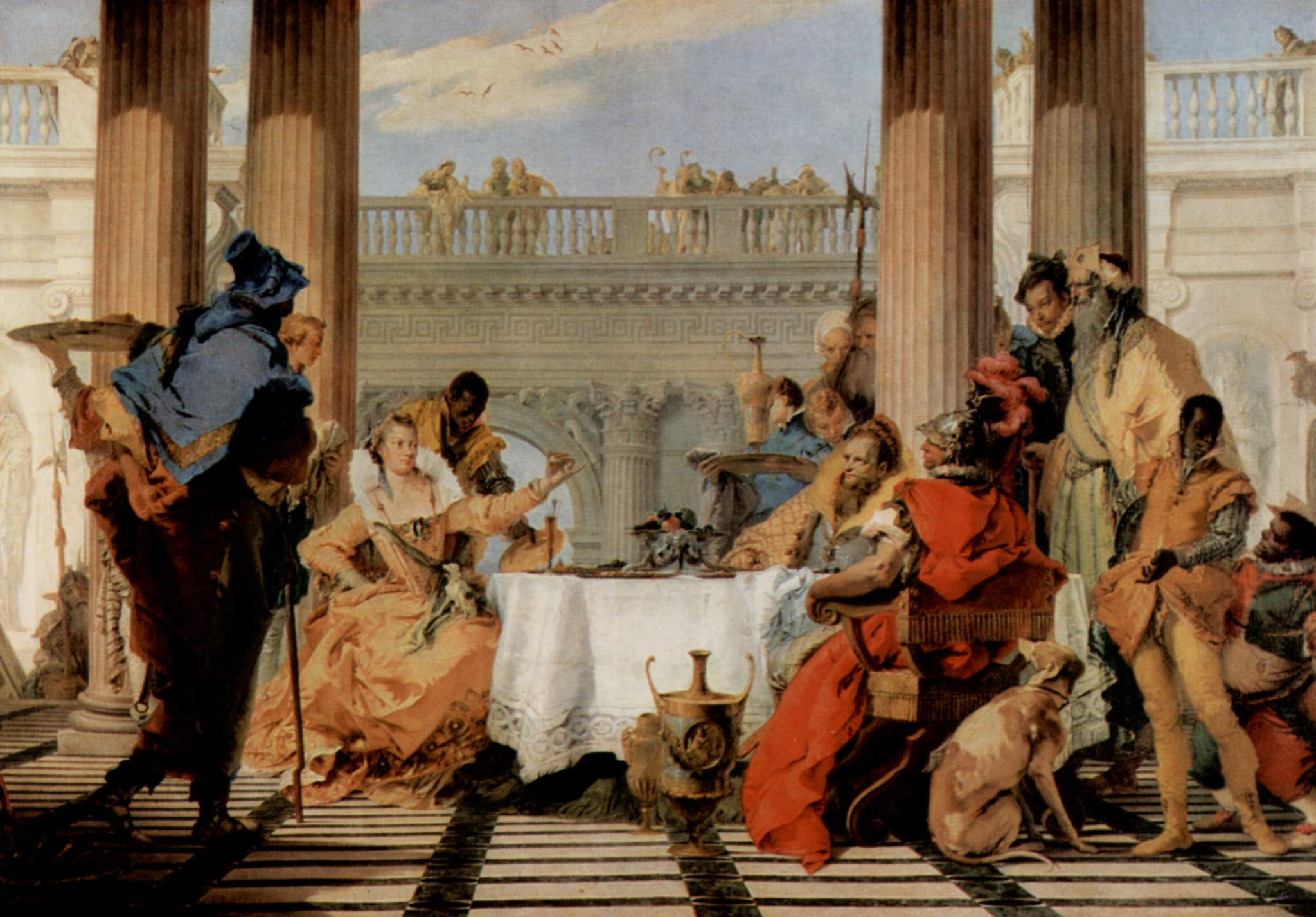
Banquet of Cleopatra by Tiepolo. Fair Use. 


Welcome to my 2022 A to Z! The theme this year is the works of Shakespeare.I hope you all enjoy. 


A is for Antony And Cleopatra, one of Shakespeare’s later plays. It was first performed in 1607, so in the Jacobean era. 


The painting above, by Tiepolo, is right here in Melbourne, in the National Gallery of Victoria. It is connected with a story in which the lovers challenge each other to do the most expensive banquet. Cleopatra won the bet when she dissolved a very valuable pearl in vinegar and drank it. Cheeky! 


Even if you have never seen or read it, you probably know some bits from it. Have you ever heard someone older speak of their “salad days”? It’s right here in this play. You may or may not have heard the speech that begins with “The barge she sat in like a burnished throne burned on the water”, but I bet you have heard “Age cannot wither her, nor custom stale her infinite variety”. I will talk more of this speech in my E entry on Enobarbus. 


It’s about the relationship between Roman General Mark Antony and Cleopatra, Queen of Egypt. Well, mostly. A lot of it is also Roman politics. Antony is lounging around in Egypt with his lover. His wife Fulvia dies offstage early in the play, so not a spoiler. 


He makes some stupid decisions and loses his friends and his final battle and dies. Cleopatra also dies, deliberately letting an asp bite her. Again, not really a spoiler as we have all seen films and read stories about this. It’s just a really great play for speeches, and worth checking out adaptations. 


I’ve seen a few versions. Back in 1972, Charlton Heston directed and starred in a film of it. He wasn’t very good, alas, but he did choose a good supporting cast. There are names like Eric Porter and Julian Glover. The role of Cleopatra was played by Hildegarde Neil, who has done quite a lot over her acting career, and is married to Brian Blessed. I believe some of the sea battle footage was taken from Ben-Hur. Still, not very good.


I saw it on stage many years ago, done in Melbourne by the Bell Shakespeare Company. More of that later in “E is for Enobarbus”. 


Currently I’m viewing the National Theatre production, on the National Theatre At Home app. It’s in modern dress, which is fine. The role of Antony is played by Ralph Fiennes(well known for many roles, including Lord Voldemort in the Harry Potter films) and Cleopatra is Sophie Okenedo, whom I last saw in the Hollow Crown series as the elderly Queen Margaret in Richard III, with Benedict Cumberbatch. Interesting to see her go from old hag to glamorous Queen of Egypt! 


There are some other names of interest. Have you seen Good Omens? (If not, why not? Get Amazon Prime’s free week and binge) Gloria Obianyo, playing Cleopatra’s maid Charmian here, was in Good Omens as a truly dreadful angel, Uriel.  (Though all the angels were awful except Aziraphale and all the demons except his friend Crowley)


Unlike other Shakespeare productions I’ve seen, this one is the whole play, well over three hours, so if anything is missing, it’s probably just as well. 


Anyway, well worth a watch or a read. The 1974 Royal Shakespeare Company production is up on YouTube for free. I haven’t seen it yet, but I believe Patrick Stewart plays Enobarbus. 


Monday, March 28, 2022

A to Z Theme Reveal For 2022

 Time for this year’s A to Z reveal. And this year’s theme is…Shakespeare’s plays! 


Shakespeare - Public Domain


If you have been following this blog for a while, you’ll know I’m a huge fan of the Bard, and have been since I was about twelve, at which age I first read Julius Caesar. I found my sister’s copy, which she had studied in Year 10, and opened it up to read. Next thing I knew I was reading it aloud, declaiming speeches all over the house. I had never before been so excited by anything I had read! 


Then there was Wayne and Schuster’s comic skit, Rinse The Blood Off My Toga. My father and I listened to a recording and quoted bits to each other. I’ll talk more about this further down the track, but meanwhile, you can see the visual version on YouTube if interested, along with other Wayne and Schuster skits. 


I’ll be talking about plays, characters, productions, actors and what films and books have been inspired by Shakespeare.


And, like every year except last year, when I did Greek myths, I will have a hard time thinking of something starting with X.


Oh, well. See you in April.


Sunday, March 27, 2022

If You Want Blog Promo…

 In the last couple of weeks I have had several inquiries about doing reviews of self published books. I don’t usually do that, but I did offer guest posts for all those whose books fitted this blog.


I got one response. I published the guest post a few days ago, as you will know. It was an excellent post which got some impressed comments from you, and I hope will have made some sales for Hans since then. 


I’ve also had inquiries from people whom you would think would have paid attention to the blurb, or at least had a browse through some posts before emailing me. 


I said no. The most recent was from a woman who spent her entire blurb making her book sound like a romance with some adventure,  and not a YA one, which I could have considered. When I explained that it didn’t really fit due to this blog being about children’s, YA, historical, crime fiction and true crime, she said it was so a crime book! That might be so, but if she wanted to draw my attention to that, she should have said so in the first place, instead of all the romance stuff. Which told me she hadn’t checked out the blog, despite saying she had read some posts - I did ask which posts, and she didn’t answer that.


At least she didn’t claim to love my blog as did some of the others. 


So here are some of my suggestions to people inquiring about blog reviews. Firstly, check your market, just as you would a publisher market. If your book is self published, of course, you don’t have to check out publishing markets, but review markets are important too, whether or not your book is traditionally published. (And you will still have to do that, if you sell a book, because publishers are not helpful in that regard as I discovered when my one novel was published). Don’t send your inquiry for a children’s book review to a blog that writes about true crime or movies. 


Well, unless your children’s book is a true crime book, anyway, and even then read some of the posts first; it may still not be suited. 


If there is a contact name, use it; I have had too many inquiries that were obviously one of a hundred inquiries copied and sent everywhere, so I don’t reply to those that don’t use my name. I do understand, but half the time it’s for a book that doesn’t fit here, yet the author claims to love my blog.  


Which leads me to the next issue: absolutely don’t say you love a blog you haven’t read. The lie doesn’t flatter the blogger and just suggests you are using it to get their attention. And you do, but in the wrong way.


Interestingly, nobody who says this in an inquiry has ever answered me when I say, “Really? That’s great! What do you love about my blog? Any particular posts?”


Just a general suggestion to self published authors using marketing companies: be aware that they will charge you quite a lot of money just to send the same email to several hundred blogs, whether or not they suit your book. Better to do that yourself and spend the money on a good quality editor, especially if it’s your first book. And I don’t mean asking your family and friends to be beta readers; they will tell you what you want to hear so as not to hurt your feelings or lose your friendship. (The one time I was a beta reader for a friend, she ignored ALL my suggestions. I was lucky she didn’t take me off her Christmas card list. Never again!)


I do know someone who doesn’t bother with editors for her self published books, but she knows what she is doing, and has sold enough stories in the regular market to be allowed to join the Science Fiction Writers of America. And even so, I remember her sneering at the very idea of doing research for a fantasy novel. Fortunately she mostly writes SF.


Anyway, if you want to be reviewed or guest posted on a blog, and not offended by a reply, please do read the blurb and at least a few posts on the chosen site. 


I hate saying no to an inquiry! And I bet other bloggers do too.