Search This Blog

Wednesday, June 30, 2021

Angela Armstrong: A Guest Post!


Today’s guest post is by Kiwi author Angela Armstrong, who has a new book coming out soon, but who has had to write it under very difficult conditions! I’ll let her tell you herself ,  but I really must take off my hat to someone who didn’t let the pandemic or lack of a proper home deter her from getting the book done. Take it away, Angela! 


In a world like ours, Mystics once ruled the night. Well, so long as they were men.


On Ash’s day of naming, she chose the Mystic path nonetheless. The same illusions that garner gasps of awe from the lamp-lit crowds earn her scorn from the basilica.


There is only one way forward: a perilous quest -- earn the Queen’s Seal, a badge of honour, and immunity.


She’ll simply have to avoid being hanged, burned or drowned first.


Our family began house-sitting as a way to explore New Zealand and different versions of “living a beautiful life.”  Home-schooling and writing, as lifestyle choices, offered us the flexibility, and my kids’ love for animals is never satiated, so we got hooked, hard.  We’d bottle-feed lambs for a week near paradisiacal sounds or walk dogs on picturesque beaches, and enjoy beautiful lodging in return, and then we’d go home to Dunedin.

As time went on, we saw longer house-sit opportunities advertised, and an idea began to take root.  When a year-long house-sit in Northland came up, my husband and I looked at each other and said, “This is it.  It’s time to leave.”  We consulted the kids, and they agreed.  Our family geared up for our next grand adventure – starting over in the winterless North after decades in the deep South. First: to be chosen for The Big Sit.

I flew up first to be interviewed by the house-owners, who had a selection of eager candidates to consider.  I flew back to deliver the news they’d picked us – we could spend a year living rent-free looking for where we wanted to buy our next home, and I could really write this book I’d started! 

That’s how we ended up selling all of our furniture and stacking our material world into a shipping container and saying goodbye to a city we loved.

While the house-owners prepared for their motorcycle trip through Russia, I lamented sliding my beloved manuscript of The Unflinching Ash to the backburner with the promise: I’ll be back.  To sour the pot, the editor I’d been working with from a major publishing house was made redundant in a restructure, and I wasn’t sure if the agent I’d secured since was a great match.  But I’d figure all that out after we were settled in the year-long sit.  I’d work on the book in earnest once I had routines on my side.  Once all the moving was over, I’d secure its publication.  Once everything was some semblance of normal.  (Foreshadowing is impossible these days, isn’t it? Because we all know where this is going).

We began our meandering road trip North, our possessions unloaded and waiting in the garage of our home-to-be.  

But we never moved into that house, because New Zealand locked down, and the exiting home-owners bound for Russia with it.  We found ourselves at the opposite end of the country without a house and without an immediate plan.  Since that fateful day when all was upturned, we’ve moved from temporary accommodation to house-sit, to house-sit, to house-sit.  Then we managed to buy a section, only to see a skills- and supply-shortage lead to our Plan B (Build a Modest Home Earlier Than Planned) sputter and stall. We haven’t even broken ground.  We’re still house-surfing.  The potential for panic like Poppy Nwosu described in her excellent guest post – has been real.

A month or so into riding out this spontaneous contingency wave, I realised The Unflinching Ash was still a draft, still on the backburner, and my agent wasn’t going to the Bologna Book Fair for the first time in decades.  As another guest-poster put it so well, things in publishing were looking grim.

It hit me that I couldn’t wait for the perfect conditions to reclaim writing, and that no one was going to slide this pot back onto the heat but me. That meant I had to make writing work while we were homeless – or gypsies, if you want to go gently with the connotations.  

So I woke early, and I wrote.  I dictated scenes while I did other people’s chores in other people’s homes.  The story I’d sketched in Dunedin was slowly filled in, in other people’s living rooms and in other people’s offices.  I typed at improvised standing desks in an array of kitchens, in libraries all across Northland, in loggias and hallways. I’m typing this guest post now from someone else’s house.  I don’t have a home, let alone an office.  I have surroundings and schedules that constantly change.  But nothing is guaranteed right now, is it? So I’m not waiting. 

Often when people ask, “Do you know where you’ll be next month?”  I answer, “Nope,” or “For some of it.”  But what I can say is: Wherever it is, I’ll be writing.  

The Unflinching Ash (the book I finished as a nomad) is available for pre-order now.  

Multiple formats release 12 July.  

Paperbacks will land on Book Depository and in bookstores soon after.


Tuesday, June 22, 2021

A Student’s Success!

 The other day I had an email from a former student, a member of my lunchtime library book club. She is multi talented - singing, acting, folk dance, figure skating, writing, drawing and more. But she and her mother have no money.


As such, she was eligible for the Western Chances scholarship, a scholarship for bright but disadvantaged teens in the western suburbs of Melbourne. 


When she was in Year 8, I heard her singing on the way to class. The song was the Queen of the Night aria from Mozart’s Magic Flute. Not only did she know the aria, she knew what it was about. I think she must have learned a lot from her mother.


I knew her well, but it hadn’t occurred to me to check if she was eligible. Well, I had, but the office lady, who kept records for kids claiming the Camps and Excursions Fund, for kids with low income families, said she hadn’t applied, so was probably not eligible. But when I asked the girl, she said they had forgotten to apply due to difficult distractions. 


I managed to apply for Western Chances though it was past the deadline, and was given a week to get my application in. I remember inviting her to hit the “send” button. She had no problem getting the scholarship.


Now she is finishing her time at the Victorian College of the Arts secondary school, with classes at NIDA, Australia’s top actor training institute (quite a few big names studied there, including Mel Gibson)and the National Theatre. She asked me if I’d like to go to her final class performance of The Master And Margarita. (The tickets were sold out, but I was able to get one for the streaming performance)


She also thanked me for getting her that scholarship which had helped her do all those things. 


My little student, now a young woman, is going to be an actor! I am so very proud of her. 


She absolutely deserved that scholarship, but nice to be thanked, always. 


One lovely thing about being a teacher is seeing how what you did worked out. And even if the kids don’t go on to be actors or even professionals, when they are happy to see you it tells you that you succeeded. 


If you live in Australia and are interested in seeing the show on line, here is the link. 


https://vcasspresents.5stream.com/?fbclid=IwAR2A38KodyXSrtUwhS0Nh2LpJOr1s8pjdHmPYIEADeciysn4j86IRPmhWtY#/play/72113


I will be talking about the show after I’ve seen it.

Saturday, June 19, 2021

Pyramids by Terry Pratchett: An Anniversary


I have just discovered that this week marks 22 years since the publication of Terry Pratchett’s very funny novel Pyramids. It’s one of his early novels, the seventh in the Discworld series.


Discworld is a flat world on the backs of four enormous elephants standing on the back of an even bigger turtle. The countries on it are based on countries and cities in our world, tweaked. 


If you haven’t yet read anything by Terry Pratchett, you can read this one stand-alone. In fact, it’s the first stand alone novel in the series; three are on the theme of klutzy wizard Rincewind, two begin the Witches series, one is the first of the Death novels. There are a number of other standalone novels following, but they usually have characters who turn up in other books; we don’t meet the hero of this novel, Pteppic, again, nor does the scene return to his kingdom, Djelibeybi, meaning “Child of the Djel”. (Pronounced Jelly Baby, of course).


We do have the Assassins’ Guild, which appears many times in the series, but then so does the city of Ankh-Morpork.


Anyway, you don’t have to have read any of the others to enjoy this book. 


I remember when I first read this, many years ago. It starts with Pteppic, crown Prince of Djelibeybi, the Discworld version of ancient Egypt, completing his final exam at the Assassins Guild in Ankh-Morpork, a very practical exam which is likely to kill you if you fail.


But the Assassins Guild is a sort of British public school, where mostly aristocratic boys(and a few girls) get a very good education which incidentally teaches them how to kill efficiently. And one of the early scenes is a flashback to Pteppic’s first night at the school,  where a shy child gets up out of bed to start performing a detailed, gruesome animal sacrifice, interrupted by the bullies. Pteppic defends him, challenging them as to which of them is “man enough to say his prayers”. Yep, a sendup of Tom Brown’s Schooldays


I was sitting on a bus and everyone nearby must have wondered why I burst out laughing so loudly.


There was plenty more that set me off. Pteppic returns to his kingdom soon after the graduation, as his father has just died. He is now Pharaoh and orders a huge pyramid for his father, so enormous that it warps space and time. Gods start turning up, walking the streets, fighting each other, accompanied by sports commentary. His ancestors all return to life, still in their mummy wrappings, including his father. It’s having fun with all those beliefs about mystical pyramids and the things they can do, eg sharpen razor blades. 


Ptraci, the former king’s favourite handmaiden, insists that Pteppic’s father didn’t want to be buried under a pyramid, but it’s the tradition, as overseen by the vizier, who is more than he seems.


It’s hilarious and only gets funnier as the book goes on - wildly over the top, like Terry Pratchett’s other books.


If you haven’t read Terry Pratchett’s work, do try it out. It’s not just fantasy, it has plenty to say about our world. There are no quests, the only Elves are nasty pieces of work and the only long-lost king is working as a policeman and happy with his job. Each novel pokes fun at something, whether it’s Shakespeare’s plays(Wyrd Sisters and Lords And Ladies), film making(Moving Pictures), Phantom Of The Opera(Maskerade), vampires(Carpe Jugulum) or Christmas(Hogfather). And you care about the characters, something important to me; if I don’t care about the characters, I don’t care about the story. 


If you enjoy audiobooks, the abridged versions are read by the wonderful Tony Robinson, whom you probably know from Blackadder, in which he played the dimwitted Baldrick, but who has, since then, hosted a huge number of enjoyable documentaries about history and archaeology. The full editions are read by Nigel Planer, who has done two of the Discworld telemovies, but if you’re old enough you may remember him as Neil in The Young Ones


If you’re keen to start reading some Pratchett, the novels are all easily available in ebook, print and audiobook, from your favourite book stores and web sites. 


Sunday, June 06, 2021

Memories of My Typewriter

Olivetti typewriter like mine. Fair use.

 On this morning’s Twitter, someone was wondering how “hellish” it must have been to have to use a typewriter. 

I chuckled at this, and a few of us chatted about it. It seems like a good topic for a post.


I did post about my relationship with modern technology here. 

https://suebursztynski.blogspot.com/2013/06/a-baby-boomer-in-age-of-technology.html


But here is what I did before I got my first computer, on which I wrote my very first published book! (I should add that even then I couldn’t email my MS, it had to be printed out, and my entire communication with my editor was by snail mail and phone.)


I started writing as a child, in my sister’s old exercise books. As she had tiny handwriting, there was plenty of space, even on the pages which didn’t have space left at the bottom. Eventually I got a typewriter, an Olivetti Portable, which I still have, though I don’t use it any more. I might still be able to get typewriter ribbons online, perhaps, but it doesn’t work properly any more, even with a new ribbon it looks faded. 


However, that was a wonderful piece of equipment. It’s lighter than a laptop; when I was overseas for a year, I took it with me. I learned to type speedily on it. Just for the record, I had to teach myself, because in those days you couldn’t take typing lessons at school unless you were planning to do that for a living. And that was all girls in those sexist days! My sister, who did do it for a living, told me she had never seen anything so fast done with two fingers. These days, of course, we both do it on computer or iPad.


I started university and my sister organised an office model for me, so I could type my Honours thesis, but in the end she typed most of that and I went on using my “laptop” typewriter. 


Eventually, I won my first writing competition(the Mary Grant Bruce Award for Children’s Literature) and used the prize money to buy an electronic typewriter, which used a daisy wheel and thrilled me because it was able to type a whole line before printing out. And you could change fonts with chosen daisy wheels! I called it Merlin, because it was such a whiz. 


I was on the road to my computer tech days. 


But before that, I typed up my stories and even a novel using a typewriter. And three fanzines. 


Let’s go through the process I used to write my stories in those days. First I would write it in longhand. It wasn’t a good idea to do it any other way, because you can’t correct mistakes with a typewriter except by using correction fluid. Which is a pain and shows up embarrassingly. You can fix typos but it’s not good for editing. 


So, I always carried notebooks or exercise books with me, and on one occasion, when I was lying in bed with a temperature and flu, I wrote a whole novel in longhand. I never typed it up, by the way, let alone submitted it anywhere. It was too awful.


Second draft I typed up, with carbon paper between pages, to make three copies. I didn’t want to risk having only one copy (People did, by the way. There is a story about Aussie writer Tim Winton carrying his only copy of his manuscript of  Cloudstreet at the airport in Paris and dropping it. Luckily for him someone saw and handed it back to him). There were photocopiers, but they weren’t everywhere and they were wet copiers; any copy you made faded with time. 


I used the typing for my editing process. I had to hope that this would be enough, because if it wasn’t, you had to type it all again. All of it! 


And that brings me to my fanzines. I edited four media fanzines before I got my first computer. They were lovely things, with beautiful art work by my fannish friends, but... when there were typos, I had the choice of Liquid Paper or retyping the whole damn page, something I will never have to do again, thankfully. If there were too many typos it had to be the entire page done again, or it would look dreadful. 


When I finally got my first computer, a Mac Classic 2, I rejoiced at the prospect of being able to do my next fanzine much more easily, but I never did another zine, as I sold my first professional book instead. 


When I was submitting stories, I finally had access to proper photo copiers, but not yet the Internet, so it was all snail mail and “don’t worry about returning the MS if you don’t want it, just reply with this postage paid envelope.” 


Oh, yes, I kept a pile of those little international reply coupons you could buy in those days so they could reply without paying postage. I also found a philatelist shop where I could buy foreign stamps. And a packet of large envelopes to send my stories off. 


How times have changed! 


What do you say, gentle readers? Are any of you old enough to remember the humble typewriter? 

Monday, May 31, 2021

The Boy Who Stepped Through Time by Anna Ciddor. Melbourne, Allen and Unwin, 2021


The title of this novel is very suitable. The hero, Perry, literally goes for a walk and ends up in fourth century Roman Gaul. There is a bit more to it than that, but it’s a pretty good description.


Twelve year old Australian boy Perry, in the south of France with his family, is attending a Roman festival in Aix, for which his enthusiastic mother has made costumes. While there, he checks out a display which includes a Roman child’s coffin from the fourth century. Roman children’s coffins included the exact age they were when they died. 


Perry goes for a walk, picks up a Roman stylus and writes on the ground with it and...voila! Back in Roman times, at a villa which was only a ruin last time he looked at it. The master is just returning from the north after a long trip and somehow Perry(Peregrinus in Latin) is mixed up with the new slaves who have returned with the travel party. Not only that, but he can speak and understand Latin. 


Fortunately, the family for whom he is working is quite nice, and he soon makes two friends, Carotus, a fellow slave, and Valentia, the master’s daughter. 


Naturally he spends a lot of the novel trying to work out how he got there and how to get back to his family, but he soon discovers to his horror that the Roman child who died in Aix is someone he knows and cares about. Can he change history before he goes home? 


In the course of the story we are taken through some of the Roman agricultural year and festivals. (Perry agrees the Saturnalia is more fun than Christmas) And there is none of this “don’t step on a butterfly” business. It’s not history when you meet and like the people way back when. Perry works hard to find his way home, but also to save the person who is otherwise doomed to die, by finding out how and where it will happen; thanks to the coffin inscription he already knows when. 


It’s a sweet story, and charming. It’s not an exciting adventure, but not meant to be. There is no villain, which makes that easier.


It rather reminds me of her other two most recent novels, in which not a lot happens, but we learn a bit of history and culture, very  entertainingly. Somehow it works.


And once again, Anna Ciddor shows her artist skills with the internal illustrations.


The author has done her research, but doesn’t shove it in your face. In fact, her sister, a historian who knows a lot about the era, helped with the research, as did another sister and a nephew. Oh, my goodness, how much work those researchers did! 


Well worth a read, for children from about 9-13.


Check out this link from the author’s web site to see what children think of it so far. Hopefully it should be available soon outside Australia.


https://annaciddor.com/books-by-anna-ciddor/the-boy-who-stepped-through-time/

Balticon #55 - A Virtual And Free Science Fiction Convention


Over the last year, one silver lining to the lockdowns has been the ability to attend science fiction conventions on-line via Zoom or YouTube. I know, the social aspect has been cut back to chatting on line, and the joy of meeting new people and having room parties is not there. But if you want to learn new stuff and hear favourite writers and artists you can still do that, and I have to say I have learned a lot from experts in various subjects. Plus I can leave if the panel isn’t what I had in mind, without offending anyone.


I’ve attended, on line, Worldcon, World Fantasy Con, NASFIC, and others. I couldn’t have done that face to face, due to family commitments. And some were free. Those that weren’t gave attendees lots of books to enjoy and vote on. I’ve joined this year’s Worldcon, even though I can’t go and it’s face to face, because the Hugo Award packet alone is worth the price of membership and I can vote. 


This weekend I have been attending yet another virtual con, Balticon, which is free. 


I have only seen a couple of panels so far, but nearly everything is being recorded and put up on YouTube, so not hard to catch up. Just type “Balticon” into YouTube to find it, and as a bonus you will find panels from other years, which is nice, because the recorded panels of most of the virtual cons we have been enjoying over the last year have been up for about a month on average. This year’s Balticon is #55. You don’t have to join, just wander over to the website to see what is on, or go straight to YouTube, probably best as the con will be over now. The Guest of Honour is Seanan McGuire, author of the October Daye urban fantasy series and many others. Seanan was here in Melbourne for a convention a few years ago. She has cats, which get mentioned on her Twitter account. 


The panel on which I saw her over the weekend, was about bad movie adaptations. It was interesting to hear what the panellists thought were bad(nobody mentioned The Dark Is Rising, a British classic which was completely ruined by being Americanised). But one question which stuck in my mind was “Would you agree to having your books turned into films?” All of the panellists said hell, yeah! Seanan argued that even a film that gets a lot of bad reviews and drops out of sight can make the author of the original book much more money than normal income. I do remember her, at the Melbourne event, saying that even as a full time writer she was not well off and couldn’t afford to pay health insurance, something necessary in the US, where there is no universal health cover. 


I’m off to watch some more panels. See you on YouTube! 

Tuesday, May 18, 2021

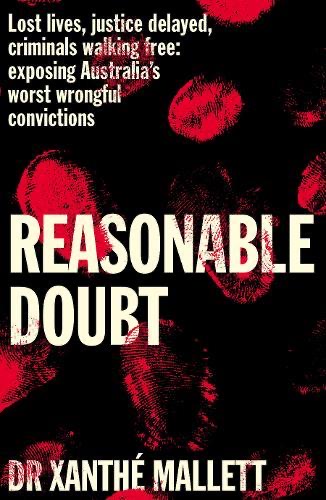
Reasonable Doubt by Dr Xanthe Mallett. Sydney: Pan Macmillan, 2020


 We all put our faith in the criminal justice system. We trust the professionals: the police, the lawyers, the judges, the expert witnesses. But what happens when the process lets us down and the wrong person ends up in jail?


Henry Keogh spent almost twenty years locked away for a murder that never even happened. Khalid Baker was imprisoned for the death of a man his best friend has openly admitted to causing. And the exposure of 'Lawyer X' Nicola Gobbo's double-dealing could lead to some of Australia's most notorious convictions being overturned.


Dr Xanthe Mallett is a forensic anthropologist who has written a number of books on the subject of crime.


This time, the theme is what happens when forensic scientists and other experts get it wrong, so that innocent people are convicted, often spending years in prison before being freed when the error is picked up - if it ever is. 


If you are Australian, you will certainly have heard of one case not  covered in this book, but which is a good example: Lindy Chamberlain. She was the woman whose baby was carried off by a dingo while the family was camping. The forensics team found her guilty of killing her own child in the car. That area of forensics was not very good at the time and they came to the wrong conclusion. It was several years before the baby’s matinee jacket was found and she was exonerated. 


The cases covered in this book make me wonder if we can rely on those who are supposed to work out what happened using science. I have, in fact, recently read an article that says there is now an argument going on among forensic specialists about whether “shaken baby syndrome” is a thing. Forensics will hopefully improve, but the cases in this book were mishandled because the experts stuffed up. If you are a jury member and an expert witness gets up to explain why the defendant is guilty, you think, well, he knows what he is talking about...


The final chapter of the book deals not with a victim of miscarriage of justice but with someone who has been responsible for many herself.


For many years Nicola Gobbo, known as Lawyer X, was both representing some of the most notorious members of Melbourne’s crime community, during the gangland wars, and using what she had learned to inform against them. Not only that but she also used information from the police taskforce to help her clients. 


  “Conflict of interest” is a major understatement!


   As a result of all this coming to light, hundreds of convicted people will have the opportunity to claim miscarriage of justice and some will be released. 


What a mess! 


Dr Mallett concludes that on the whole the system works, despite all the cases covered in the book, but urges any readers who might find themselves on a jury not to be blinded by science or powerful expert testimony, which can, after all, go horribly wrong, and has. 


Each chapter has a useful section in which an expert in that area explains how it works. 


A fascinating true crime book that shows the other side of crime - when convictions go wrong. Highly recommended.


You can buy this book on all the usual websites, including Amazon, Booktopia and Book Depository. It’s available both in print and ebook, both Kindle and ePub.


Cuckoo’s Flight by Wendy Orr. Melbourne: Allen And Unwin, 2021


 If she had stayed to load the kiln as she should have, she’d never have seen the ship. Mama said the ship still would have been there, so everything had to happen the way it did. But that’s not true. Clio saw it, and the world changed.


When a raiders’ ship appears off the coast, the goddess demands an unthinkable price to save the town – and Clio’s grandmother creates a sacred statue to save Clio’s life.But Clio is torn between the demands of guarding the statue and caring for her beloved horses. Disabled in an accident, she must try to put aside her own grief at no longer being able to ride – and in the process, save a friend’s life and stop a war.


Here is the third of Wendy Orr’s ancient Crete novels. The first, Dragonfly Song,  was about Aissa, a girl who travels to Crete to become a bull dancer. The heroine of the second was Leira, a girl who fled her island, Thera, to escape a volcanic eruption that was bigger than Krakatoa’s. 


In this third volume, the heroine is Leira’s granddaughter, the daughter of a potter and her Trojan husband. Clio has an injury that makes it no longer possible for her to ride her beloved horse Grey Girl, but her father is building her a chariot. 


Clio sees raiders in the bay. There is time for the townsfolk to prepare to defend themselves, unlike in Dragonfly Song, but the Lady(priestess of the mother goddess) of the town, announces that they may have to choose a girl for sacrifice, so grandmother Leira prepares a perfect priestess figurine as an alternative, one which must be preserved until the final decision is made. She dies, but in the course of the novel we learn about all the good things she has done over the years, since we last met her as a girl in Swallow’s Dance


Clio is a worthy granddaughter to Leira. Despite all her problems, she is willing to help a refugee girl who is being badly treated by her brother - who also has reasons for being the way he is. 


Each of the books in this series has just a touch of fantasy, and it’s nice to see a throwaway mention of Troy, presumably the Trojan War. Clio’s father Hector is definitely one of Homer’s “horse taming Trojans.” It doesn’t matter, because the book is aimed at children, who have probably never heard of Homer, but some will look it up, others will simply find out about it later.  


There are no kings or princesses in this book, just a peaceful small town daily life with ordinary people who suddenly have to prepare for war. 


It’s also the most personal of the trilogy, as the author, too, has had an injury preventing her from riding. 


A nice ending to the series! 


I’m not sure when it will be available outside Australia, but it’s worth checking the usual sites to pre order. 


Although each novel stands alone, it’s also worth reading the first two. Why not do that if you have to wait for the new one?


Recommended, especially for children from about 9 to 12.


Friday, April 30, 2021

A To Z Challenge 2021 - Reflections


Public Domain

So, yet another month of A to Z has passed! As usual, I chose a topic of which I knew something already, and it worked, I think. This is a subject that fascinated me when I first discovered it as a child in primary school.


Oddly, the first one I can remember is the story of Achilles being dipped in the river and his mother missing the heel. But I did read the whole Robert Graves book from cover to cover.


Again, I have only visited the sites of people who visited me. I would have liked to discover some more and will try next year, but I have made some new friends here, whom I am now following, and had visits from old ones, which is nice. 


It’s a fun activity and makes me write something every day, even if it’s not something I can sell.


I do try to choose a topic each year that connects in some way with my book blog. I think Greek myths worked in that respect. 


No idea, yet, what next year’s theme will be, but that will continue. 


Thank you to everyone who visited and commented! You were much appreciated. For those who are now following, I will see you soon, as I have a few reviews to do. 


Fair Use


Just one sad thing to share. A lady called Valerie Parv has passed away. I only met her once or twice, but we did correspond for a while. She was Australia’s best known romance writer, and someone pointed out on social media that she had sold literally millions of books (in fact, 34,000,000), which would put her on a bestseller list if it was anything but romance fiction. She did receive an Order of Australia. Personally, I don’t read romance except for books of other genres with romance in them,  but I admire anyone who can do it. It’s not a skill I possess, alas! I had a pen pal who wrote for Mills And Boon, who told me that any new book would stay  on bookshop shelves for a month and no more. You have just that much time to woo new readers.


I knew Valerie before she became a big name, back when she was a Star Trek fan writer. Who knew then that she would do so well? 


Vale, Valerie! 

Thursday, April 29, 2021

A To Z Blogging Challenge - Z Is For Zeus

Zeus. Public Domain


 What we know most about Zeus is all those women he seduced or raped. It’s hard to see how he found time to run the universe in between all those amorous adventures(not all of them even in human shape), but he did. 


In the opening episode of the TV series Hercules: The Legendary Journeys, he appears, holding his newborn son and, smiling, assuring him that one day he will learn the pleasures of women and have a great time. That role was played by Anthony Quinn, not the majestic Zeus we usually imagine, but certainly getting across Zeus the womaniser.


A number of other actors have played the role in films, of course. Liam Neeson played the role in the 2010 Clash Of The Titans, with Laurence Olivier in the Ray Harryhausen film. Sean Bean played the role in Percy Jackson And The Lightning Thief. Even Rip Torn got to play Zeus, in the animated Hercules film.


Usually he is presented as a dignified figure, with a long white beard and long hair - think Laurence Olivier. I believe that the later images of Jesus are based on the image of Zeus; the Byzantine Jesus is very different. 


To be honest, though, I don’t see him as remotely dignified. He is always at it, with chasing women, and having to make sure nobody can overthrow him, for which I don’t blame him, as he overthrew his own father, Cronos, who had done nasty things to Uranus, his father.


In Offenbach’s Orpheus In The Underworld, the gods of Olympus laugh at Jupiter(Zeus) for all his affairs, after he has taken Pluton(Hades) to task for his.


After escaping being swallowed by Cronos and being nursed and cared for by some nymphs(one of them a goat, whose horn became the Horn of Plenty), Zeus grows up on Mount Ida, among the shepherds. Armed by his mother, Rhea, with the appropriate emetic, he makes Cronos vomit up his siblings and leads them in revolt, before taking up his position as king of the gods on Olympus. 


Zeus in his chariot. Public Domain


After that, it’s one woman after another, with Hera pursuing her rivals to make their lives miserable. Pretty much every myth I can think of about him, after that rebellion, involves a woman(or, in some cases, a boy). A randy god indeed! Thinking about it, it’s surprising the world isn’t filled with demigods! 


Someone said that a lot of us are related to Genghis Khan; if the Greek myths are true, we can probably add Zeus as a relative.


What do you think? Would you like to be a Zeus descendant? 


And here we will end, except tomorrow’s summary of this year’s A to Z. I hope you have enjoyed reading this as much as I have enjoyed writing it.


Wednesday, April 28, 2021

A To Z Blogging Challenge 2021 - Y Is For Youth

 Today’s brief post will be about the youth of some characters in Greek mythology. We read so much about their adventures as adults, but not much about their childhood, a shame, because there are some interesting childhoods there.


Hera was the enemy of Heracles from his birth onwards, but was tricked into suckling the baby once. Heracles was such a big strong boy that he sucked rather too greedily and Hera, in pain, she pulled her breast out of his mouth. The milk splattered over the sky and became the Milky Way. That’s one of the imaginative ways that Greek myths explain the universe.


Baby Heracles strangles a snake. Public Domain


A few months later, Hera sent a couple of snakes to kill him. As they slithered into his crib, his mortal twin Iphicles screamed in terror, but when Amphitryon, the father of Iphicles, rushed in, armed with the sword he had grabbed up to defend the children, he found little Heracles,  Zeus’s boy, chuckling and waving the strangled snakes. Take that, Hera! 


Hermes has one of the more entertaining childhood stories. He is born in a cave to a nymph called Maia. She wraps him in swaddling clothes and lays him down to sleep. 


Little Hermes gets bored very quickly and grows into a little boy, so he can go out and have adventures. Outside he wanders off and steals the cattle of Apollo. Taking them away, he confuses any pursuit by wrapping their hooves in bark.


Apollo is indeed confused, but eventually tracks down the thief, who, however, is back in his swaddling clothes, looking innocent and pretending to be asleep. 


However, Apollo wakes Maia, who has been lulled to sleep by her son’s new invention, the lyre, and demands she do something about her naughty son. She can’t believe it, so Apollo takes him to Olympus and complains. 


Hermes admits the theft, but says he only slaughtered two of the cattle and sacrificed them to all the gods. He used the guts to make the lyre. He agrees to take Apollo to where the cows are hidden, inventing shepherds’ pipes on the way. Delighted with both instruments, Apollo offers to swap the cattle for the lyre and his golden staff for the pipes. That’s why you see Apollo as the god of music and Hermes as the patron of heralds. But the instruments were invented by a cheeky little boy.


Apollo and Artemis were born to the goddess Leto, on a floating island, as Hera had made it impossible for her to give birth on land or in water. As soon as she was born, Artemis was helping her mother to give birth to Apollo. The children defended their mother from the giant snake threatening her. 


As a three year old, she asked Zeus, her father, for a long list of gifts, mainly involving hunting gear and attendants to look after her hounds and goods. The attendants were to be nymphs of her own age. When he had agreed, she went away to organise it. 


Because of her help with her mother’s childbirth, she knew already that she would be the patroness of childbirth, despite the fact that she had no intention of ever having her own children.


Other gods, of course, were grown-up from the start. Athene sprang fully-armed from Zeus’s head. Like Artemis, she was a girl who knew exactly what she wanted! 


See you tomorrow, when Z is for Zeus! 


Tuesday, April 27, 2021

A to Z Blogging Challenge 2021 - X Is For Xanthus


Xanthus and Balius. Public Domain


Today’s mythological characters aren’t human or even human-shaped. They are Xanthus and Balius, a couple of horses, immortal ones. In Greek myth, it doesn’t seem to take a horse shaped being to make a horse shaped child. In this case, the mother was the harpy Podarge; harpies tend to be bird-women. The father was Zephyrus, the West Wind. Winds were sometimes depicted as winged men, sometimes as horses, which may explain the horse children. Anyway, I can definitely see the appeal of a horse that is literally a son of the wind! 


But Xanthus and Balius were, in the end, horses, even if they were immortal. They didn’t even talk, except Xanthus, on one very special occasion. 


Poseidon, who had a connection with horses, as the god of horses, trained these two and gave them to Peleus as a wedding gift at that fateful wedding when Eris, goddess of strife, started the Trojan War at second hand. 


Later, Peleus gave these two beautiful animals to his son Achilles, who took them to the war with him, to pull his chariot. They would have been kept idle for a while when Achilles went on strike. 


However, when Achilles’ lover and best friend, Patroclus, decided to fight in his place, they were hitched up and driven into battle again, till Patroclus got himself killed. 


After this, Achilles hitches them up, but tells off his horses for having let Patroclus down. This is when Hera gives Xanthus a voice, even temporarily, and the horse says it wasn’t their fault, that it was a god who killed Patroclus and by the way, Achilles hasn’t much longer to live. Then an Erinye shuts Xanthus up.


It would have been Xanthus and Balius pulling the chariot when Achilles tied the body of Hector to the tail of his chariot. 


Achilles didn’t live much longer, as predicted, and the horses mourned him till his son, Neoptolemus, arrived to drive them. 


I’m uncertain what happened to them next. If they were indeed immortal, perhaps they are still around somewhere, thinking how different the world is now. 


Tomorrow I’ll muse a little about the youth of some of the characters we have met. See you then!