Search This Blog

Thursday, August 31, 2023

Honey And The Valley Of Horses by Wendy Orr. Melbourne: Allen And Unwin, 2023


 Honey and her family pack up their converted ice cream van with food and clothes, and head off for an adventure during a bad time(I suspect it’s during the pandemic, though COVID isn’t mentioned). They find themselves in a valley occupied by a herd of sentient magical horses. They know an ancestor was there and returned after seven years, but can’t find a way out; the trail to and from the river and a bridge which they crossed to get in have both vanished. 


Now seven years have passed. The family have managed well, and the two children, Honey and her little brother Rumi, have grown. The family have been adopted by individual horses in the herd. But Papa is very sick and needs help from outside the valley…


This is a gentle story about family - and the family includes the horses, which protect Honey, her parents and grandmother and her little brother. The humans ride only when the horses invite them. The family has learned not only to grow food from seeds of the fruit and vegetables they brought with them and renew clothes, they have created their own culture of story telling around the fire at night. The ice cream van has become their home.  


The magical paradise in which they live is Australian, with native Australian animals and plants, except for the horses, which are descended from a horse brought by the ancestor and a mysterious mare who was there when they arrived. 


The story was inspired by her parents, who loved camping and preparing for long journeys and converted a boat into a home in their eighties, and by wondering how children raised in the pandemic would cope with going back into the world. That was inspired by her own family’s experiences during the pandemic.


It’s a good read for middle school children like the horse-loving girl I was at that age, and definitely recommended! 


Thank you to Allen And Unwin for this copy.


Available on Australian web sites, including ebooks. The book should be available outside of Australia soon, so keep an eye out! While you wait, check out Wendy Orr’s other books, which are right there on Amazon. The award winning Ancient Greek trilogy is very special.


Friday, June 30, 2023

Crows Nest by Nikki Mottram. St Lucia, Queensland, University of Queensland Press, 2023


 Child protection worker Dana Gibson has had marriage issues after the loss of her own child, and leaves Sydney for a job in Queensland regional town Toowoomba. She visits nearby Crows Nest to assess the children of Sandra Kirby. Soon after, Sandra and her friend Debbie are shot dead in Sandra’s car late at night. Potential killers all seem to have alibis. The police declare it a murder suicide and close the case, but to Dana it doesn’t make sense. She continues to investigate, despite getting into trouble at work over it.There are people who would rather she didn’t…


The novel is set in 1996, mentioning the Port Arthur massacre in the first chapter. 


I enjoyed this novel very much. Dana is someone you can cheer for, though she has many woes. This is the first of a series, so hopefully she will have developed past her troubles by the next novel. There is also a delightful child, Angus, who looks set to be her assistant sleuth in future books; he does pretty well in this one, coming up with ideas Dana hasn’t thought of.


I’m looking forward to future books in this series. It’s a fine debut novel for the author, who is herself a child protection worker. 


Thanks to the publisher University of Queensland Press and Victorian Sisters In Crime for sending me this! 


It’s now available from all good bookshops and websites. 


Tuesday, June 27, 2023

Books And Films Featuring Shakespeare As A Character!

 I’ve been rewatching the wonderful Upstart Crow by Ben Elton. It’s a sitcom about Shakespeare. That made me think of all the Shakespeare-related work I have come across over the years - books, films, plays and more. So, let me have a waffle!


One play, by Aussie playwright David Williamson, is Dead White Males, set in academia, in which Shakespeare pops up several  times. In the very first scene, a University academic shoots him down. He does, however, turn up again and there are scenes taken from his plays, which the play’s main characters perform. I know it sounds over the top, but it was very funny and entertaining. 


Shakespeare appears briefly in the Blackadder New Year’s Eve special. A time travelling Blackadder punches him in defence of all the schoolkids who will suffer through his plays. When he returns to the present, Shakespeare is known as the guy who invented the ballpoint pen.


Upstart Crow was written to commemorate the anniversary of Shakespeare’s death. Each episode is centred around one of his plays. It’s especially funny because Ben Elton has a poke at such things as “words created by Shakespeare”; this Shakespeare claims a whole lot of words and sayings he never did create, despite being told he didn’t. Elton also has fun with the entire “Shakespeare didn’t write his plays” thing. In fact, not only does Elton’s Shakespeare write all his plays, he also writes Marlowe’s plays! Kit Marlowe doesn’t write anything, but he does like to be known as a playwright and is always nagging Shakespeare to let him have plays to claim. Sometimes he succeeds…


My favourite book with Shakespeare in it is Harry Turtledove’s alternative universe novel Ruled Britannia, in which the Spanish Armada succeeded in conquering England. It’s seen from two viewpoints, Shakespeare and Lope Da Vega, a real Spanish playwright who actually wrote a lot more than Shakespeare - and was in the Spanish Armada, but never got as far as England in our world. Lope Da Vega is a lieutenant in the Spanish forces but still writing his plays for the entertainment of the Spanish occupiers, but he speaks English, so loves going to the theatre and is a huge fan of Shakespeare. Shakespeare has been commissioned to write a play about King Phillip - and another one he has to keep secret, because it’s to be used after Phillip’s death to inspire rebellion. 


If you get curious about Lope Da Vega, a few of his plays have been translated into English; I found a couple in Apple Books.


Of course, you have probably seen Shakespeare In Love, or at least heard of it. It’s a gentle comedy which starts with Shakespeare having writer’s block while trying to write his play Romeo And Ethel The Pirate’s Daughter. He is inspired by a young woman called Viola, and the film ends with a shipwreck like the one in Twelfth Night.


More recently, there was All Is True, with some big names - Kenneth Branagh, Judi Dench as Shakespeare’s wife Anne and Ian McKellen as the Earl of Southampton. Shakespeare’s theatre has burned down. He has returned to Stratford and his family, vowing never to write again. But the family has its own issues, given how little time he has spent at home over the years. In fact, there is an in joke about that second best bed he left Anne in his will. When he comes home, she makes him sleep in the guest bed(the best), suited to a guest. Later, when that problem is solved, he leaves her the second best bed as their own personal in joke.


Both his daughters have problems of their own and there is still a secret about his son’s death. However, by the end, the worst is over and his wife is learning to read.


It’s a lovely film, well worth a watch.


Shakespeare appears in some children’s books too. Susan Cooper, author of the magnificent Dark Is Rising series, also wrote a lovely novel called King Of Shadows. In it, a teenage American boy in England for a boys’ acting tour in which he is playing Puck, finds himself in Elizabeth’s England, playing Puck to Shakespeare’s Oberon. Shakespeare has lost his son, Hamnet, and Nat, the hero, is an orphan, so they have a father-son relationship. Susan Cooper had a good reason for making her hero American; he comes from North Carolina, where there is a place where people still speak with accents from Elizabethan England. 


Cue For Treason by Geoffrey Trease, features a girl disguised as a boy working as a boy actor in Shakespeare’s company. He figures her out pretty quickly, but doesn’t give her away. It’s well and truly out of print, alas, like most of Geoffrey Trease’s books, but you can get it in audiobook, read by the wonderful Clive Mantle, who played Little John in Robin Of Sherwood


Can you think of another book or film with Shakespeare in it? 

Saturday, May 20, 2023

A Message Through Time by Anna Ciddor. Melbourne: Allen And Unwin, 2023


Australian boy Felix and his older stepsister Zoe have been on holiday in France, in the city of Arles. In the last hour or so before departure, Felix finds a Roman stylus, with a message in a bottle giving instructions for time travel, writing the Latin word “Ave” to travel into the past and “Vale” to return. Of course, he can’t resist and they find themselves in Roman Arles, or Arelate, in the time of Emperor Constantine. There they accidentally pick up a Roman girl, Petronia, whom they show around briefly before taking her back to her own time, where they may be stuck…


If you have read the novel The Boy Who Stepped Through Time by the same author this will be familiar, but you don’t need to have read it to enjoy this, though there is a guest appearance by a character from that novel. 


The novel is a lot of fun, with culture clash mixed into the adventure. Petronia’s attitude to modern times is hilarious(though she is impressed by public playgrounds). When the three young people return to Roman times the culture clash is even more over-the-top, with food, medicine and customs bizarre to the two modern children, but quite normal to their hostess. Like the previous novel, it is well researched with the help of the author’s sister, an expert in this era. The author has also done the very good internal artwork. 


They take a trip on a barge along the river Rhone to reach Petronia’s family, and from here things start going wrong for  Felix, but he can’t tell Zoe.


The adventure does bring them closer, though.


I enjoy time-slip stories and this one is an excellent example of its type. 


Perry, hero of The Boy Who Stepped Through Time, has to live in this era by himself and work out how to get home while Felix and Zoe have each other and know what to do - the problem is a very different one. 


But anyone who enjoyed the first novel in this universe will certainly enjoy this one. 


I recommend it for ages 9-12, late primary school to early secondary. 


Available in both ebook and print, along with the rest of her fiction, at all good web sites in Australia, or order from your local bookshop. If you live outside Australia you might have to find out when it’s available in your country. Right now, it’s only available here, sorry!  But you can get her other books, including The Boy Who Stepped Through Time, on overseas sites, including Amazon, both print and Kindle.


Thank you, Allen and Unwin, for sending me a copy of this novel! 


Tuesday, May 02, 2023

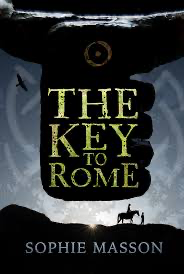
The Key To Rome by Sophie Masson. Armidale, NSW: Eagle Books, 2023


The year is 84 CE, the place is the Roman province of Britannia. The rebellion of Boudicca is within living memory for many adults. 


Twelve year old Livia, daughter of an eye doctor, is now an orphan. She has promised her dying father to take a mysterious key to her uncle Marcus, who was estranged from her father, but will know what to do with it. Livia has nothing now but her old horse Pegasus, her father’s doctoring kit, which she knows how to use - and the key. When her uncle is not at home, she travels further, to the home of someone who might know where Marcus is.  Her uncle is not there either, and she is advised to go back to his home,  but a British slave boy, Mato, offers to help her if she will take him with her. There is more to this story than Livia had believed. She and her new friend will have to solve the mystery before disaster strikes.


Here is another one of the talented Sophie Masson’s exciting historical adventures. Many of them have fantasy elements but this is a straight historical mystery, well researched and with a useful historical background and glossary at the back. 


The cover art and internals, including a map, are drawn by Lorena Carrington, a gifted Aussie artist who has worked with Sophie Masson before. 


Livia is a strong leading character who refuses to give up, even when the quest for her uncle looks as if it might be useless. She weaves together the clues to lead her in the right direction. 


This novel, aimed at ages about nine to twelve, reads like a Rosemary Sutcliff adventure, perfect for young readers who enjoy history and are inspired by strong characters their own age. It’s also not a bad place to start children on historical fiction.


Christmas Press, of which Eagle Books is an imprint, is an Australian small press which has been doing very well. For now, though, The Key To Rome will only be available in Australia. Dymock’s Bookshop already has copies, as does Amazon Australia, but it’s just as simple to ask your bookshop to get it in.


If you haven’t yet discovered Sophie Masson’s wonderful work, you can get it outside Australia in the usual good websites. 


A To Z Challenge 2023: Myth And Folk Tales In Fiction - Some After Thoughts

This year’s Challenge badge!

So, another A to Z has come and gone. Every year I think I won’t come up with a theme, and then I do, and get passionately involved. The same has happened this year. 

I really enjoyed talking about some of my favourite books and others I have only discovered recently. I haven’t done much this year about the actual registration stuff apart from join the official page. It gets exhausting to do much more than that; in previous years I have gone to the Challenge website every day and slotted in a new piece of information, found interesting blog sites to visit and put a link to whatever was my daily post so people I visited and their visitors might wander over. It just got to be too much; the only sites I have visited were those who visited me, and I’m a bit behind even in those. I will be catching up and finally getting around to reading those posts I have promised myself.


 But I’m glad I had a go at writing something every day. And the theme was a good one - yes? Just writing about it reminded me of how many books, short stories and films have myths or folk tales in their backgrounds. It’s all part of our cultures, reminding us where we come from.


I have a review to write, so I will keep this short, but thank you to all those lovely people who have visited and commented, whether you were taking part this year or not. I couldn’t have done it without knowing you were reading and enjoying.


Cheers!

Sue

Monday, May 01, 2023

A To Z Challenge 2023: Myth and Folk Tale in Fiction - Z Is For Zoology!

Z is for Zoology, or, fantastical critters in fiction.


For the last post in this series, we will check out some of the unusual folk lore of mythical creatures to be found in fiction.


We’ll start with unicorns, those virgin-hunters who can be trapped by a pure maiden. Not necessarily a young girl - in Terry Pratchett’s Lords And Ladies, the elderly witch Granny Weatherwax is able to force the unicorn to come with her to be shod.


Unicorns vary from book to book. The unicorns in the Harry Potter books are the kind we think about first when we think of that word. They are beautiful, innocent beings which have blood that will bring you back from the brink of death, but which curses you because how dare you kill something so innocent and pure! They do prefer “the woman’s touch”, so Professor Grubbly-Plank, covering Hagrid’s class, gets the girls to come to the front.


On the other hand, there are the dangerous ones. The one in Lords And Ladies is running around the kingdom killing people on behalf of the evil Fairy Queen. 


In Ben Aaronovitch’s Rivers Of London novel, Broken Homes, the paranormal police Constable Peter Grant is investigating a case in the countryside when he encounters a unicorn which is huge, totally crazy and carnivorous. The fairies are around too, and they are not nice either. The unicorn is definitely not sweet, innocent or pure. It kills!  I do recommend this series, by the way, it’s funny and touching and - did I say it was funny? 


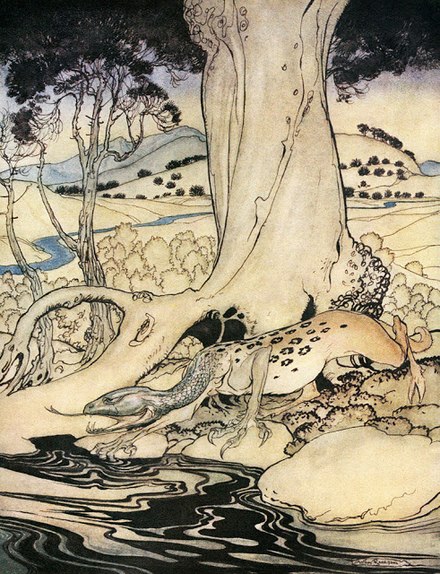
Arthur Rackham, Questing Beast: public Domain


We first meet the Questing Beast, or “beast Glatisant”,  in Malory’s Morte D’Arthure. Well, it’s where I first met it, anyway! It has the head and neck of a snake, the body of a leopard, haunches of a lion and feet of a hart. It makes a sound like “thirty couple of hounds questing.” I believe it’s to be found in a lot of Arthurian literature. In Malory, it’s the beast traditionally hunted by the family of King Pellinore. I assume they never catch it. It does eventually get caught, in Malory, by the Saracen knight Palomides. 


T.H White writes it into his Arthurian novel The Once And Future King. In that novel, Pellinore is a comical character who isn’t really trying to kill the Beast; he just collects its fewmets(hard droppings). They have a relationship - the Questing Beast enjoys the hunt. 


The Beast appeared in an episode of Lost In Space, along with a knight chasing it. When the knight finds out the Beast is female, he doesn’t want to continue, so the Beast, feeling sorry for him, teases him into hunting her again. 


Dragons appear in so much fantasy fiction, it’s just too much for this post, so I will just note a few. 


As you may know, dragons are different in the east and the west. In Asia, they are benign water beings which are respected. The only Asian dragon novel I have read is Tea With The Black Dragon by R.A MacAvoy. The Black Dragon of the title, Maryland Long, is in human shape for reasons explained later in the novel. He is a distinguished Chinese gentleman who works with the heroine, Martha Macnamara, a middle-aged woman who is a folk musician to find her daughter, who has gone missing. It’s a lovely, charming novel,well worth a read.


And then there are the other kind of dragons. You know - the fire breathing Western dragons. In tradition, they are not benign animals. They are connected to the devil. When St George kills the dragon and rescues the maiden, he is saving the Church. There are dragons which are symbols, such as the red and white dragons seen fighting in the story of young Merlin, which symbolise the British(red) and the Saxons(white). 


Those do turn up in Arthurian fiction. 


Terry Pratchett has dragons that only stay solid if you believe in them, in his first Discworld novel The Colour Of Magic. It’s not a good idea to stop believing while you are riding one in flight…


Mostly, though, there are the little swamp dragons, which are so fragile they can and often do, explode. They first appear in Guards!Guards!, the first novel in the City Watch series which features policeman Sam Vimes. Someone has been calling up a “noble dragon”, a much bigger variety which no longer lives on Discworld. It turns out not to be a good idea at all, as the dragon can’t be controlled. Sam visits Lady Sibyl Ramkin, who breeds, shows and sells swamp dragons. By the second novel, Sam marries her.


It’s a very funny story and be careful not to be drinking tea when reading it, as the laughs start on the first page. 


The Gorgon is a being from Greek mythology we are all familiar with. She was a beautiful woman turned into a hideous creature with snakes for hair, turning people into stone if they come near. In the end, she is killed in her cave by Perseus, while minding her own business and asleep. It’s not even to protect a community, just to  achieve a quest Perseus has been set by an evil king who wants to marry his mother and is getting him out if the way.


I have just started on a collection of Tanith Lee short stories The Gorgon: And Other Beastly Tales. The book’s title tells you all. Each story is about a fantastical being. The title story has a meeting on a Greek island with a mysterious masked woman. The reason for the cover up is not quite what you might think, but at the end, the narrator, a professional writer, does feel he has been turned to stone if not in the way you would expect from a Gorgon. I bought this in Apple Books, where it’s cheap.


In the anthology Mythic Resonance(in which I have a story) there is a story called “Through These Eyes I See” which is a twist on the story of Medusa. Mandy is a girl, living with her parents, who has a gift of healing - her look heals, not turns to stone. She has a room full of mirrors, which protect her, not those who come for healing. She is being used; the gift doesn’t help her. The book is available in Apple Books. 


Australian author Simon Haynes wrote a very short piece in which, in modern times, the Gorgon has become a sculptress who takes men home and… well, you can guess what happens next!


Finally in this post, werewolves. The standard werewolf of folklore turns into a wolf at the full moon. Professor Lupin in Harry Potter And The Prisoner Of Azkaban is that kind of werewolf. Once in wolf shape he can’t control himself, which is why the Whomping Willow and the Shrieking Shack are set up for his benefit while he is at school, before his friends work out a way to become animagi and join him in animal form. You can be turned into a werewolf by being bitten, as in folklore, and Remus Lupin was turned as a child by a nasty piece of work called Fenrir Greyback who specialises in turning children. I couldn’t help feeling, as I read, that it’s a symbol for pedophilia - and shuddering. 


But many werewolf stories don’t bother with the full moon thing. In Petronius’s Satyricon, there is a story told about a werewolf who protects his clothes before simply changing, with a spell created by urinating in a ring around them. (I used that idea in my werewolf novel!). There are stories in Greek myth about men turning into wolves for several years before turning back.


Terry Pratchett’s character, Angua, a member of the City Watch, is a werewolf. You are born a werewolf in this series, and there are great werewolf clans in her country, Uberwald. It’s not possible to be turned. She is an aristocrat where she comes from, and not very fond of her family. Silver does affect her, though only in the sense of controlling her. A family member was born a wolf instead of human with shapechanging abilities, and killed by her family. A brother of Angua’s fled the family home and has done well, getting himself a job as a sheepdog. 


Tanya Huff’s novel Blood Trail is one I found intriguing because it did something different with werewolves. There is a peaceful werewolf family with a farm. They aren’t just humans who can shapeshift, they are a pack of wolves in human form, so the brother and sister have to be separated from each other before they do something incestuous, not acceptable for humans.


A fascinating series, by the way, one I do recommend highly. It involves Vicki Nelson, a private investigator with an eye condition that forced her to leave the police force and makes working at night almost impossible. Her partner is Henry Fitzroy, the son of Henry VIII, who has lived for hundreds of years as a vampire, so he can work at night and needs help during the day. Henry makes a living as the author of bodice rippers. He doesn’t harm anyone, as he only needs a small amount of blood, which he takes from sexual partners who have no idea what he is doing! 


I think I will leave it here, with a short reflection tomorrow. I’m going to catch up with visiting your blogs in the next day or two. I have been held up for various reasons, but I do want to read what you have done. 

  I hope you have enjoyed this set of posts as much as I have enjoyed sharing them with you! Thank you for following! 


Saturday, April 29, 2023

A To Z Challenge 3023: Myth And Folk Tales in Fiction - Y Is For Jane Yolen

 I see I have already written about Jane Yolen in a previous post, back in 2019, but this one is based on the theme of using fairy tales in modern fiction and she is THE reteller of fairy tales.


Jane Yolen is an American Jewish fantasy writer. I specify the Jewish because there are so many Jewish elements in her writing. 


She is also a writer of a lot of fiction based on fairy tales. 


Her book How To Fracture A Fairy Tale features several of her short stories based on fairy tales, then blurbs explaining what she had in mind when writing them. I have a copy in Apple Books, but you can also get it in Kindle, print and audiobook.


The good news is, there is literally a Jane Yolen book for every day of the year, whether adult, children’s, YA, picture book or poetry - 365 so far and I see there are more coming! 


I haven’t read anywhere near all of them so far and there wouldn’t be space in this post anyway, so I’ll just cover a few.


I’ve said a lot of her fiction has Jewish elements. In How To Fracture A Fairy Tale there is her short story “Granny Rumple” which sets the story of Rumplestiltskin in 19th century Ukraine. It’s not a kingdom, just a small town, and the father’s boast is that his daughter can do amazing tapestries when she can’t. She borrows from a young Jewish moneylender who organises to buy the tapestries and goes easy on her with the loan. She marries the mayor’s son and when she hasn’t repaid the loan, the moneylender’s wife goes to try to get the money. The woman screams that they want her baby and this leads to a pogrom and the death of the moneylender. It’s an interesting take on the fairy tale; the author says that in the fairy tale the only character who does what he promises and isn’t lying is Rumplestiltskin. 


Another story in the book is Holocaust themed, “Slipping Sideways Through Eternity” in which the heroine slips away from a Passover Seder, following the prophet Elijah, who has a task for her that involves time travel and rescue of some concentration camp inmates. Elijah the prophet is a folklore character as part of Passover celebrations. As well as leaving an extra seat for the stranger who might turn up you leave a glass of wine for Elijah. At some stage in the ceremony the children are sent to open the door for him. I remember doing this as a child. My father used to drink the prophet’s wine while I was at the door. 


Her novel Briar Rose is a retelling of Sleeping Beauty set during the Holocaust. You can’t get this one in ebook, but in paperback. 


Mapping The Bones is based on “Hansel And Gretel”, also set during the Holocaust. When you think about “Hansel And Gretel”, the image of an oven pops up. It’s easy to make the connection with the ovens of the Nazi death camps. It’s available in audiobook from both Amazon and Apple Books and in print, but not in ebook.


She doesn’t only write Holocaust themed fiction. The stories in How To Fracture A Fairy Tale vary from a story seen from the viewpoint of the bridge crossed by the Billygoats Gruff to another in which Icarus doesn’t die of his fall, but…


And there is, of course, the verse novel Finding Baba Yaga I mentioned in a previous post.


A children’s book, Merlin And The Dragons is available very cheaply on Apple Books and it’s read by Kevin Kline!


She isn’t the only reteller of folk tales by any means, but is certainly the most prolific!


Friday, April 28, 2023

A To Z Challenge 2023: Myth and Folk Tales In Fiction - X is For EXtras!

 Let’s face it, X is always a difficult letter to come up with a post for - I think I only managed it once, for Greek mythology - X Is For Xanthus and Balius(Achilles’ horses). 


So, this post will cheat a bit and I’m using it for writing about a few books that didn’t quite fit into any of the other posts.


Here they are.


The Time Of The Ghosts by Aussie writer Gillian Polack is set in Canberra, Australia’s capital city. The main characters are three older women, Ann, Lil and Mabel, who enjoy each other’s company and dinner parties. 


One of them is dating the ghost of a bushranger. Another of them is actually mediaeval water fae Melusine, who has allowed herself to age so she doesn’t have to keep moving on. There are flashbacks to her memories of other times and places.


Melusine, in case you don’t know about her, is a folklore character who met Raymond of Poitou and agreed to marry him on condition he never tried to see her on a Saturday. They had ten sons and she built him fabulous castles, but like other men of this kind of fairy tale, he just had to take a peek eventually, didn’t he? He was shocked to see his wife sitting in the bath as a snake from the waist down, so she had to leave him. Elizabeth Woodville, Edward IV’s Queen, was supposed to be descended from Raymond and Melusine, which would make her an ancestor of the British royal family. Just saying. 


In the novel, she has also participated in the story of Bisclavret, a story written by Marie De France(if you want a YA novel based on that story, check out my novel Wolfborn, available in ebook, or print on demand.) Oh, and she long ago converted to Judaism. Gillian Polack does a lot of fiction with Jewish characters and themes. 


It’s my favourite of her novels and is available in ebook, both Kindle and Apple Books.


Sophie Masson, who wrote a version of Cinderella, Moonlight And Ashes, mentioned in an earlier post, has also done a novel about Snow White, set in the same universe as Moonlight And Ashes


This novel, Hunter’s Moon, is also set in the 19th century. Her heroine is called Bianca, daughter of the owner of a department store chain, who is known as “the king of elegance”, rather than a regular king. Her stepmother is the beautiful, elegant Belladonna, whom Bianca admires greatly till Belladonna tries to kill her. The Mirror is a newspaper! When it declares Bianca the fairest instead of her stepmother, Belladonna is not impressed… 


If you like fairy tale retellings, this author is worth checking out, as she has done several.


Melissa Marr is the author of the YA Wicked Lovely series of urban fantasies. In this series, punk fairies hang around the city streets and are tattooed as part of their culture. (The author said it was because she liked tattoos, but it works) There is rivalry between the Summer and Winter courts. It has a lot of Celtic folklore elements in it, including Beira the winter queen, who is a part of Scottish myth and legend. Melissa Marr is a PhD in this area and her bibliography includes a number of books I used to research Wolfborn.


I have just started reading Juliet Marillier’s YA novel Wildwood Dancing, which is the Grimm fairy tale  of “The Twelve Dancing Princesses” set in Transylvania. The sisters are the daughters of a wealthy merchant. I’m enjoying it so far. Juliet Marillier is a wonderful interpreter of fairy tales and I recommend anything she writes.


I also recommend anything edited by Terri Windling and Ellen Datlow, who have done several amazing fairy tale anthologies, which feature well known authors. They are prolific writers themselves, but best known for their editing of fantasy fiction. 


Tomorrow: Y Is For Jane Yolen